Two kits can contain exactly the same yarn and still be different products, because the question a customer answers in the shop is not what is in the bag but how much work is left to do. A crochet DIY kits supplier who sets that boundary deliberately produces a kit people finish. A supplier who lets it drift produces kits that are returned unfinished.
This article is about the skill floor: the minimum ability a kit assumes, and the list of tasks it quietly hands to the customer. Setting the floor before the parts list is the single decision that keeps reviews, returns and repeat orders in reasonable agreement.
A DIY kit is defined by what the buyer still has to do
The word DIY covers a wide territory. At one end sits a bundle of yarn and a chart, which assumes the customer can count, read a pattern and judge tension. At the other sits a kit that has been shaped, joined and partly finished, where the customer adds detail and feels productive within twenty minutes. Both are legitimate products and they belong on different shelves.
Buyers get into trouble when the marketing copy describes the easy end and the contents deliver the hard end. The customer then reads the gap as a fault in the kit rather than a mismatch in expectation.
| Task | Can be done by the supplier | Has to be done by the maker |
|---|---|---|
| Choosing colours | Fully, as a fixed colourway | Only if the kit is sold as a pick-your-own |
| Reading a chart | Replaceable with row-by-row written steps | Counting rows and repeats |
| Starting a round | Demonstrable with a prepared first ring | The first ten stitches in almost every case |
| Shaping | Partly, if the base is pre-formed | Increasing, decreasing and judging where to stop |
| Joining pieces | Rarely worth pre-doing | Seaming limbs and closing openings |
| Finishing | Never fully | Weaving in ends and shaping the final object |
Writing the crochet kit task split down is what makes the table useful. A supplier who can name every step that has been moved off the customer's shoulders is describing a product, and a buyer who reads that sentence against the shelf price can usually tell within a minute whether the two belong together.
Setting the skill floor before the parts list
Skill floor is not a difficulty rating printed on a sticker, it is a design constraint. If the kit is aimed at a complete beginner, the pattern has to survive being read by someone who has never held a hook. That means written steps rather than symbols alone, a forgiving yarn, and a first shape that can be recognised after three rows.
Working in this order also saves money. A generous yarn allowance is the normal way to absorb beginner mistakes, and the allowance is much smaller when the pattern itself is designed to be hard to get wrong.
It also makes a crochet kit skill level meaningful. A level printed on a sticker describes a feeling, while a level written as a short list of tasks a maker has to manage describes a product, and only the second version survives its first season of customer feedback.
Tasks a kit can pre-finish without spoiling the hobby
Pre-finishing is a continuum, and every step removed from the customer has to be paid for somewhere. The question is not whether to add convenience but which convenience the audience actually wants, and the answer differs sharply between an adult beginner and a child with an adult helper.
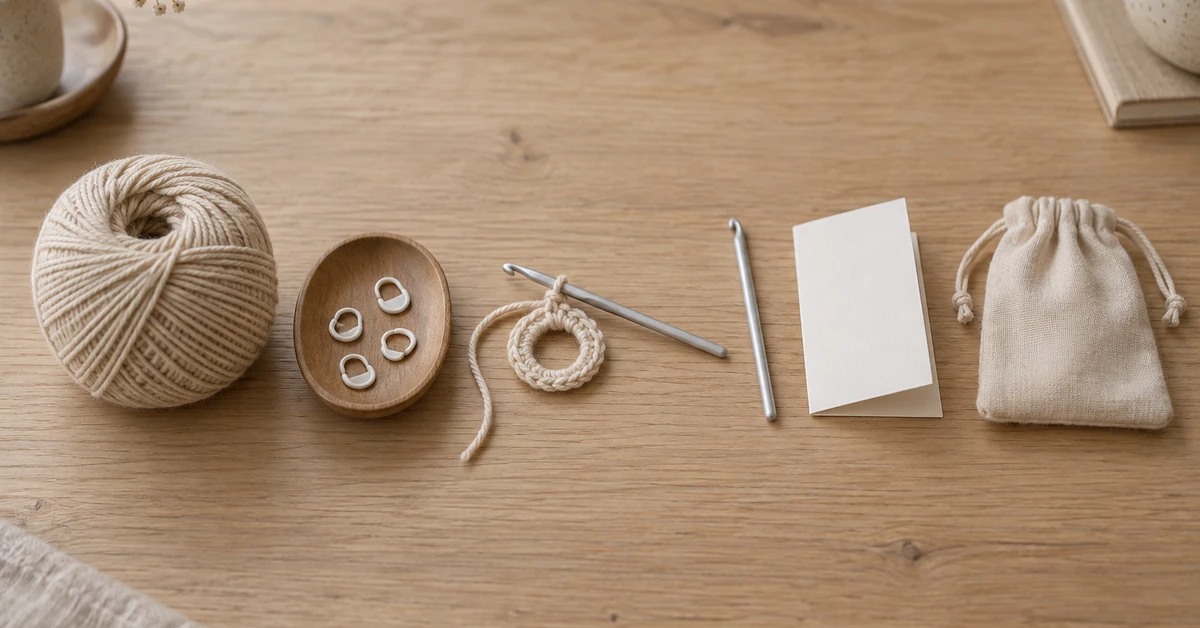
- Winding yarn into a centre-pull ball, which removes a fiddly start with no loss of craft.
- Splitting the yarn into the order it will be used, which reduces searching.
- Marking the first stitch with a removable marker, which removes the most common counting error.
- Preparing the first ring, so the maker begins on the second round.
- Packing the finishing needle and a spare, since the end of a project is where tools go missing.
What is usually not worth pre-doing is the visible work. A maker who has not contributed the main rows tends to describe the kit as assembly rather than craft, which shows up in reviews even when the finished object is well made.
There is also a labelling consequence. A part finished crochet kit has to say clearly which parts are already done, because a customer who opens a bag expecting a full project and finds a prepared base will read that as a short shipment rather than as a design choice.
Counting, reading and patience are three different demands
Difficulty ratings treat skill as one axis, but the three demands a crochet kit makes are separate. Counting is a working-memory task, reading is a decoding task, and patience is about how long the reward takes. A kit can be easy on one and demanding on another.
| Demand | What makes it harder | What lowers it |
|---|---|---|
| Counting | Long rounds with no markers | Stitch markers, row counts, repeats of five or ten |
| Reading | Symbol charts with abbreviations | Written steps beside every symbol |
| Patience | A big object in a single colour | Colour changes and a visible milestone early on |
An adult beginner crochet kit usually tolerates counting and reading well and struggles with patience, which is why a small finished object with an early milestone outperforms a large one. A kit for a child with an adult helper behaves the other way round.
Yarn weight and hook size as a skill decision
Yarn weight is usually described as a cost decision and it is also a skill decision. A heavier yarn in a lighter colour shows every stitch clearly, which makes reading the work much easier for a beginner. A fine dark yarn hides mistakes from the maker at the same time as it makes the fabric look more refined.
Material screening sits behind that choice. The textile screening references published by OEKO-TEX are commonly used when a buyer wants a yarn checked against restricted substances, and the answer sometimes favours a fibre that was not the cheapest option on the list.
That trade-off has to be resolved against the shelf. A kit that looks premium and is hard to read will be praised in photographs and criticised in reviews, which is a poor combination for a repeat order.
Instructions that assume too much
The most common hidden assumption in a beginner kit is prior knowledge of conventions: that the maker knows what a turning chain is, that a slip stitch is not a decorative extra, that the pattern's first row is not the ring. None of it is difficult to explain and all of it produces confusion when it is left out.
Good crochet kit pattern notes are therefore repetitive on purpose. Repeating the stitch count at the end of every round, naming the colour before each block and spelling out a turning chain in words costs a page and removes the three questions that a beginner would otherwise email the shop to ask.
- A short glossary using the same words as the steps, not different ones.
- A stated stitch count at the end of each round, so the maker can check before continuing.
- One photograph per unfamiliar step, taken with the same yarn colour as the kit.
- A plain-language note on how to undo a round without losing the whole evening.
Where pre-work hides cost
Every pre-finished step adds labour that no customer sees. Centring yarn, marking stitches and preparing a first ring are all small operations, and together they can add more minutes per kit than the visible crochet in a very small design.
| Pre-work step | Time per kit | Visible to the customer |
|---|---|---|
| Winding and splitting yarn | Small, done in batches | Yes, at first opening |
| Marking the first stitch | Very small | Yes, removes a whole class of error |
| Preparing the first ring | Small but fiddly | Yes, changes where the project starts |
| Partial shaping of the base | Large, essentially production crochet | Yes, and it changes what the kit is |
Age bands, beginner labels and the same kit
One kit cannot be labelled for a nine-year-old and an adult beginner without a compromise that satisfies neither. The age band changes the number of steps a maker can hold, the length of text they will read, and the amount of adult supervision assumed in the instruction.
Splitting the range is usually cheaper than it looks. Two instruction versions of the same contents can sit behind different covers, and the yarn, the hook and the packing stay identical. What changes is the skill floor, described in writing rather than implied by a sticker.
Testing a skill floor with three real beginners
A skill floor is testable and the test is short. Give the kit to three people who have never crocheted and watch without helping. The first ten minutes tell you whether the start works, the first round tells you whether the instructions read, and the first evening tells you whether the reward arrives soon enough.
Testing a crochet kit for beginners this way is uncomfortable the first time, because the watcher has to stay quiet while somebody struggles with something obvious. That silence is the measurement. Every question the tester would have asked belongs in the instruction sheet, and every pause belongs in the timing.
- Choose three testers from the intended age band, not from the office.
- Hand over the kit unopened and say nothing beyond where it was bought.
- Record the time to the first completed round and the first request for help.
- Ask afterwards what they thought was missing, rather than what was difficult.
- Repeat with the revised instructions and compare the two timelines.
Returns, reviews and the frustration window
Unfinished kits do not always come back, which is why the returns rate understates the problem. They sit in a bag and produce a review that mentions giving up. The frustration window is short: most abandoned beginner kits are abandoned in the first hour, before any visible progress exists.
| Complaint | Skill floor signal | Usual fix |
|---|---|---|
| I could not get started | First ring or first stitch not explained | Prepare the ring or rewrite the opening |
| I lost count | No markers or stitch counts | Add markers and a count at the end of each round |
| It looked nothing like the picture | Yarn weight or hook not matched to the sample | Restate the hook and add a gauge note |
| I ran out of yarn | Allowance measured on an expert | Re-measure with the beginner timeline |
What a crochet DIY kits supplier should refuse to shorten
There are steps that should survive every cost conversation. A written stitch count at the end of each round, a glossary that matches the steps, and a finishing note that explains how to close the work are all cheap and all decisive. Removing them saves a page and costs the kit the audience it was designed for.
The same applies to the spare needle and the yarn allowance. Both look like margin when the quotation is being trimmed and both are the items a beginner notices most when they are missing.
How Onehourcrafts writes a skill floor into the brief
Onehourcrafts treats the skill floor as the first line of the specification. The intended maker, the first ten minutes and the first evening are agreed before the parts list, and the instruction version follows the audience rather than the reverse. Where a design is only viable above a certain skill level, that is said at the brief stage instead of being softened in the copy.
The process behind that is written down rather than remembered. The quality-management principles published by ISO describe the general shape of a documented supplier process, and the practical version for a kit is a short specification, a test record and a revision note kept with each instruction version.
The kit formats this applies to are described on the crochet DIY kits page, and the wider selection notes are in the buying guide. Buyers comparing a kit with a finished-product programme may find the finished range on the crocheted products page a useful contrast.
When a higher skill floor is the right call
Not every kit should be made easier. A kit aimed at experienced makers can assume tension control, chart reading and an appetite for a long project, and lowering the floor would remove the thing that audience is buying. The mistake is not a high floor, it is a high floor presented as a low one.
Where the audience is genuinely mixed, the answer is often two covers rather than one compromise. A crochet DIY kits supplier who can ship the same contents behind two instruction levels is offering a range, not a variant.
Send the intended maker, the first-evening target and the shelf price through the inquiry form, and the sample can be built to a stated floor. Earlier notes on instruction design and kit testing are collected on the Onehourcrafts blog.
Frequently asked questions
How do I describe a skill level on a kit?
In tasks rather than adjectives. Saying the kit needs counting and joining is more useful than calling it intermediate.
Is pre-winding yarn worth the labour?
It removes a fiddly start and costs very little, particularly when it is done in batches. It is one of the cheapest floor-lowering steps.
Should the first ring be prepared for beginners?
It shortens the frustration window considerably. The maker still does the visible work, so the project still feels like their own.
Why do beginners run out of yarn?
Because the allowance was measured on someone with steady tension who rarely unpicks. Re-measuring with a beginner timeline usually doubles the margin.
Can one kit serve children and adults?
Not comfortably under one cover. Two instruction versions of the same contents generally sell better than a single compromise.
What is the most common instruction failure?
Missing stitch counts at the end of a round. Without them the maker cannot tell whether the work is still correct.
How much detail should a glossary carry?
Enough to cover every term used in the steps, worded the same way in both places. A glossary that uses different phrasing adds confusion.
Does a premium look conflict with an easy floor?
It can, because fine dark yarn is harder to read. The usual answer is a heavier yarn in a colour that still photographs well.
How quickly do beginners abandon a kit?
Most abandonment happens in the first hour, before any visible progress. That is why the opening of the project deserves the most design attention.
Is a higher skill floor ever better for sales?
Yes, for an audience buying a long project on purpose. The problem is a high floor advertised as a low one, not a high floor as such.