
Most complaints about a small purse are not about the crochet. They are about the clasp that will not shut, the zip that catches the lining, or the strap that pulled out of the seam after a fortnight. A crocheted coin purse manufacturer earns its reputation on the hardware and the lining, because that is where a small, cheap-looking failure becomes a return.
The crochet body is forgiving. Wool and cotton hide small differences in tension, and a slightly loose stitch reads as handmade rather than as defective. Metal and plastic do not hide anything. A frame that sits two tenths of a millimetre out is a frame that clicks unreliably, and the customer will notice on the first day.
Returns start at the fastening, not at the stitch
Return data from small accessories is remarkably consistent. The two largest causes are a closure that fails within weeks and a lining that separates at the opening. Both are specification problems rather than craft problems, and both can be pinned down with numbers before the sample is approved.
That is why the specification for a small purse should read like a mini engineering document. It names the closure, the opening force, the lining construction, the seam allowance and the point at which the strap is anchored. Everything else is decoration on top of those five.
The components that decide how it feels
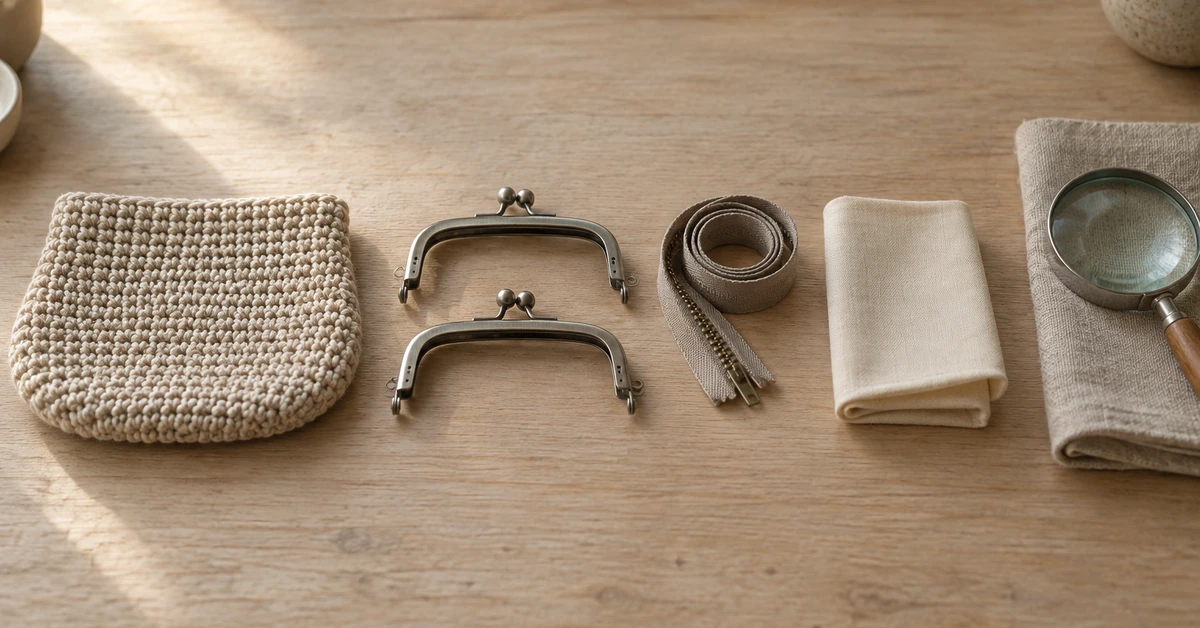
| Component | What to specify | What failure looks like |
|---|---|---|
| Frame clasp | Frame width in millimetres, closing force, and the gap at the kiss point | The purse opens in a pocket and spills coins |
| Zipper | Tape width, slider size, pull length and whether the tape is sewn inside the seam | The slider sticks, or the tape frays into the lining |
| Lining | Fibre, seam allowance, bagging method and colour fastness against the yarn | Dye transfers onto coins, or the seam splits at the opening |
| Strap or ring | Anchor point, stitch count at the anchor, and a pull-test figure | The strap tears out on the first firm tug |
| Body | Yarn, hook size, finished dimensions and the tolerance on each | The purse holds less than the photograph suggested |
Two of those rows are worth more attention than the rest. The frame, because it is the part customers touch first; and the lining, because it is the part that fails invisibly and then suddenly.
The same specification logic applies whoever makes the item. A crocheted products manufacturer that produces bags and toys as well will happily apply the closure numbers to a purse, and a crochet products for retailers programme usually starts from this table rather than from a photograph, because a retail buyer has to describe the same purse to three different people.
Frame clasps and the pull test
A metal frame is bought to a nominal width, and the tolerance on that width is what decides whether the clasp shuts cleanly on a crocheted body. Because the body compresses, the frame has to be specified together with the fabric thickness it will sit against, not on its own.
The workable test is mechanical: open and close a finished sample a set number of times and record whether the gap at the centre grows. A frame that starts tight and stays tight is acceptable even if it feels stiff. One that starts tight and loosens over a few hundred cycles will fail in a customer's handbag within a month.
Zippers: tape, slider and the seam behind them
Small zips are specified by tape width in millimetres and by slider number, and the two are not interchangeable across suppliers. A tape that is too wide for the seam allowance leaves a ridge that catches on the inside of the purse; one that is too narrow frays where the slider runs.
The construction question matters as much as the component. A zip set into the seam line behaves differently from one sewn on top of a finished edge, and the second version is usually the one a buyer receives when the specification only said 'zip closure'.
Lining and the colour that travels
Coins abrade. A dark lining against a pale yarn, or a saturated colour against a light one, will transfer dye under friction and moisture long before any laundry is involved. Where the lining is dyed, a fastness test on the finished combination is the only way to know, because the interaction is between two materials rather than one.
Screenings published by OEKO-TEX are the usual reference points when a buyer wants to describe this in a purchase order, and they are a useful shorthand even when the finished goods themselves sit outside the scheme.
Where the yarn and the lining come from different suppliers, the risk sits between them and belongs to nobody until it is written down. Naming both materials, and the test that was run on the combination, is what moves that risk back to the party able to control it.
Straps, rings and the pull-out point
A wrist strap fails at the anchor, not in the middle. The specification should say how many stitches pass through the anchor and whether the anchor is reinforced with a second row. Two extra rows cost almost nothing and change the failure mode from a tear to nothing at all.
Where rings or clips are used, the same logic applies to the seam that holds them. A ring attached to a single crocheted edge will rotate under load and work the yarn loose; a ring attached through a reinforced tab will not.
A drop sequence written into the specification
- Load the purse with coins to its stated capacity, then close it.
- Drop it from waist height onto a hard floor five times, on each face in turn.
- Open and close the closure the number of times the durability test requires.
- Inspect the kiss point, the lining seam and the strap anchor after every stage.
- Record the result against the sample reference, not against a description.
- Repeat the sequence on production pieces at the agreed sampling interval.
Testing to a written sequence turns 'the sample felt fine' into a result that can be repeated. It also settles arguments early, because a buyer and a factory comparing the same recorded steps rarely disagree about what happened.
How much a coin purse should hold
Capacity is a design decision that rarely appears in the specification and always appears in the reviews. A purse sized for a handful of coins will be judged on that handful, and a purse sized for a card and a key will be judged against purses twice its size.
The practical approach is to state a filled weight and a filled thickness, then check the sample against both. The closure force, the seam allowance and the strap anchor all follow from that number, so settling it first saves a sampling round later.
Packing a small item so it survives the post
Small purses are often shipped in a polybag with a hang card, and the post is where the hardware meets its first real test. A frame resting against the edge of a carton takes the impact of every drop in the journey.
Giving each purse a small amount of protection around the closure, and packing cartons so that no frame sits on an outer face, costs a fraction of the return rate it prevents. It also protects the shape, which is what a shop photographs.
Retail ready crochet products usually travel on a printed hang card, and the card changes the drop behaviour by stiffening one face while leaving the other exposed. Where the silhouette matters on a shelf, the purse is better packed flat against the card than left to swing free inside a polybag.
The record-keeping habit behind these checks is described in the quality management practice published by ISO: the test figure, the sample reference and the approval date kept together. A crocheted coin purse manufacturer that keeps those three in one place can re-quote a repeat order from the file instead of from memory.
Round one, round two: what to send for approval
- Round one: body only, in the specified yarn, to check size, tension and colour.
- Round two: finished purse with the production closure, lining and strap, weighed and measured.
- The recorded results of the drop and cycle sequence on the round-two sample.
- A photograph of the purse filled, so capacity is judged rather than assumed.
- The named components, with the supplier's article number, so round two can be repeated.
| Approval stage | What is signed off | What it prevents later |
|---|---|---|
| Shape and body | Finished dimensions, yarn and tension | A purse that holds less than the photograph promised |
| Hardware | Frame or zip model, closing force and cycle result | A substitution that looks identical and fails sooner |
| Lining | Fibre, colour, seam allowance and fastness result | Dye transfer, and seams splitting at the opening |
| Capacity | Filled weight and filled thickness | Reviews that judge the purse against a larger shape |
Approving a body and then discovering the hardware in bulk is the most expensive ordering mistake in this product family, and the sequence above exists to stop it.
How Onehourcrafts specs small crocheted purses
Onehourcrafts writes the closure, lining, strap and capacity into the specification before the first sample is made, then sends the round-two sample with its measured results attached. A buyer comparing quotations is comparing the same set of numbers rather than two descriptions of the same idea.
A crocheted coin purse manufacturer working from that list can quote a new shape without a fresh development round, because the components behind the shape are already chosen and already tested. Where the components change, the change is quoted as a change rather than absorbed into a new sample price.
The small accessories this applies to sit on the crocheted products page, and the wider sourcing notes are collected in the buying guide.
Where the same shape is sold under a buyer's own name, the closure and lining figures travel with it, and that is what makes custom branded crochet products repeatable across seasons instead of a fresh sampling exercise every year. A crochet accessories supplier can usually quote a second colourway from the same specification without retesting the hardware, and crochet supplies for craft stores orders can be built from the same component list with a different hang card.
What a sample cannot prove
A sample cannot prove how a closure behaves after a thousand cycles, and it cannot prove that the yarn will arrive in the same dye lot next season. Those need a test figure and a dye-lot clause, and a buyer who treats a sample as proof of both will eventually be disappointed.
The remaining risk is worth naming early rather than discovering late. Send the capacity, the closure type and the channel the purse will sell through, and the reply will come back with a specification rather than a price alone. Send the three details and the quote will carry the component list. More retail planning notes are on the blog.
Frequently asked questions
Which closure should a small purse use?
It depends on capacity and on how the purse will be carried. A frame suits a compact coin-only shape, a zip suits anything that will hold a card, and the choice drives the lining construction that follows.
How many cycles should a frame survive?
Set the figure in the specification and test to it. The number matters less than having one, because it converts a subjective feel into a recorded result.
Does the lining have to match the yarn exactly?
It has to be safe against the yarn. Where the two colours differ strongly, a fastness test on the finished combination is the only reliable check.
Can a crocheted purse be washed?
Sometimes, but the closure and lining usually decide the answer rather than the yarn. If care is not specified, customers will assume the harshest option.
Why does the strap pull out so often?
Because the anchor carries all the load through a single crocheted edge. Reinforcing the anchor with extra rows moves the failure away from the most stressed point.
Is a plastic clasp acceptable?
It can be, provided the tolerance is specified and the cycle test is run on the production component. The risk is substituting a similar-looking part later without retesting.
How should capacity be described?
As a filled weight and a filled thickness, with the sample photographed while full. Descriptions in words are read differently by every customer.
What is the smallest sensible order for a new shape?
Enough to cover the closure purchase, which is usually bought in larger quantities than the crochet itself. Confirming that quantity early avoids a surprise minimum.
Do small purses need individual packaging?
Not always, but they need protection around the closure. Where they are sold from a counter display, the hang card becomes part of the specification.
How long does a first sample take?
The crochet is quick; the closure, lining and testing take longer. Expect the component lead time rather than the hand-work time to set the date.