
When shoppers enter a visitor center or museum shop, they do not begin with a thread count. They begin with a story, a gift recipient and a sense of how much time they have. A cross stitch kits for gift shops assortment should therefore be easy to explain in three questions: What does it become? Why does it belong here? Can I finish it without taking over my week? Onehourcrafts uses that conversation as the buying brief.
Question one: what is the finished moment?
Put the stitched reference beside the unopened kit and ask a staffer to describe the finished object in one sentence. If the answer depends on a long explanation, the image, title or pack front is not doing enough work.
The finished moment can be a small wall piece, a postcard-style gift or a seasonal ornament. Name the use without promising a frame, backing or display method that is not in the kit. This protects the customer expectation and keeps the quote honest.
| Reference | Conversation cue | Proof |
|---|---|---|
| Finished sample | What will I make? | Scale shown |
| Pack front | What is included? | Parts listed |
| Gift card | Who is it for? | Audience cue |
Question two: why here?
A gift shop needs a local or institutional reason for a design to sit beside postcards, books and keepsakes. Map each motif to a place, collection, season or visitor memory that the shop can verify. A generic flower may be attractive; a translated local symbol may be more useful.
Do not borrow a heritage claim from a mood board. Ask the buyer to approve the wording and the image relationship. A small note on the back of the pack can carry context, but it should not crowd the instructions or imply an official endorsement.
- Place or collection
- Approved wording
- Image relationship
- Seasonal status
Question three: how long?
Use a real timer and a production-intent sample to estimate the first session, not just the full project. A gift buyer may accept a project that continues at home, but only when the pack makes the first satisfying step visible.
Separate stitch count from customer time. Fabric size, chart complexity and color changes affect the experience differently. Use a simple difficulty cue that the staffer can repeat, then mark the boundary for younger makers or supervised workshops.
| Time cue | What to show | Buyer action |
|---|---|---|
| First 20 minutes | Started motif | Approve opening |
| Weekend project | Progress photo | Set expectation |
| Longer project | Finished sample | Check gift fit |
Build a motif shelf, not a theme pile
Group kits by a buyer-recognizable story: local architecture, nature, seasonal travel or a collection color. Keep the display shallow enough that the staffer can retrieve a pack without disturbing the reference sample.
A motif shelf makes gift shop craft kits easier to compare. It also exposes gaps: a beautiful design may not have a companion price point, a small format or a replenishment rule. Give each group a lead item and a quieter follow-on item.
- Choose one story
- Select a lead motif
- Add one companion
- Check price steps
Let the chart prove the promise
Open one kit and inspect the chart, symbols, legend and thread organization. The chart should let a reviewer locate the first row without a separate verbal lesson. Check that the printed lines remain readable under the shop's typical lighting.
A sample can hide an instruction gap because the finished piece looks persuasive. Ask someone unfamiliar with the design to find the first color, start point and stopping point. Record questions instead of explaining around them; those questions are packaging evidence.
| Chart check | Observe | Fix |
|---|---|---|
| Legend | Symbol clarity | Increase contrast |
| Start point | First action | Add cue |
| Thread map | Color retrieval | Reorder card |
Use the back of the pack as a handoff
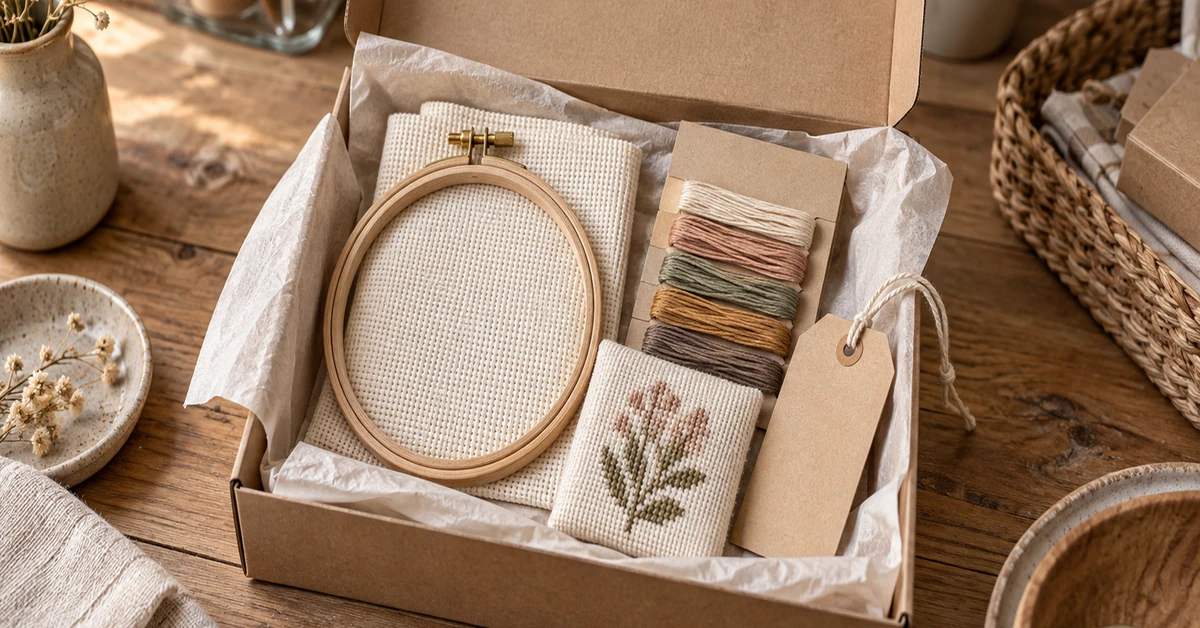
The front sells the idea; the back should hand the project to the customer. Include contents, finished size, skill cue, care boundary and a short next step. Keep the wording visible while the pack is held in one hand.
Do not let the back become a wall of warnings. Place detailed instructions inside the kit and reserve the exterior for decisions made before purchase. If a frame or hoop is not included, say so near the finished reference rather than in a hidden footnote.
- Contents
- Finished size
- Skill cue
- First step
- Not included
Test the gift hand
Ask a visitor or staff member to pick a kit for a named recipient: a traveler, a grandparent, a beginner or a design-minded friend. Watch whether the choice is made from the image, the story or the difficulty cue.
The test should not be mistaken for universal demand. It tells the buyer which information is doing the work in this fixture. Keep the exact question, kit and display position with the observation so the assortment can be changed deliberately.
| Recipient | Decision clue | Assortment note |
|---|---|---|
| Traveler | Place story | Small pack |
| Beginner | First-step clarity | Lower chart load |
| Collector | Motif detail | Premium reference |
Price the souvenir moment
Compare the kit with a postcard bundle, small book and local keepsake. The price should make sense in that neighborhood, while the package still signals a complete project rather than a loose chart and a few threads.
Use a pilot to track pick-up, gift-wrap requests, questions about completion and sales by story group. A low price can attract handling but still fail to convert if the project promise feels vague. Record the reason, not only the unit count.
- Map adjacent prices
- Place one reference
- Track questions
- Review by story group
Prepare for travel home
Gift-shop customers may carry the kit through a train station, airport or crowded street. Test the packed unit in a tote, under a book and beside a postcard bundle. Corners, hoops and printed charts should remain protected without making the gift bulky.
Ask the supplier to show the inner carton and the point at which the chart is separated from the thread. A compact pack that arrives neat is part of the souvenir experience, especially when the customer will not start the project immediately.
- Tote movement
- Corner protection
- Chart flatness
- Gift-wrap fit
Create a staff handoff card
A small internal card can keep the three questions consistent across shifts. It should name the story, the first step, the project-time cue and the companion items. Keep it operational; do not copy the entire consumer instruction sheet.
A handoff card also helps a distributor train several locations without making the product sound identical everywhere. Add a field for the local context so the shop can approve a story without rewriting the production file.
| Field | Example | Use |
|---|---|---|
| Story | Harbor map | Why here |
| Start | Find blue symbol | First action |
| Time | Two short sessions | Expectation |
| Companion | Postcard set | Basket |
Write the inquiry as a shelf conversation
The RFQ should include the shop story, reference sample, chart readability, finished size, pack front and staff handoff. Ask for two quantity scenarios so the buyer can compare a test run with a broader visitor-season order.
Use the buying-guide library for internal buying context, the embroidery collection for adjacent needlework references, and the GS1 barcode guidance to frame retail identification. The ISO quality principles provides a neutral way to assign version control and corrective actions.
| RFQ block | Evidence | Owner |
|---|---|---|
| Story | Approved copy | Shop |
| Project | Open kit | Product |
| Pack | Front and back | Brand |
| Route | Carton test | Operations |
Onehourcrafts makes the gift easy to pass on
Onehourcrafts can connect a local story, an honest finished reference, a readable chart, a compact pack and a staff handoff card. That chain lets the gift-shop buyer judge the product before the customer has to trust it.
Before approving cross stitch kits for gift shops, ask a new staffer to answer the three questions without help. If the story, first step and time cue survive that handoff, the kit has a stronger chance of earning its shelf and its next order.
- Story approved
- First step visible
- Time cue honest
- Handoff repeatable
The final cross stitch kits for gift shops brief should connect gift shop craft kits, souvenir embroidery kits and retail ready cross stitch kits to one honest staff handoff. Keep the buyer's approval file linked to the company home so the commercial context remains visible without adding a new claim.
Frequently asked questions
What makes a cross stitch kit suitable for a gift shop?
It has a clear finished idea, a credible local or collection story, a visible project boundary and a pack that can be explained quickly.
Should every kit have a local motif?
No. Use local relevance where the shop can verify it, and use a separate story for general gift designs.
How should project time be described?
Show the first satisfying session and distinguish it from the total project so the customer can decide with realistic expectations.
What belongs on the outside of the pack?
Contents, finished size, skill cue, first step and important exclusions; detailed instructions can remain inside.
How can staff recommend the right kit?
Give them three questions about finished result, why it belongs in the shop and how long the first session takes.
How do you test chart readability?
Ask someone unfamiliar with the design to find the legend, start point and first color under actual shop lighting.
What should a gift-shop pilot track?
Record pick-ups, questions, gift-wrap requests, story-group sales and the exact display used.
How can kits travel safely?
Test a packed unit in a tote and beside other gifts, checking corners, chart flatness and gift-wrap fit.
Should a shop display a finished sample?
Yes, when the sample is labeled honestly and does not imply that an unlisted frame or accessory is included.
What should a supplier receive in the RFQ?
Send the story brief, reference sample, chart test, pack requirements, quantity scenarios and carton handling evidence.