For custom packaging crochet kits, the right format depends on the fixture, route and opening moment you need to control, not on the box shape that looks nicest in a dieline preview.
The five formats at a glance
| Format | Best starting condition | Main compromise |
|---|---|---|
| Folding carton | Flat-shelf retail with broad artwork area | Needs an internal plan for loose parts |
| Stand-up pouch | Light kits and low parcel volume | Soft walls can hide count or shape |
| Paper tube | Small vertical assortment or gift-led display | Round geometry limits information panels |
| Window card pack | Impulse fixture where contents must be seen | Window, hook and card need structural coordination |
| Rigid drawer box | Premium gift or reusable storage promise | Higher cube, material and assembly burden |
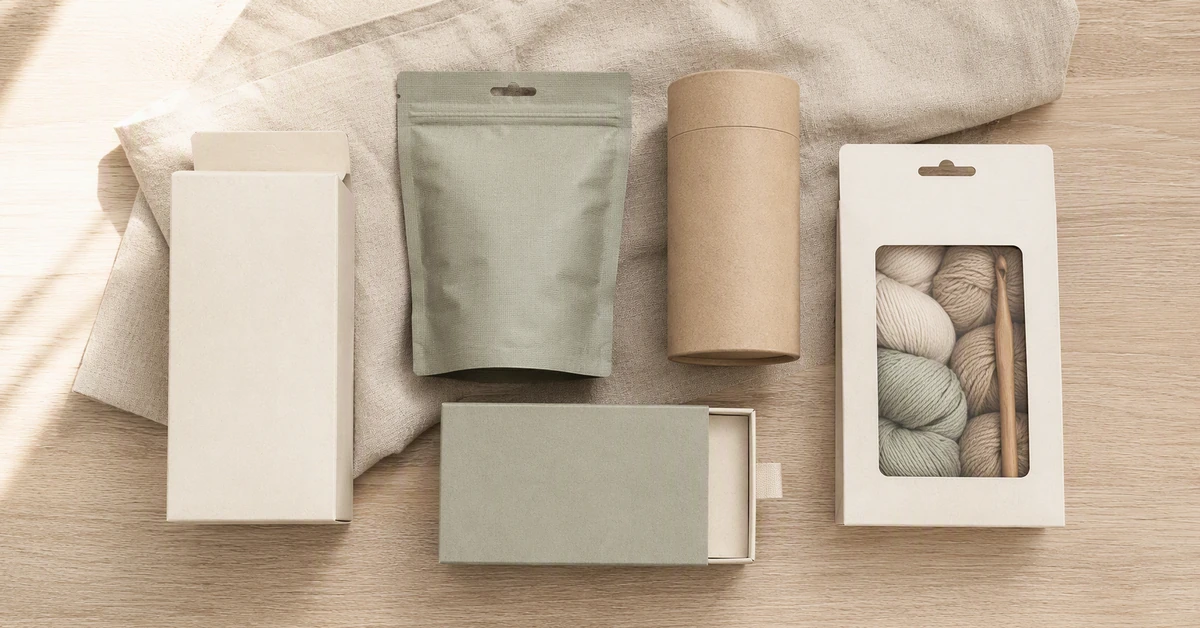
This is a starting comparison, not a universal ranking. A format wins only when its footprint, closure, component control and route evidence agree with the channel that will sell it. Treat the table as a packaging format comparison, then confirm the loaded sample in the intended fixture. Good crochet kit packaging makes that evidence easy to inspect.
Start from the fixture, not the empty dieline
Write down the real selling position before asking for artwork. Is the item hung from a peg, faced on a 300 mm shelf, stacked in a bin, or placed in a gift department? Record the maximum front width, the available depth, the number of facings and whether a shopper can lift the pack with one hand.
- Measure the fixture opening and the usable shelf depth, including the price rail.
- Photograph an adjacent product at the same distance to understand visual competition.
- Mark the pack's centre of gravity and the side a shopper is likely to grab.
- Decide whether the first proof must read from one metre away or from hand distance.
A package that is stable on a studio table can lean on a shallow shelf. A package that looks generous in a product photo can disappear beside a taller competitor. The fixture gives the first non-negotiable dimensions.
Folding carton: the controlled generalist
A folding carton is usually the most forgiving first option for a crochet kit with several small components, a printed instruction sheet and a retail front that needs a clear hierarchy. Its broad panels make it easier to show the finished project, contents and age or skill information without shrinking every line.
The carton still needs an internal answer. A yarn ball can roll into the fold, a hook can press through a thin panel and a small needle can disappear under an insert. Use a paperboard tray, a captive pouch or a component count card when the route includes vibration or repeated handling. Keep the external carton simple enough to erect consistently at the planned assembly rate.
Choose this format when you need front-and-back information, a conventional shelf footprint and a controlled unboxing sequence. These crochet kit boxes are a practical default when the board earns its space. Reject the carton when the kit is so light and flexible that the board becomes the largest part of the shipped volume.
Stand-up pouch: light, visible and easy to ship
A stand-up pouch can reduce empty space around yarn, fabric and soft accessories. It is useful for refill-like kits, low-weight projects and online bundles where the pouch will travel inside a protective master carton. The bottom gusset gives it a stable face, while a small clear area can show colour or texture without exposing every component.
The same flexibility creates its main risk. A pouch can slump, wrinkle a barcode area or let a hook migrate into a corner. Define the filled dimensions, not just the flat film dimensions. Specify the closure cycle, seal width and a simple internal separation method if a sharp or rigid part shares the pouch.
Use a pouch when shipping cube and material weight matter more than a rigid premium feel. It is also a useful route for custom packaging for craft kits when the buyer values a light parcel over a rigid unboxing. Pair it with a printed card or belly band only when the added part has a job, such as a peg hook, an instruction summary or a reusable storage promise.
Paper tube: a vertical signal with a narrow panel
A paper tube gives a small crochet project a tall, giftable silhouette. It can sit in a narrow shelf slot or a countertop stand, and the round body naturally resists corner crush. It is a good match for one-colour mini kits, seasonal capsules or a collection that benefits from a repeated vertical rhythm.
Its constraint is information geometry. The readable front is narrow, curved text becomes harder to scan and a tube can roll unless the base is designed for the fixture. Put the essential identity on a flat cap or a wide label zone, then keep the rest of the information on an insert or a linked digital page.
Do not use a tube merely because it looks distinctive in a render. Confirm that the cap stays closed after repeated opening and that the tube does not consume more master-carton volume than the kit needs.
Window card pack: strongest first look, highest coordination
A window card pack can answer the shopper's first question immediately: what is inside? The card supplies the printed face and peg hole; the window exposes yarn colour, a sample motif or the hook. This format works when the fixture is a hook wall or an impulse bay where the pack must communicate at arm's length.
The window is also a structural opening. Leave enough board around it for stiffness, keep the hook hole away from a fold, and stop loose parts from pressing against the film. The visible contents should stay in the intended orientation after the pack is picked up and returned to the hook.
Use this format when visual proof closes the sale. Avoid it when glare, dust or repeated handling will make the window look tired before the kit is bought.
Rigid drawer box: premium storage with a real cost
A rigid drawer box earns its extra board when the package is part of the product promise: a gift, a keepsake or a box the buyer will reuse for works in progress. The tray can separate yarn, hook and finishing pieces, and the outer shell protects the contents from casual compression.
The cost is not just material. The box occupies more shipping cube, takes longer to assemble and can require a different packing station. The drawer must be pulled far enough to feel intentional but not so far that components spill. Add a stop, a ribbon or a friction fit only after testing the loaded box.
Choose it when perceived value and reuse justify the cube. Choose a carton or pouch when the same contents need to reach a lower price point or a high-volume parcel route.
Cost, speed and control: where the formats actually differ
| Decision factor | Usually favours | Question to put in the quote |
|---|---|---|
| Lowest empty volume | Pouch or folding carton | Is the quoted size the loaded size or the flat blank? |
| Fastest artwork iteration | Folding carton or card | Which panels can change without a new tool or window? |
| Strongest component separation | Drawer box or fitted carton insert | What keeps the hook and small pieces captive? |
| Highest shelf theatre | Window card or tube | Does the fixture support the hook, base or hanging orientation? |
| Best reuse story | Rigid drawer box | How many open-close cycles was the closure tested for? |
Ask for material, printing, tooling, inserts, assembly, master-carton assumptions and quantity tiers as separate lines. A low unit figure can conceal a high setup cost or an assembly step that the first quotation omitted.
What GS1 says before a barcode is placed
Barcode placement is a packaging decision, not an artwork afterthought. In its 10 steps to barcode your product, GS1 says to consider the packaging process before placing the symbol and warns against folds, flaps, edges and obstructions. That is a short rule with a practical consequence: show the loaded pack, its seams and its likely shelf orientation before approving the code panel.
For carded items, the GS1 General Specifications also make adequate space and a clear scan area part of the design conversation. Print a final-material proof, scan it on the loaded package and retain the result with the approved artwork. A digital dieline cannot prove a curved tube, a wrinkled pouch or a window edge will scan cleanly.
What ISTA route testing exposes
A retail fixture test does not replace a transport test. The ISTA 3L test profile describes hazards such as vibration, shock, compression, temperature and humidity for packaged products moving through distribution. For a crochet kit, translate those hazards into observations: did the hook move, did the yarn rub through a window, did the drawer open, and can an operator still count every part?
- Condition a loaded sample in the planned master carton, not an empty display pack.
- Inspect the closure and component count after vibration and handling.
- Repeat the shelf test after conditioning; a soft pouch can change shape.
- Record damage by location so the next structural revision has a specific target.
What an FSC claim can and cannot say
Paperboard is not automatically FSC-certified because it looks natural. The FSC Chain of Custody guidance ties a claim to certified material flow and licence controls. If a pack is meant to carry an FSC claim, ask for the supplier's current certificate and the claim wording before artwork is released. That evidence belongs in the retail packaging formats file with the approved substrate.
That distinction protects the buyer and the supplier. You can specify recycled content, an uncoated board or a paper-reduction target without making an unsupported certification statement. Sustainability language should describe evidence that exists for the exact substrate and production route.
How Onehourcrafts scopes custom packaging crochet kits
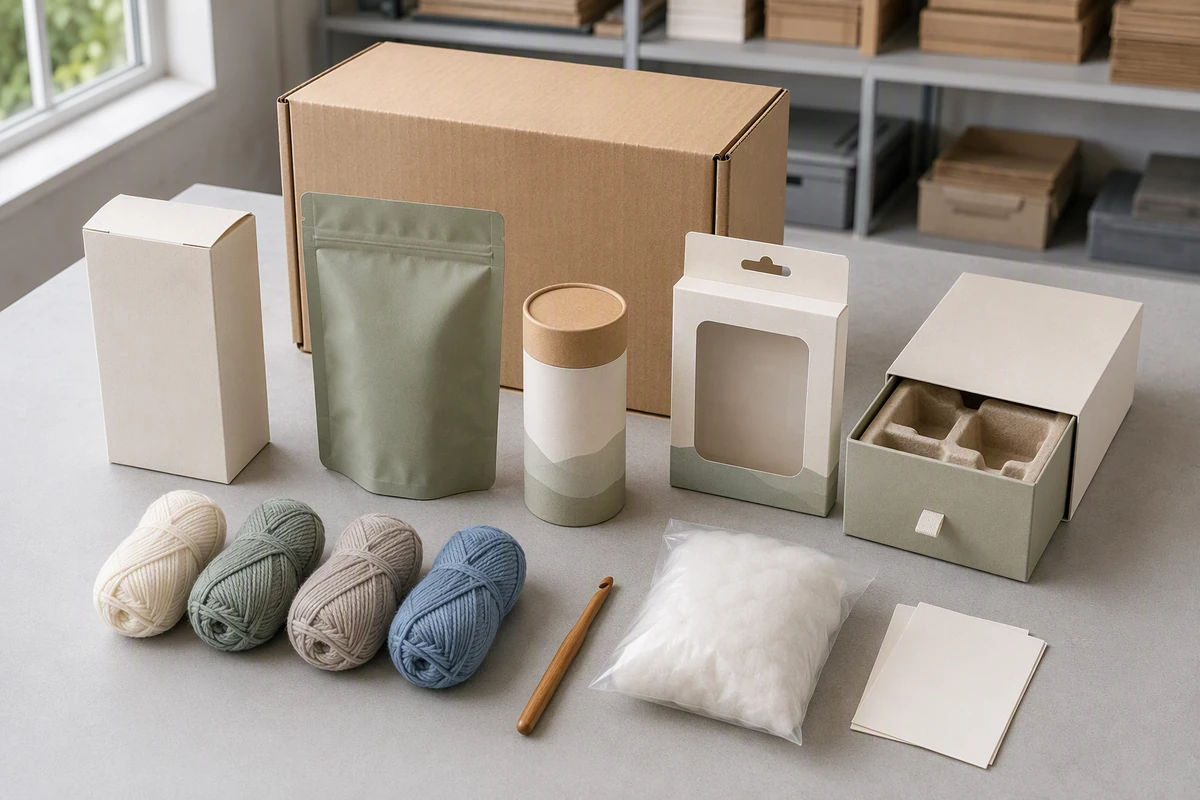
Onehourcrafts starts with the selling channel, packed component list and delivery route, then maps those constraints to a carton, pouch, tube, window card or drawer box. The sample record carries loaded dimensions, closure details, an image of the component layout and the test observations, so a later artwork change does not quietly change the product.
The working brief also separates what the package must show from what it must protect. A window may sell colour; a fitted insert may protect the hook; a plain master carton may solve the route. Keeping those jobs separate makes the quotation easier to compare and the revision easier to approve.
A five-minute decision rule
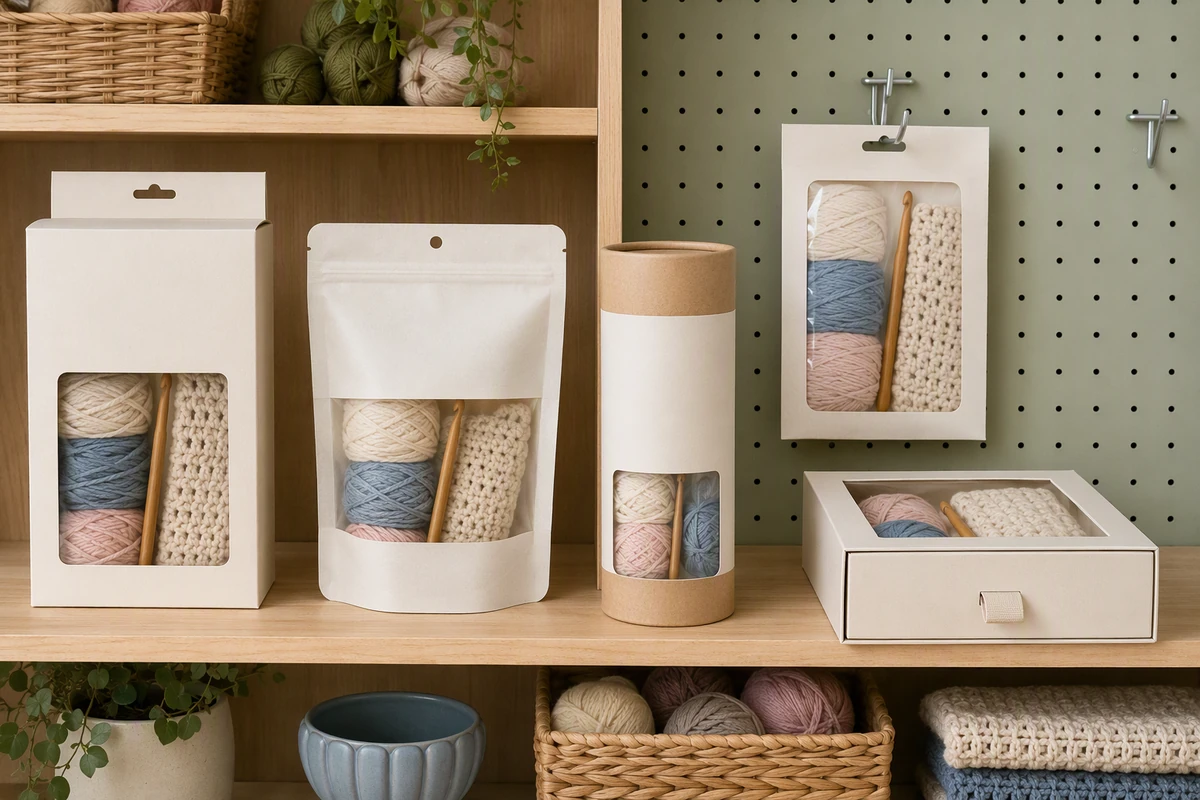
- If the pack must hang and the contents must be seen, start with a window card pack.
- If the pack must ship light and the components are soft, start with a stand-up pouch.
- If the pack needs broad information panels and a conventional shelf face, start with a folding carton.
- If the pack is a gift or must become storage, test a rigid drawer box.
- If the assortment needs a tall, narrow visual rhythm, prototype a paper tube and its base first.
Then challenge the first choice with two questions: what happens to the smallest component after route conditioning, and can a new operator pack the unit correctly without a verbal explanation? If either answer is unclear, the format is not ready for artwork.
Where the rule breaks down
Retailers combine fixtures, marketplaces add their own fulfilment rules and a seasonal colourway can change the component count. A pouch that works for a soft beginner kit may fail for a metal needle. A drawer box that works in a gift shop may be too large for a parcel-rate threshold. Treat the decision rule as a prototype selector, then let loaded samples and route evidence overrule the first impression.
Two worked examples
Example one: a peg-wall beginner kit. The store has 250 mm hooks, shoppers need to see yarn colour and the kit includes one hook, three yarn bundles and a folded guide. A window card pack is the sensible first sample. The board carries the front story, the window shows the colour, and a captive inner sleeve keeps the hook away from the film.
Example two: an online refill bundle. The product is light, the buyer already knows the project and the parcel route is more important than shelf theatre. A stand-up pouch inside a plain protective master carton is a better starting point. The pouch needs loaded dimensions, a closure test and a count check, while the master carton absorbs route compression.
Next step: send a format brief before artwork
- Channel, fixture or parcel route, with a reference photo.
- Loaded component list, including the largest rigid part and the smallest loose part.
- Maximum front width, depth, height and target packed weight.
- Opening, reuse and display expectations.
- Barcode, certification and language requirements for the selling market.
- Test evidence required before the golden pack is signed.
Buyers comparing custom packaging crochet kits can send this format brief to Onehourcrafts for a loaded sample plan. The crochet DIY kits range and the buying guide provide useful starting context, but the fixture and route still decide the final pack.
Frequently asked questions
Which package is best for a beginner crochet kit?
Start with a folding carton when the kit has several loose parts and needs broad information panels. Use a window card pack when colour visibility on a hook wall is the main selling job.
Is a stand-up pouch strong enough for a crochet kit?
It can be, if the loaded pouch is tested with the largest rigid part, the closure and the planned master carton. Add an inner sleeve or separation method when a hook can migrate or press against a seal.
When does a paper tube make sense?
A tube suits a small, gift-led or seasonal kit that benefits from a tall silhouette. Check the base, cap and master-carton cube before treating the distinctive shape as an advantage.
Does a window always improve conversion?
No. It can show colour and contents, but glare, dust, scuffing and component movement can make the pack look less trustworthy. Test the loaded window under the store's light.
What should be tested before barcode artwork?
Test the final substrate, coating, curvature, quiet zone and loaded orientation. Scan the production-intent material rather than relying only on a digital file.
How do I compare packaging quotes fairly?
Request separate lines for material, printing, tooling, inserts, assembly, master cartons, sampling and quantity tiers. Confirm whether each dimension is flat, empty or loaded.
Can a rigid drawer box reduce product damage?
It can improve separation and compression resistance, but only when the tray, closure and component layout are tested together. Its extra cube and assembly time must fit the route and price point.
What does an FSC claim require?
It requires the relevant certified material flow and licence controls. Ask for current supplier evidence and approved wording before putting an FSC claim on artwork.
How many packaging samples should a buyer request?
Request at least one loaded structural sample and one route-conditioned sample before final approval. Add a printed proof when barcode, colour or small information panels matter.
What should go into a packaging format brief?
Include the channel, fixture or route, loaded contents, dimensions, weight, opening expectation, barcode and certification needs, and the evidence required before the golden pack is signed.