
A button falls off ten minutes before someone leaves for work. At that moment, nobody wants to compare a wall of “assorted notions.” They want the button back on the shirt.
That small panic is a better starting point for haberdashery wholesale than a catalogue count. Needles, thread, elastic, fasteners, scissors, and tape measures become much easier to buy when the pack says which problem it solves.
A broad notions department still has value. The ideas below simply give customers a recognizable way into it.
The button rescue card
This can be slim enough for a handbag, desk drawer, hotel shop, or checkout hook: a few common shirt buttons, two usable needles, matched thread, a threader, and one safety pin.
Make separate light and dark versions instead of pretending one assortment matches every garment. Show the button sizes and thread colors. The best front label may be nothing more complicated than “Fix a loose shirt button.”
A hem kit for the evening before an event
A dropped trouser or skirt hem is rarely discovered at a convenient time. A compact pack can offer two routes: temporary hemming tape for the immediate problem and hand-sewing basics for a longer repair.
The fabric guidance needs to be honest. One adhesive is not suitable for every material, and a fine needle will not enjoy heavy denim. Clear limitations make the product more credible, not less useful.
Placed beside occasion clothing, workwear, travel accessories, or laundry care, the kit explains itself without needing a craft expert nearby.
The travel wallet that contains real tools
Many travel sewing kits look complete until the customer tries to use them. The thread snaps, the scissors fold rather than cut, or the needle has a rough eye. A small product deserves the same functional review as a larger one.
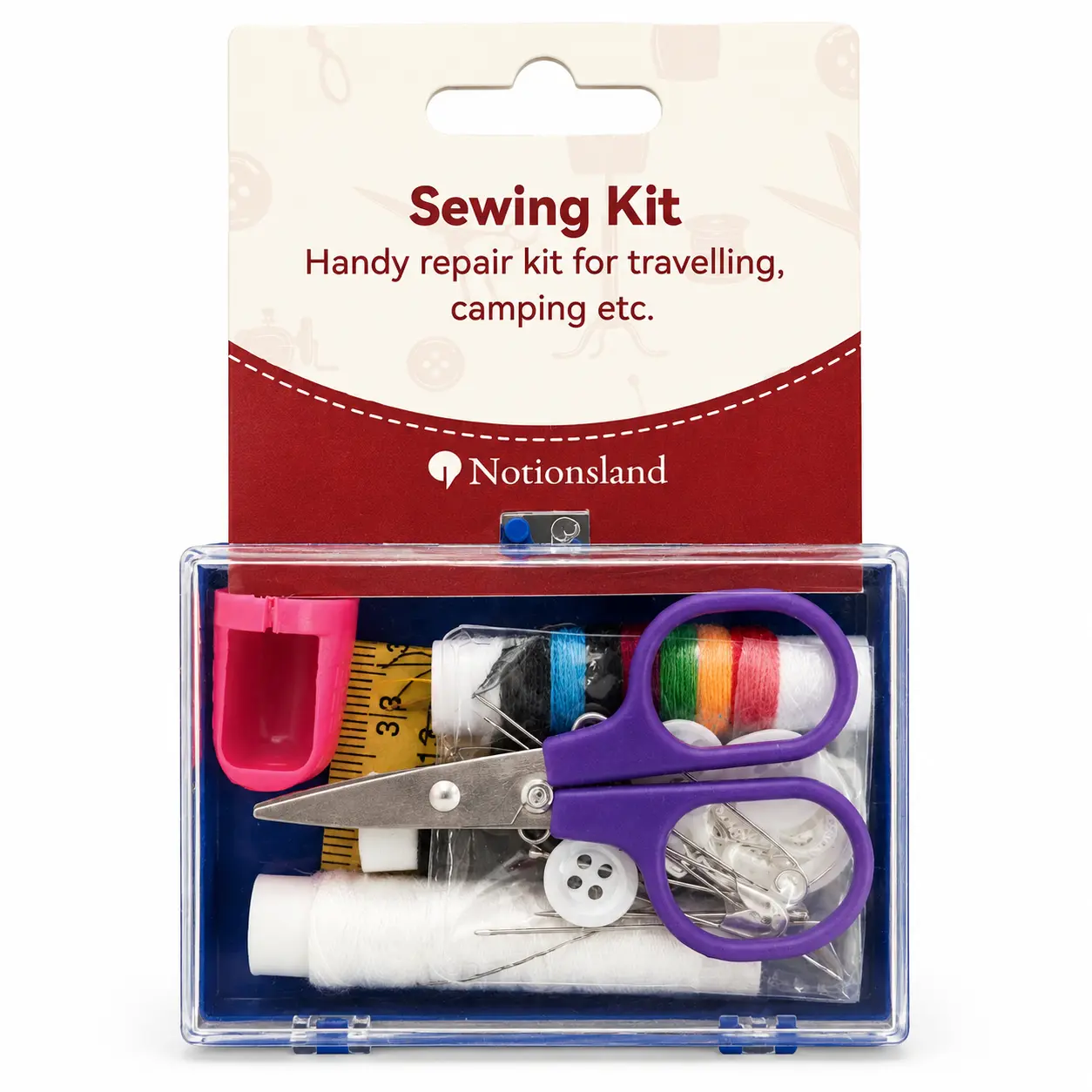
A flat wallet can hold needles, practical thread colors, small scissors, buttons, safety pins, and a fabric patch without becoming bulky. Mark each position inside. The layout helps customers return the pieces and notice what needs replacing.
This is useful beyond airports. Hotels, outdoor shops, uniform suppliers, luggage stores, and online travel bundles all have customers who understand the problem.
The school-uniform Sunday-night pack
Uniform repairs have their own rhythm. A missing button or split seam is often found when shops are closed and Monday morning is approaching.
Build the pack around the common local colors, button sizes, elastic, name-label needs, and garment types. A small measuring guide and four short repairs are more helpful than a general booklet about sewing.
A denim tin worth keeping
Denim, canvas, and workwear ask more from a repair kit. Strong needles, suitable thread, a thimble, and useful patches belong here. A generic hotel needle does not.
A metal tin or rigid case can remain in the household after the first repair. Put needle type, thread material, patch size, and intended fabrics on the pack. Rugged artwork may attract attention, but specifications make the product trustworthy.
Pre-threaded needles for the person who avoids threading needles
The first obstacle is sometimes not sewing. It is seeing the needle eye, holding the thread steady, and getting one through the other. A protected set of pre-threaded needles can make an emergency repair possible for people with limited eyesight, shaky hands, or no confidence.
The storage design must keep the points covered and the threads separated. Add a threader for later use and a tiny guide to starting and finishing a stitch. Common garment colors are more valuable than a decorative rainbow.
The fastener box nobody has to empty onto the table
Hooks, eyes, snaps, safety pins, and spare buttons are useful until they become one noisy mixture. A divided box with a contents map under the lid turns them back into a working product.
Do not fill every compartment merely because it exists. A focused assortment is easier to understand. Refill packs can then replace the pieces people actually use and create repeat purchases without selling another box.
A first-apartment case for people who do not call themselves makers
A new apartment eventually produces a loose seam, a curtain measurement, a label that needs attaching, or a button rolling across the floor. The resident may never visit a specialist craft aisle.
A calm, organized case can hold hand needles, thread, pins, scissors, tape measure, seam ripper, and a few fasteners. The short guide should begin with ordinary household repairs. Specialist pieces that need a paragraph of explanation probably do not belong in the first version.
This can sit comfortably in a graduation, housewarming, laundry, or home-care range. It is useful first and a sewing product second.
A visible-mending kit for the favorite garment
Some repairs are more appealing when they are allowed to show. Contrasting thread, patches, simple templates, and a handful of stitch ideas can turn a worn elbow or small hole into a deliberate detail.
Photograph the repair on a real garment, not only the loose contents. One quiet palette and one brighter palette may be enough. Material claims should name the intended fabric and any care limitations.
This idea gives sewing notions a place beside personalization, clothing care, and creative gift products rather than limiting the category to emergencies.
Three shelves, three kinds of need
A first haberdashery wholesale range can be easier to plan if it covers three time horizons.
Fix it now: button cards, hem kits, and pre-threaded needles. Prepare for later: travel wallets, uniform packs, and denim tins. Keep at home: fastener boxes, first-apartment cases, and visible-mending kits.
These groups support different prices and display positions. A shared color system can identify garment type or repair difficulty without making every pack look identical.
Open the pack and make the repair
Sample review should happen on fabric, not only across a meeting table. Thread the needles. Sew on the buttons. Cut thread and light cloth with the scissors. Open the snaps and safety pins. Stretch the elastic, then see whether it returns. Compare the tape measure with a trusted reference.
Pack everything again and carry the case in a bag. A closure that spills pins or a needle section that exposes points can undo the value of otherwise good components.
Customer language belongs on the front
“Assorted sewing notions” is supplier language. “Repair a school shirt tonight” is customer language. Use the front for the task and the back for size, material, count, warnings, and instructions.
Online, photograph the closed pack, the organized contents, and one finished repair. Add dimensions. A hand can suggest scale, but it should not be the only clue.
Where Onehourcrafts fits
The Onehourcrafts sewing notions range includes sewing kits, baskets, portable repair products, pre-threaded needles, supplies, storage, private labeling, and retail displays.
Retailers and brands can discuss component specifications, colors, cases, tins, printed cards, barcodes, packaging systems, carton packing, and repeat supply. A useful enquiry names the repair problem, target customer, channel, market, quantity, and planned retail position.
Frequently asked questions
What should be inside a travel sewing kit?
Use functional needles, practical thread colors, small scissors, safety pins, a few common buttons, and storage that keeps every piece secure. The contents should match the travelers and garments shown on the package.
Can repair kits be private labeled?
Common options include component combinations, thread colors, cases, tins, printed instructions, labels, boxes, barcodes, and displays. Quantities and feasibility depend on the specification.
How can small notions be easier to shop?
Group them by task, use plain-language front labels, show accurate sizes and uses, and avoid too many near-identical assortments.
What should a buyer test?
Use the needles, thread, scissors, fasteners, tape measure, and storage exactly as a customer would. Check strength, points, eyes, cutting, counts, closure, and labeling.
Start with the loose button
The most convincing haberdashery wholesale products begin with a loose button, a fallen hem, a journey, a uniform, or a favorite pair of jeans. Once the problem is clear, every component has a reason to be in the pack.
Contact Onehourcrafts with the repair moment, product format, target customer, quantity, packaging direction, and launch timing to discuss a focused sewing-notions range.