
A portable sewing kit earns its place in a bag by being useful at exactly the wrong moment: a button comes loose before a meeting, a hem drops during a trip, or a strap needs a quick temporary repair. If the needle bends, the thread snaps, or the case spills open, the product fails when the customer has the least patience for it.
A practical sewing kit supplier quality checklist should therefore test more than whether the package contains many pieces. It should ask whether the contents work together, whether the case keeps them organized, and whether production units remain as useful as the approved sample.
The checklist below can be adapted for travel kits, hotel amenities, promotional sets, household sewing boxes, camping repair kits, gift products, and private-label retail ranges.
Start with the repair the kit promises to handle
A tiny emergency kit and a home sewing case should not be judged by the same standard. Define the likely jobs first.
- Replacing or securing a button.
- Closing a small seam opening.
- Holding a hem temporarily or permanently.
- Trimming thread safely.
- Making a basic clothing repair while traveling.
- Organizing frequently used hand-sewing tools at home.
The product does not need to solve every sewing problem. It needs to do the advertised jobs reliably. A focused kit with functional tools is more valuable than a crowded case filled with pieces that are too small, weak, or difficult to use.
Check the contents against a controlled list
Create a bill of materials with the name, quantity, size, color, material, and approved reference for every component. Do not rely only on a package photograph. Small differences in needle count, thread cards, buttons, pins, safety pins, or fasteners are easy to miss during assembly.
Open several kits and count every item. Check that the contents match the printed list and that replacements have not been introduced without approval. If the case has shaped loops or compartments, confirm that the intended tool is actually placed in each position.
Completeness should be checked after transit testing too. A kit can leave the assembly line correctly and still arrive with needles or buttons scattered behind an insert.
Test needles as tools, not decorations
Needles should be straight, clean, appropriately sharp for the intended use, and securely stored. The eye must be large enough for the supplied thread without being difficult to pull through ordinary fabric.
Use the needle and thread together. A needle may look acceptable but have a rough eye that damages the thread. A small plastic holder may organize the kit beautifully but make the needle difficult to remove without touching the point.
For pre-threaded products, examine thread length, attachment, color variety, and whether the thread remains secure during shipping. The customer should be able to select and remove one needle without tangling the rest.
Pull, knot and sew with the supplied thread
Thread quality is difficult to judge by color alone. Sew a short seam through common lightweight and medium fabrics. Pull the stitch, tie a knot, and check for excessive fraying, breakage, uneven thickness, or color transfer.
Confirm the amount of thread available for the repairs the package suggests. Very short decorative wraps can make a set look colorful while providing little practical use. If several colors are included, choose shades that cover common clothing needs or fit the intended market rather than adding variety only for the product photograph.
Check how the thread is wound and secured. Loose ends should not create tangles before the customer begins.
Use every tool once
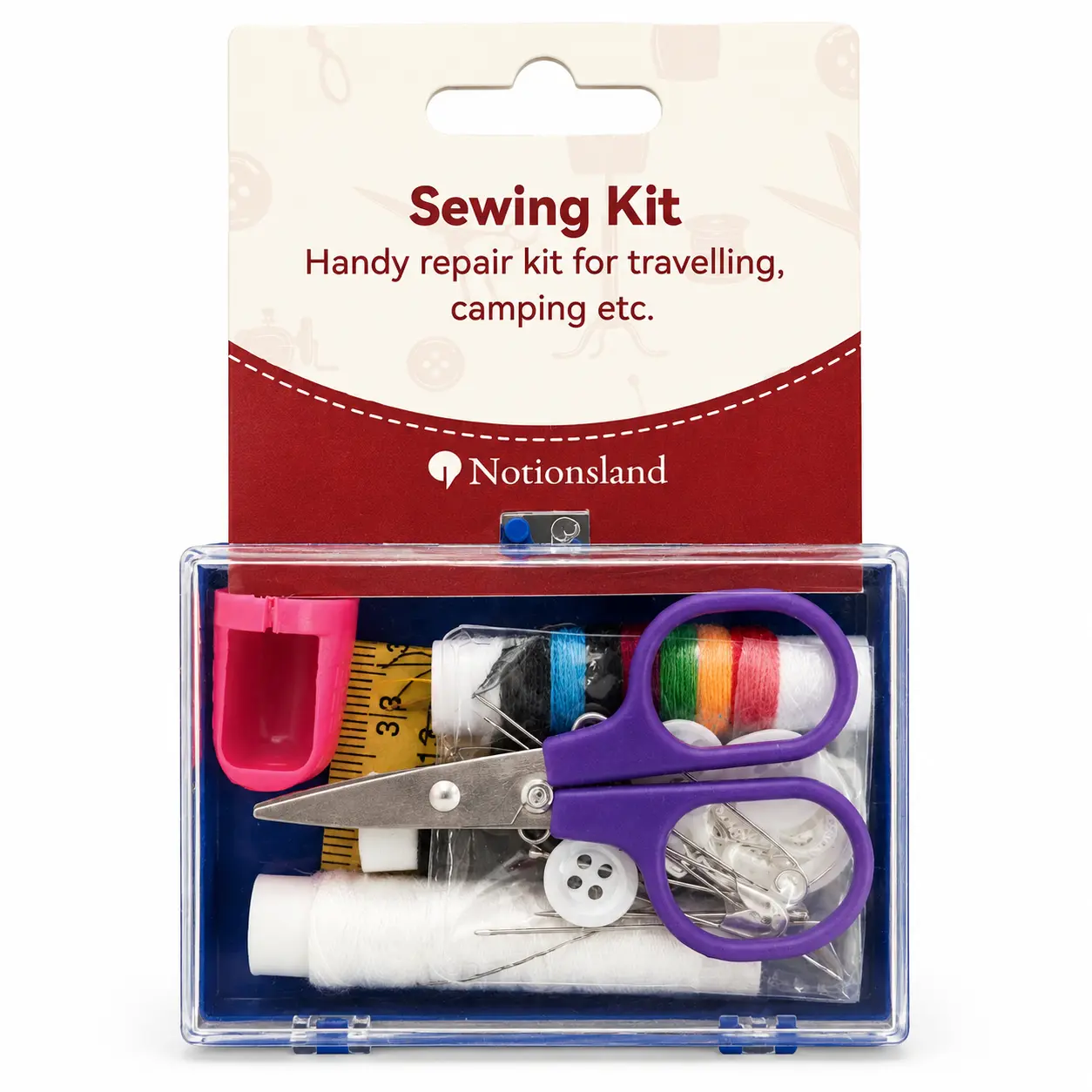
Small scissors should cut the supplied thread cleanly rather than folding it between the blades. A thimble should have smooth edges. A seam ripper should be protected in storage and function without a loose handle. A tape measure should return properly and show readable markings. Safety pins should open and close without sharp burrs.
The correct tool list depends on the kit. The important rule is simple: if an item is presented as functional, use it during approval. A non-working accessory adds cost, weight, and customer disappointment.
Check hand comfort too. Extremely small tools may fit a compact case but become difficult to control. Portability should not make the product unusable.
Inspect the case, pouch or basket
The container is part of the product, not only packaging. Open and close it repeatedly. Turn it upside down. Place it in a bag with ordinary objects. Check zippers, snaps, hinges, handles, elastic loops, pockets, trays, and lining attachment.
Sharp items should remain secured. Tools should be visible enough to find without emptying the entire kit. If the container is intended for continued use, allow space for the customer to return thread and tools after the first repair.
For sewing baskets, review lid alignment, handle strength, tray fit, fabric adhesion, interior cleanliness, and whether the base sits evenly. Decorative surfaces should survive normal shelf handling without obvious scuffing or loose trim.
Check the package promise against the contents
If the front says “complete travel repair kit,” the back should make clear what is included and what type of repairs the product supports. Avoid images that make the tools appear larger than they are or imply components not included in the package.
Review product name, contents, quantity, dimensions, instructions, warnings or market information where required, barcode space, brand details, and the finished pack's readability. Confirm applicable labeling and compliance requirements for the destination market with qualified specialists.
The package should also explain how to access sharp items safely. An attractive open display is not useful if needles can move freely during transit.
Compare several units for consistency
One sample cannot reveal assembly variation. Review multiple finished units side by side. Count contents, compare thread colors and lengths, test closure alignment, inspect tool placement, and check whether inserts remain neat.
Define defects in specific language:
- Missing, incorrect, or substituted component.
- Needle bent, corroded, blunt, or unsecured.
- Thread frayed, stained, tangled, or below approved length.
- Tool does not perform its intended basic function.
- Sharp edge, burr, loose part, or damaged holder.
- Case does not close, sits unevenly, or releases contents.
- Packaging is crushed, unreadable, incomplete, or incorrectly labeled.
Clear definitions help the supplier inspect the same risk the buyer is trying to prevent.
Review assembly and packing order
A good kit can be damaged by a poor assembly sequence. Needles placed before a protective card is secured may pierce the lining. Thread cards packed loosely can shift over the scissors. A rigid tool pressed against the window can scratch the package during transit.
Ask how workers confirm component count and placement. A visual standard at the packing station can show the correct orientation and position of every item. For complex sets, count controls or staged trays may reduce omissions.
Check the master carton as well as the individual package. Carton strength, internal movement, stacking, moisture protection, and shipping orientation can affect the condition customers see.
Use a simple completion test
When applying a sewing kit supplier quality checklist, complete two or three repairs using only the kit. Replace a button, close a short seam, and secure a hem or small tear on appropriate scrap fabric.
Record what was easy, what failed, which component ran short, and whether the tools returned neatly to the case. Repeat the same test with units from different production cartons when possible. This turns a general quality discussion into a customer task the supplier can understand.
Questions to ask before production
- Which components are made in-house and which are sourced?
- How are needles and sharp tools protected during assembly?
- How are component quantities checked?
- What substitutions require buyer approval?
- Can thread and tool function be included in inspection?
- How are approved colors, lengths, and sizes controlled?
- What packaging and transit tests are appropriate?
- How will defects be handled before shipment?
Where Onehourcrafts fits
Onehourcrafts supplies portable sewing and repair kits, including travel-focused formats and organized retail sets. Buyers can also review the wider sewing notions range when planning contents, storage, packaging, and private-label requirements.
A useful enquiry includes the intended repairs, sales channel, component list, container format, quantity, destination market, packaging direction, quality criteria, and launch date.
Quality questions buyers ask
How many sewing kits should be tested before production?
There is no universal number. Review enough samples to check component function and design, then define an appropriate inspection approach based on order size, product risk, destination requirements, and buyer standards.
What is the most common quality risk in a multi-piece kit?
Completeness and substitution deserve special attention because many small components are assembled together. Tool function, sharp-item storage, and packaging stability are also important.
Should every included tool be function-tested?
At least representative units should be used during development and inspection planning. A component presented as a tool should perform its advertised basic task.
How can buyers control thread quality?
Approve material, color, length, winding, and functional sewing tests. Keep reference samples and define what fraying, breakage, staining, or shortage is unacceptable.
Does the case need a separate quality standard?
Yes. The container affects organization, safety, portability, display, and reuse. Closures, handles, compartments, lining, and structural fit should be included in approval and inspection.
Test the repair, not only the inventory
The most useful sewing kit supplier quality checklist follows the customer's hands. Can they find the needle, thread it, complete a basic repair, cut the thread, and put everything away without the product creating a second problem?
Contact Onehourcrafts with your intended kit format, contents, quality criteria, packaging, quantity, and market to discuss sampling and a production-ready sewing kit specification.