
Plan a sewing supplies wall display solution by making the wall bay earn its space. Vertical fixtures can hold many small items, but a dense hook field may hide sizes, interrupt replenishment and force shoppers to ask questions the pack should answer. Onehourcrafts treats each bay as a working retail unit with a role, reach boundary, adjacency and reset proof.
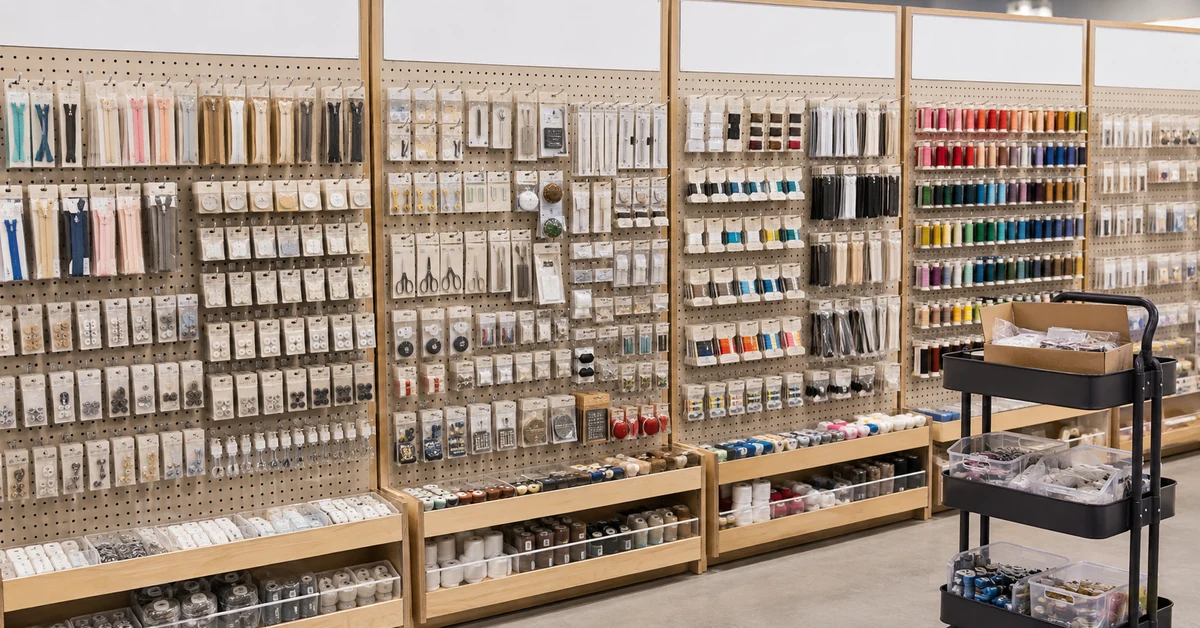
Draw the bay as a set of jobs
Divide the wall into jobs such as urgent repair, everyday notions, project refills, tools and seasonal accents. Start with the shopper decision each zone supports, not the number of hooks available.
A bay job gives the fixture a reason to exist. It also lets a buyer compare a display supplier on how well the system supports retail work rather than on finish alone.
- Find quickly
- Compare sizes
- Add to a project
- Replenish cleanly
Set the reach boundary first
Record the lowest and highest position intended for each product group. Small scissors, needles, threaders and boxed kits may need different reach and visibility rules.
For sewing supplies wall display, test the actual pack at the actual height. A label that reads on a table may disappear when the shopper stands below the top row.
| Zone | Primary job | Reach question |
|---|---|---|
| Urgent repair | Find a quick fix | Can a shopper scan and remove it? |
| Notions | Compare small variants | Can labels face forward? |
| Tools | Choose by function | Does the pack show the difference? |
| Refill | Return to a project | Can identity survive a reset? |
Let adjacency explain the project
Place thread, needles, fasteners, repair kits and storage where their relationship is visible. Keep enough separation to avoid implying that every neighbor is included.
An adjacency is a merchandising choice, not a product claim. Write the optional relationship on the shelf cue when a shopper might mistake a companion item for part of the pack.
Change one zone at a time during the review. Otherwise the buyer cannot tell whether a stronger adjacency or a new sign created the improvement.
Test one-handed removal and return
Ask a shopper or staff member to remove a pack while holding another item, then return it to the correct hook. Record snagging, hook visibility, neighboring movement and the chance of a wrong-slot return.
A wall fixture should support the ordinary moment, not only a staged photo. A return rule is especially important for small sewing notions with similar silhouettes.
If a pack needs two hands or staff assistance, document that boundary and place it where the store can support it. Do not hide the requirement in a generic display claim.
Build a visibility ladder
Rank what must be seen from a distance, at arm’s length and in the hand: category cue, function, size, count, material and variant. Use the pack and a small shelf cue to divide the work.
A large sign should not repeat every detail while leaving the actual size unreadable. The ladder helps the buyer decide which information belongs at each distance.
Use plain comparisons such as “for quick repair” or “three sizes” only when the released pack supports them. Avoid unsupported superlatives.
Make replenishment part of the fixture
Observe the restock route from carton to hook. Mark where unopened units wait, how the staff member identifies a variant and what happens when a hook is empty.
For a sewing notions display supplier, ask for a replenishment photo taken during the real store reset. A broader craft supplies wall display may need separate reset routes for small notions and boxed projects. The best-looking empty bay is not useful if it takes too long to restore.
A fixture can reduce labor when hook positions, labels and carton references agree. Record that as an observed process benefit, not a guaranteed labor saving.
Use an empty slot as information
Decide what an empty hook means: sold item, delayed refill, discontinued variant or display-only position. Give each state a visible or staff-facing cue.
Empty space can help shoppers understand a range, but only if the team knows how to interpret it. A blank hook should not silently become a false out-of-stock signal.
Keep an exception route for a missing display card or damaged hook. The wall system should make the problem visible and assign the next action.
Check pack protection at the hook
Hang the actual packs for a day or a defined handling session. Review corner crush, hole tearing, label curl, movement and whether the product remains easy to identify.
A display trial is not a transport certification. It is evidence about the chosen retail configuration and the fixture interaction.
If a heavier pack needs a different hook or backing, record the change as part of the released display specification.
Give staff a reset sentence
Write one sentence that tells a staff member how to restore each zone: where the item faces, which hook it uses and what companion stays beside it. The sentence should fit a checklist.
A reset sentence is more durable than a memory of the original plan. It also gives the display supplier a concrete test for signage and labels.
Ask a second employee to reset the bay from the sentence and a photo. Any disagreement belongs in the plan before rollout.
Compare wall and tabletop roles
Some sewing supplies need close comparison and may work better on a tabletop surface. Decide what the wall should do and what the tabletop should reserve for deeper handling.
Use the sewing-notions range, the product collection and the display inquiry page as internal context, then keep the decision tied to the store’s footprint and product mix.
Do not force every item into the wall bay just because the fixture has capacity. A clear handoff between wall and table can improve both surfaces.
Keep safety and compliance boundaries explicit
Use general CPSC business guidance as a prompt for documenting product and audience questions where relevant, and use the GS1 barcode standards overview to frame product-identity questions. Neither certifies a display, fixture or sewing item.
Keep sharp-item access, local rules and store policy within the qualified review they require. The display brief should state the boundary instead of making a universal safety conclusion.
A visible boundary protects staff and shoppers from an ambiguous fixture promise and makes a supplier question easier to answer.
Run the five-minute wall reset
Remove three items, create one empty hook, move one companion and ask staff to restore the bay in five minutes. A sewing supplies wall display solution should make search, reach, identity and the original adjacency observable during that reset.
The reset is a practical acceptance check. If it fails, the answer may be a smaller range, clearer cards or a different bay job rather than a larger fixture.
Photograph the approved end state and the ordinary exception state. Both are useful during future store visits and supplier revisions.
Write the wall-bay RFQ
State bay dimensions, product roles, reach, hook types, pack weights, signage, replenishment route, reset sentence, exception states and the evidence required at approval.
Ask for a full-size mock bay or a marked reference panel. A small tabletop model may hide the reach and adjacency issues that matter on the wall.
- Assign bay jobs
- Freeze reach and identity
- Test removal and return
- Rehearse replenishment
- Approve the reset state
How Onehourcrafts makes vertical space useful
Onehourcrafts can align sewing-supply roles, wall and tabletop boundaries, pack visibility, hook behavior and replenishment evidence in one display brief. The fixture becomes a retail process rather than a backdrop.
Before approving a sewing supplies wall display solution, ask a new staffer to restock one zone and explain one companion relationship. Keep the reset photo and bay jobs with the quotation.
- Bay-job sketch
- Reach ladder
- Restock photo
- Reset sentence
Frequently asked questions
What makes a sewing-supply wall display useful?
It gives each bay a clear retail job and supports finding, comparing, removing, returning and replenishing the actual packs.
Why set the reach boundary first?
Height changes whether labels, variants and tools can be read and handled by shoppers and staff.
Should companion items always be displayed together?
Only when the relationship is clear and optional items are identified so shoppers do not confuse adjacency with inclusion.
What should a removal-and-return check observe?
Record snagging, hook visibility, neighboring movement, wrong-slot returns and whether one or two hands are needed.
What is a visibility ladder?
It assigns category, function, size, count and variant information to the distance where a shopper needs it.
How should empty hooks be interpreted?
Define whether an empty slot means sold, delayed refill, discontinued or display-only, with a cue for staff.
Why test the actual pack on the hook?
Weight, hole tearing, corner protection and label movement can change the display specification.
When should an item move to a tabletop?
Move it when close comparison or handling matters more than vertical capacity. The decision depends on the store configuration.
Does CPSC guidance approve a display?
No. It can prompt documented product and audience questions, while local requirements and qualified review remain necessary.
What belongs in a wall-display RFQ?
Include bay jobs, dimensions, reach, hooks, pack identity, signage, replenishment, reset rules, exceptions and approval evidence.