
Punch needle kits for workshops should be designed from the session deadline backward, because a kit that works for one patient maker may fail when twelve participants need the same explanation, tool adjustment and cleanup at once. The buyer needs a room-level operating plan as well as a complete individual pack.
Begin at the cleanup deadline
Write the time when tables must be clear, tools counted and unfinished work secured. Move backward through finishing, last stitching, first successful loops, setup and arrival. This exposes the actual making window. A two-hour event may contain only sixty minutes of punching after introductions, distribution, demonstrations, breaks and packing.
Choose a project that can reach a satisfying checkpoint inside that window. Completion can mean a finished small piece or a stable work-in-progress with a clear next step, but the promise must be honest.
Convert the room into a run sheet
| Time block | Participant action | Facilitator control |
|---|---|---|
| Arrival | Find place and identify pack | Confirm attendance and place count |
| Setup | Mount fabric and prepare tool | Check orientation before threading |
| First loops | Practice direction and spacing | Diagnose fabric-tool-yarn issues |
| Main make | Follow the simplified pattern | Manage pace and shared spares |
| Close | Secure work and repack | Count tools and label unfinished pieces |
Design one place setting
Lay out exactly what one participant sees on arrival. Keep sharp or delicate tools secured until the facilitator introduces them. Separate personal components from shared equipment. Color-code or number place packs so loose pieces can return to the correct participant. Then test whether the whole setting fits the table width alongside elbows, instructions and a practice area.
- Project fabric mounted or prepared for quick mounting
- Yarn arranged in the order used
- Tool and threader protected and easy to inventory
- Practice patch distinct from the main design
- Name label and reusable unfinished-work storage
Separate personal, shared and spare stock
Personal packs should contain items participants must keep with their project. Shared stock can include reference samples, templates or finishing equipment used under supervision. Spares cover predictable breakage, lost threaders, extra yarn and replacement fabric. Record all three categories so the facilitator does not quietly borrow from an unsold retail kit.
| Stock class | Typical items | Count rule |
|---|---|---|
| Personal | Project, yarn, instructions, take-home storage | One verified place pack per attendee |
| Shared | Demo sample, visual aids, selected finishing tools | Based on table layout and supervision |
| Spare | Threaders, yarn, tools, practice cloth | Based on trial failures and group size |
Teach the system before the picture
The first demonstration should show how tool, yarn, fabric and loop direction interact. Participants need to see which side faces up, how the tool opening is oriented, how deeply to insert and why the yarn must feed freely. Start on a large high-contrast practice line before introducing the finished design.
The punch needle component compatibility guide provides the technical checks behind that demonstration. The workshop version must turn them into visible, teachable actions.
Test the demonstration from the back row
Set up the real room or a scaled mock-up. Ask whether the farthest participant can see tool angle, fabric side and loop formation. Use a large sample, camera display or table-by-table repeat when necessary. Avoid relying on tiny printed diagrams during the live demonstration; keep those diagrams for individual reference afterward.
- Show the finished front and working side separately.
- Thread the tool slowly using contrasting yarn.
- Make one correct line and one deliberate error.
- Demonstrate how to remove and repunch the error.
- Have participants repeat on practice fabric before the project.
Choose a pattern with visible checkpoints
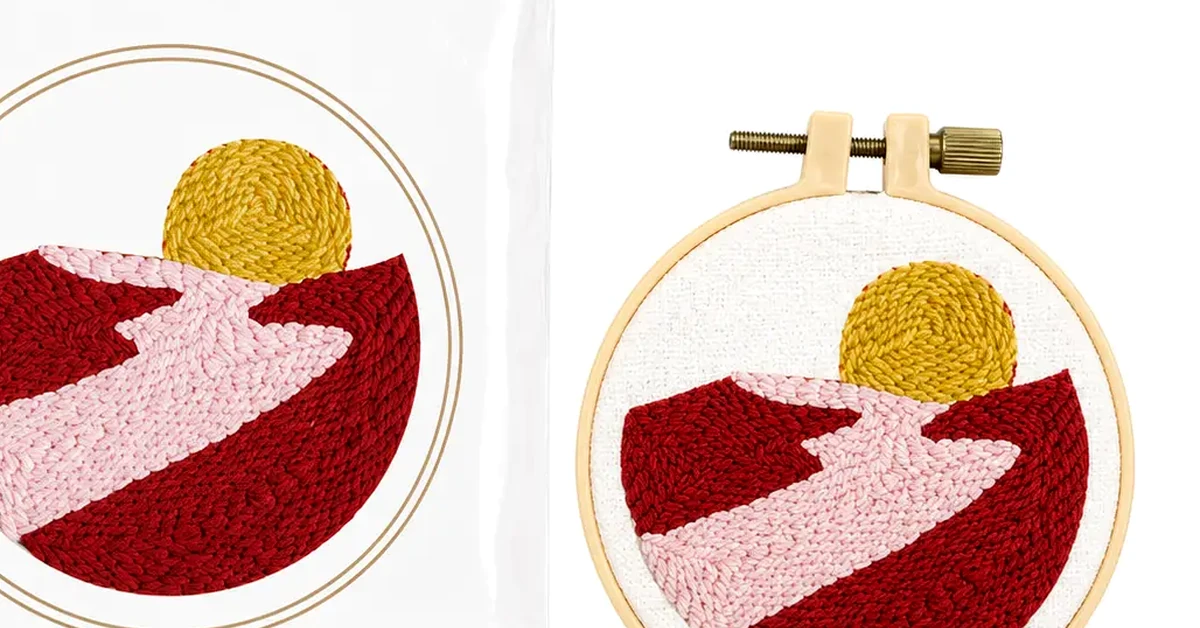
A workshop pattern needs large shapes, clear direction changes and progress that can be recognized quickly. Divide it into named zones so the facilitator can say, “complete the yellow circle before the break,” rather than estimate percentages. Check that the pattern still reads when some participants finish only the first zones.
Use the punch needle pattern design guide to control line width, detail and punchable shapes.
Budget help requests into the design
Run a pilot with one facilitator who is not the product developer. Record every intervention and classify it: threading, fabric tension, loop loss, direction, pattern reading, yarn shortage or tool failure. If the same issue appears at several places, redesign the kit or teaching step before adding more staff.
Before the pilot, compare the selected fibers against the punch needle yarn selection guide. Consistent yarn feed reduces avoidable interventions and makes the trial a fair test of the teaching plan.
| Help signal | Likely cause | Design response |
|---|---|---|
| Several tools jam | Yarn-tool mismatch or poor feed | Reapprove yarn and winding |
| Loops pull out | Direction, depth or fabric mismatch | Improve practice and system check |
| Participants lose place | Pattern zones too similar | Add named checkpoints |
| Cleanup runs late | Take-home method not rehearsed | Pre-label storage and closing steps |
Protect tool control without stopping the class
Punch tools and threaders need a countable position at distribution and return. Use trays, numbered pockets or place-pack outlines. Establish what happens when a needle is damaged or cannot be located. The facilitator should stop and secure the area when necessary rather than continue while a sharp component is unaccounted for.
Position age and supervision honestly
A group event does not remove product responsibilities. Audience, tool sharpness, small components, materials, instruction and foreseeable use still matter. The CPSC Art and Craft Safety Guide discusses common craft hazards and supervision considerations. The CPSC children's products guidance explains that intended use and marketing influence classification.
Confirm the requirements for the actual age group, venue, market and product. Adult supervision language does not automatically change a children's product into an adult product.
Plan the unfinished-project handoff
Most workshops have mixed completion speeds. Give every participant a closure path: secure the yarn, protect the tool, label the project and place the work in a reusable bag or box. Instructions should identify the exact step where the participant stopped and the next safe action at home. Test whether the partly worked hoop fits after yarn has been opened.
- Name and contact-free project identification
- Tool protection that survives the trip home
- Loose yarn separated by color
- Next-step marker on the instruction sheet
- Support route for a participant who finishes later
Connect attendance to ordering units
Punch needle kits wholesale cartons may not match workshop group sizes. Define place packs, facilitator packs and spare packs as separate order units. Build a conversion table for 8, 12, 16 or other common attendance levels. Beginner punch needle kits wholesale assortments can serve retail and events only when components and replacement policies are explicit.
Rehearse cleanup as a product trial
At the pilot, call time without warning the participants in advance. Observe how long it takes to secure projects, collect shared tools, count sharp items, clear fiber and pack waste. Check the floor and chair area as well as the table. The result determines the true closing block and whether packaging needs a built-in waste or storage function.
Reset the room immediately afterward and count the minutes until the next group could enter. That turnaround time belongs in the event plan when a venue schedules consecutive sessions.
The Onehourcrafts facilitator brief
For punch needle kits for workshops, Onehourcrafts can develop the inquiry around attendance, session length, age position, project checkpoint, place layout, tool system, yarn, fabric, shared stock, spares and take-home pack. A punch needle tools supplier should receive the same run-sheet assumptions so tool quantities and replacements support the room rather than only the retail box.
Frequently asked questions
How long should a beginner workshop be?
Set the duration from setup, teaching, practice, making and cleanup trials rather than from the pattern alone.
Does every participant need a full tool set?
Personal tools simplify flow, but the final split between personal and shared stock depends on supervision and project design.
How many spare tools are needed?
Use pilot failure data, group size, replacement time and the consequences of one unavailable tool.
Should fabric arrive in the hoop?
Pre-mounted fabric can save time, but participants may still need to learn tension and remounting for home use.
What makes a workshop pattern suitable?
It has visible checkpoints, punchable shapes, limited ambiguity and a satisfying stopping point within the session.
How should unfinished work be packed?
Protect the tool, separate loose yarn, label the project and mark the next instruction step.
Can one facilitator manage a large group?
Only a realistic pilot can show intervention demand. Repeated help requests may require redesign or more trained support.
What should be counted at cleanup?
Count controlled tools, threaders, shared equipment and any damaged pieces according to the event procedure.
Can the same kit be sold at retail?
Possibly, but retail users need independent instructions and support that do not assume a live facilitator.
What belongs in a workshop inquiry?
Include group size, timing, audience, venue, project, tool policy, packaging, market and replenishment needs.
Let the room prove the kit
A successful set is not merely complete when sealed. It distributes cleanly, teaches visibly, survives mixed pacing and closes on time. Validate punch needle kits for workshops through a full-room pilot, then turn intervention counts, spare use and cleanup evidence into the final specification.