
A punch needle yarn selection guide should match yarn thickness, twist, fiber behavior and surface texture to the actual punch tool, fabric opening, loop height and target user. A yarn that looks attractive in a ball can feed poorly, slip from the fabric or create uneven pile. Retail kit buyers should approve a working material system through samples, not fiber names alone.
Define the intended loop surface
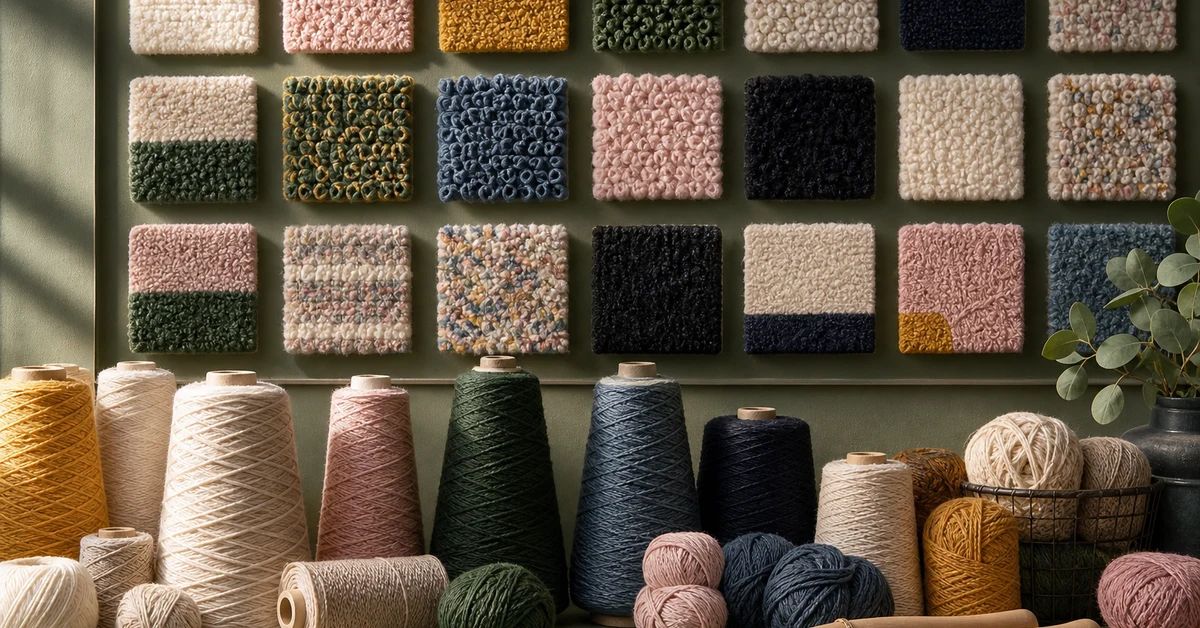
Describe what the finished pile must look and feel like. A bold beginner design may need large readable color fields and forgiving coverage. A detailed motif may need shorter, more controlled loops. Decorative wall art, cushion panels and small accessories can have different abrasion, flexibility and finishing requirements.
Record loop height, density, edge definition, softness, sheen and color behavior on the approved concept. Decide whether the reverse or loop side is presented. If the design mixes flat stitches and loops, state which yarn roles are required. These outcomes guide material selection more reliably than a general request for thick yarn.
- Desired loop height and visual density.
- Pattern detail and smallest color area.
- Surface softness, sheen and texture.
- Finished product use and handling.
- Target user and acceptable correction difficulty.
Describe yarn construction with measurable fields
Capture more than fiber content. Record mass per length where available, apparent diameter, ply, twist direction and firmness, surface hairiness, elasticity and lot information. Two yarns sold under the same broad weight category can feed and pack very differently in a punch tool.
Inspect consistency along several lengths. Thick-and-thin sections, knots, weak joins or loose plies can interrupt feeding. Check whether the yarn compresses through the tool and then expands after placement. A soft lofty yarn may fill space efficiently but create friction inside a narrow channel.
| Material field | Why it matters | Working risk |
|---|---|---|
| Apparent thickness | Controls tool and fabric fit | Jamming or loose retention |
| Ply and twist | Affects cohesion during feeding | Splitting or untwisting |
| Surface hairiness | Changes friction and pile appearance | Dragging or fuzzy boundaries |
| Elasticity | Changes tension and loop recovery | Loops retract or vary in height |
| Lot consistency | Protects color and performance | Bulk differs from approved sample |
Build a tool-fabric-yarn compatibility grid
Test candidate yarns with the proposed punch needle and production fabric. Use adjacent tool settings or sizes when the system allows them. Record threading ease, feed resistance, insertion force, loop formation and retention. Keep the operator, pattern tile and working rhythm consistent for comparisons.
A yarn that passes through the tool is not automatically compatible. It must also occupy the fabric opening without tearing the weave and remain held by friction after punching. Test the complete combination. Changing only the fabric or tool can move a previously stable yarn outside the usable window.
- Condition yarn and fabric samples consistently.
- Thread each candidate through the actual tool.
- Punch a fixed tile with straight, curved and filled areas.
- Record drag, skipped loops and fabric movement.
- Inspect pile and reverse side after resting.
Compare loop formation and retention
Measure or photograph loop height across the sample and look for gradual drift. Uneven loops can come from tool handling, yarn elasticity, feed friction or fabric tension. Repeat the tile with more than one target-level user to separate material sensitivity from one operator's technique.
Test retention with realistic handling. Gently flex, brush and manipulate the sample as the product will be finished. If instructions require trimming, gluing or backing, evaluate retention before and after that process. Do not use aggressive pull tests that do not represent the construction, but identify loops that release during ordinary correction or finishing.
| Sample signal | Possible cause | Development response |
|---|---|---|
| Tool repeatedly jams | Yarn is too bulky or hairy | Change yarn, tool channel or preparation |
| Loops pull out easily | Yarn is too fine for fabric opening | Use denser fabric, larger yarn or lower loops |
| Fabric distorts | Combination requires too much insertion force | Reduce diameter or revise fabric/tool match |
| Edges look fuzzy | Surface fibers obscure boundaries | Choose smoother yarn or simplify artwork |
| Loop height drifts | Elasticity or feed tension is unstable | Control feed path and test another construction |
Review color coverage and visual mixing
Make adjacent color fields using proposed production shades. Loop pile catches light differently from a wound yarn sample, so final color and sheen must be approved in the intended construction. Highly reflective or hairy fibers can reduce edge clarity. Dark colors may also hide the fabric and working path from beginners.
Check whether the pile covers the backing at the approved stitch spacing. A lofty yarn may appear full with fewer punches, while a smooth fine yarn can expose gaps. Do not solve weak coverage only by increasing density if that makes the fabric difficult to punch or the finished panel too stiff.
- Color appearance under retail and home lighting.
- Boundary clarity between neighboring shades.
- Backing coverage at approved stitch spacing.
- Visibility of the pattern during work.
- Lot-to-lot color and texture variation.
Measure yarn use by color and pile type
Weigh each color before and after a controlled sample or complete prototype. Loop height, density and corrections can change consumption substantially. Track colors separately because a small detailed area may create more waste and rework than a large simple field.
Add a documented user allowance after target-level trials. Loose yarn supplied in a kit must remain untangled and correctly identified. Winding form, organizer and packaging can influence whether the nominal quantity is usable. Recheck consumption when the pattern scale, loop height or yarn construction changes.
Test correction and beginner recovery
Ask users to remove and redo a short incorrect area. Observe whether the yarn survives removal, whether fabric openings recover and whether the instructions explain how to restart. A loosely twisted yarn may separate during correction; a hairy yarn can grip neighboring loops and pull more material than intended.
The best retail choice is not always the fastest yarn for an expert. A slightly firmer construction may give beginners clearer feedback and easier recovery. Score completion, surface quality and correction success together rather than selecting only by tactile appeal.
| User task | Pass signal | Risk signal |
|---|---|---|
| Thread the tool | Yarn enters without damage | Repeated compression or fraying |
| Punch a curve | Feed remains smooth | Drag changes direction or loop height |
| Fill a field | Coverage is even | Gaps, stiffness or fabric distortion |
| Correct an error | Yarn and fabric remain usable | Splitting, snagging or enlarged holes |
Review finishing, care and packaging
Complete the intended backing, trimming or display process. Adhesives and finishes can change color or hand feel and may interact differently with fiber types. If a care statement is planned, validate it with the complete product and intended market requirements rather than relying on the yarn label alone.
Pack yarn in its production form and run handling checks. Tight winding can flatten lofty material, while loose hanks can tangle. Separate colors and protect tool channels from fiber debris. Confirm that customers can identify the first required yarn without opening every bundle.
Freeze a full-system yarn approval
This is where the punch needle yarn selection guide becomes a purchasing control. Keep the approved yarn specification, physical color standards, tool and fabric references, loop tiles, consumption record and user trial together. Define which visible and functional changes require rejection.
Substitutions should be tested through the same grid. Matching fiber content and nominal thickness does not prove equal twist, friction, coverage or retention. Require relevant reapproval after changes to yarn source, construction, tool, fabric, loop setting, pattern density or finishing.
- Yarn construction, color and accepted lot variation.
- Approved tool and fabric combination.
- Loop height, density and retained sample tiles.
- Per-color quantity and winding form.
- Incoming inspection and substitution rules.
Where Onehourcrafts fits
The Onehourcrafts punch needle DIY kit page describes customizable yarn, fabric, punch tools, hoops, patterns and packaging. Buyers can use a punch needle yarn selection guide grid to approve the material with the exact tool and backing rather than selecting from yarn photographs.
Connect yarn testing with the component compatibility guide, pattern design guide, hoop size guide and sampling timeline. Send the artwork, loop target, candidate yarn, fabric, tool and order assumptions through the contact page. Care, labeling and market-specific product requirements need separate confirmation.
Frequently asked questions
Can ordinary knitting yarn be used in a punch needle kit?
Sometimes, but it must feed through the selected tool, fit the fabric openings and retain loops at the approved height. Test the complete combination rather than relying on the yarn category.
Is thicker yarn always better for beginners?
No. Thick yarn can create visible loops but may jam the tool or distort fabric. The easiest system has stable feed, clear coverage and recoverable mistakes.
Why do loops pull out of punch needle fabric?
The yarn may be too fine, the fabric opening too large, the loop too tall or handling tension inconsistent. Evaluate yarn, tool, fabric and technique together.
Should all colors use the same yarn construction?
Consistency simplifies use and appearance, but deliberate texture changes are possible when each material passes compatibility, consumption and finishing tests.
When should yarn selection be reapproved?
Reapprove after changes to supplier, construction, color lot limits, tool, fabric, loop height, pattern density, finishing or winding and packaging method.