Buying sewing supplies for supermarkets means designing for a shopper who may want a quick fix, not a long craft lesson. Onehourcrafts uses a five-minute test that begins with the shelf scan and ends with a replenishment carton back in the aisle. It connects pack clarity, countable units, sharp-item handling and store labor before a category plan is finalized.
Watch the shelf before opening the carton
Stand at the distance a shopper approaches the aisle and give yourself five minutes to identify the repair need, product difference and price. Do not read a catalogue or receive a sales explanation. Record which packs communicate their job immediately and which require a staff member.
A supermarket aisle rewards clarity over specialist vocabulary. The test does not mean every product must be simplified into one sentence; it means the important difference should appear before the customer has to compare tiny print.
| Five-minute moment | Question | Evidence |
|---|---|---|
| Approach | What category is this? | First glance |
| Compare | What differs? | Hand selection |
| Pay | Is the unit clear? | Pack and label |
Use the repair problem as navigation
Group products by the job a shopper recognizes: replace a button, mend a seam, fix a hem, secure a loose edge or carry a compact emergency set. Product family can still appear on the pack, but the first navigation cue should respect the supermarket mission.
For the supermarket sewing aisle, avoid creating five nearly identical packs whose only difference is a hidden count. A visible job cue, pack count and tool boundary help the shopper select without opening a unit.
- Job cue
- Included items
- Count
- Customer boundary
Make the front panel scan in order
Choose a fixed reading order: product job, included contents, unit count, material or size, and any important handling note. Test the order with a phone photo and a shelf view. A statement that is legible in a close-up may disappear at normal aisle distance.
If the product includes a needle, blade or small tool, keep the safety and handling message visible without allowing it to overwhelm the purchase reason. The pack should be honest about what the customer receives and what remains a household input.
| Front field | Why it appears | Check |
|---|---|---|
| Job | Navigation | Aisle view |
| Contents | Expectation | Opened reference |
| Count | Value | Pack and barcode |
| Handling | Risk cue | Market review |
Run the five-minute refill
Give a store colleague a sealed replenishment carton and a shelf diagram. Start the timer when the colleague opens the outer carton and stop when the correct units are faced, counted and the empty carton is removed. Note every search, backtrack and ambiguous pack.
The time is a diagnostic boundary, not a promised labor standard. Repeat it with a mixed inner and a low-stock shelf so the buyer can see whether the product naming, inner count and display method support ordinary store work.
- Open carton
- Find the shelf
- Face and count
- Remove waste
- Record exception
Keep sharp items under control
Small sewing supplies can include needles, pins, blades or pointed tools. Review the pack opening, display fixture and replenishment handling together. The goal is to identify where the store team or customer may meet a sharp edge unexpectedly and to route that question to the proper market-specific review.
Do not invent a universal safety claim from a visual inspection. Record the intended handling, the pack's retention method and the destination market, then obtain qualified guidance where required. A clear boundary is more useful than a vague assurance.
| Point | Observe | Owner |
|---|---|---|
| Pack opening | Retention and access | Product |
| Shelf | Facing and reach | Retail |
| Backstock | Loose-unit control | Operations |
Separate shelf unit from inner unit
Supermarket buyers often compare shelf price by retail unit while warehouses receive inner packs and cartons. Show the count at each layer and keep variant identity visible when several colors or sizes share an outer.
A supplier response should make it easy to calculate shelf capacity and reorder quantities without translating a marketing pack into an operations guess. Use one physical reference per pack level and photograph the opened inner.
- Retail unit
- Inner count
- Carton count
- Shelf capacity
Test the empty slot
Remove one fast-moving item from the shelf and ask a staff member to refill it using only the remaining labels, planogram and backstock. Watch whether the person can find the correct case and recognize the right variant without a second person.
An empty slot is a useful stress test because it removes the visual reassurance of a full range. If the refill depends on memory, the buyer can improve the carton mark, shelf label, case pack or operational name.
| Missing clue | Likely repair | Proof |
|---|---|---|
| Variant | Case mark | Read-back |
| Pack count | Inner label | Count check |
| Location | Shelf cue | Timed refill |
Give the shopper a safe boundary
A supermarket customer may expect a small sewing kit to solve a quick repair, but the exact contents and skill boundary vary. State what the pack can support and what the customer must supply. A modest, accurate promise protects both the aisle and the return desk.
For retail ready sewing notions, match front-panel language, contents, instructions and any digital support. Do not imply professional repair or universal fabric compatibility when the product has a narrower intended use.
- Name the repair
- List included items
- State the limit
- Check the return question
Build the display around replenishment
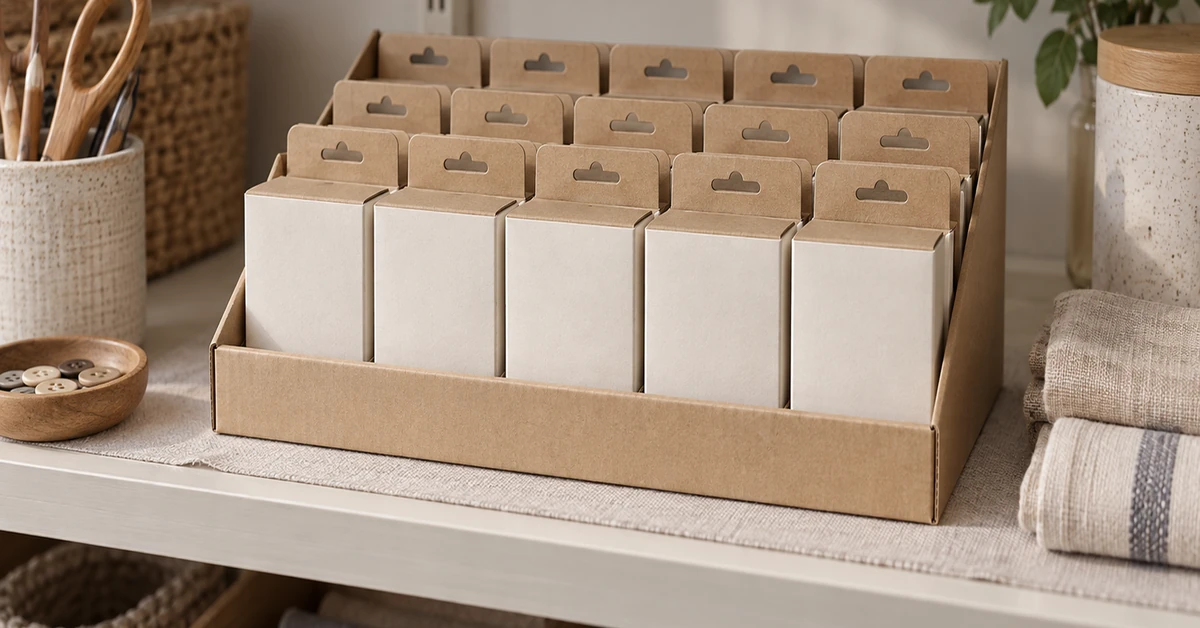
A shelf fixture should make a missing front-facing unit visible and leave a practical route for the colleague who refills it. Compare hooks, trays and small shelves with the actual pack depth. The right fixture is the one that supports the category routine, not the most decorative one.
Leave a place for one opened reference only if store policy permits. Otherwise use a clear image or sample that does not create confusion about sellable stock. Record the fixture dimensions and the backstock relationship in the buyer file.
- Facing count
- Hook or tray
- Opened reference
- Backstock route
Use the first reorder as a test
After the pilot, ask a colleague who did not build the range to reorder the fastest-moving and slowest-moving item from the store record. The exercise should recover the correct SKU, pack count and current supplier reference without relying on one buyer's memory.
Keep the reorder route separate from the sales story. A product can be easy to shop and difficult to replenish if operational names, images or pack levels are inconsistent. Fix the link before expanding the range.
A sewing supplies for supermarkets range earns its place when the second order is less mysterious than the first. Store the shelf image, the case mark and the current code together, then ask a different colleague to repeat the search after the pilot team has moved on.
| Reorder clue | Required match | Record |
|---|---|---|
| Shelf label | SKU | Photo |
| Case | Pack level | Count |
| Sales record | Current code | Confirmation |
Write the supermarket brief
State the repair jobs, shopper, shelf distance, pack hierarchy, handling boundary, fixture, five-minute refill, quantity scenarios and reorder proof. Ask for a production-intent sample and a carton that can be opened, counted and returned to the intended shelf.
Connect the brief to the sewing-notions collection and the sewing-kits collection. The ISO quality management principles can frame ownership and corrective-action questions without certifying a supplier or product.
Use the sewing-kit quality guide for a related component view. The CPSC business education resources can orient US product questions, while the responsible team still needs qualified review for the exact item, audience and destination.
| Brief block | Supplier response | Store proof |
|---|---|---|
| Shopper job | Pack concept | Shelf scan |
| Handling | Retention and access | Refill review |
| Pack | Unit hierarchy | Carton count |
| Reorder | Current code | Search test |
How Onehourcrafts protects the refill
Onehourcrafts can align the shopper job, front-panel order, pack levels, sharp-item handling, shelf fixture and reorder record in one channel brief. The five-minute test gives the buyer a practical way to compare options without pretending every store operates identically.
Before approving sewing supplies for supermarkets, run the shelf scan and the empty-slot refill on a production-intent pack. Keep the timer, fixture, carton mark and reorder search with the quotation so the category remains workable after the launch display is gone.
- Shelf scan
- Refill timer
- Handling review
- Reorder search
Frequently asked questions
Why use a five-minute test?
It reveals whether shoppers and store staff can understand, replenish and route the pack during a short, realistic category interaction.
How should supermarket sewing products be grouped?
Start with recognizable repair jobs, then show contents, count and the customer boundary clearly.
What should be tested on a replenishment carton?
Open it, find the shelf, face and count units, remove waste and record exceptions or ambiguous markings.
How should sharp items be reviewed?
Observe retention, access and handling at pack, shelf and backstock levels, then obtain qualified market-specific guidance.
Why separate retail and inner counts?
The shelf, warehouse and reorder teams make decisions at different pack levels, so each count must be visible and linked.
What does retail-ready mean here?
The pack, shelf cue, fixture, handling boundary and replenishment route work together without hidden specialist labor.
How can an empty slot help?
It removes the visual context of a full range and shows whether staff can recover the correct item from the remaining clues.
Should a small kit promise a complete repair?
Only when its contents and instructions support that exact boundary. Otherwise state the needed household inputs and limits.
What belongs in the first supermarket inquiry?
Share jobs, shopper, shelf, pack levels, handling, fixture, refill test, quantities and reorder expectations.
Why test the first reorder?
It confirms that the range remains searchable after the launch team or original buyer is no longer present.