
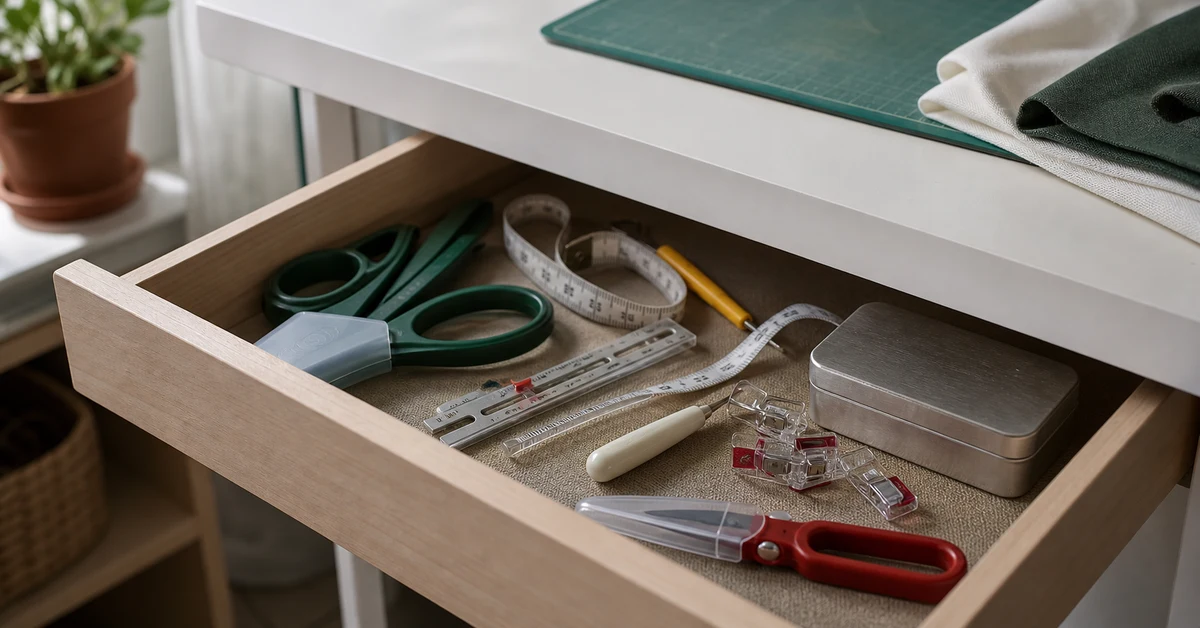
Assess a sewing tools manufacturer by opening a realistic shallow drawer slowly. Neat photography can separate scissors, cutters, gauges, markers and small notions, but storage makes those objects share space, collide and cover one another. Onehourcrafts turns that ordinary drawer into an approval fixture so buyers can observe protection, identification, retrieval order and the condition in which each tool returns after use.
Choose the drawer before choosing the assortment
Define a representative drawer, sewing box or tray for the intended customer and channel. Record its usable internal dimensions, opening direction, divider layout and any height lost to handles or overhanging edges.
This fixture is not a universal household standard. It creates a repeatable scene for comparing sample configurations and makes the storage assumption visible in the buying brief.
Map footprints before counting tool types
Trace each production-intent tool in its stable storage orientation and mark the space needed for a practical finger grip. The nominal length and width alone can hide curved handles, raised pivots or flexible parts that occupy neighboring zones.
| Footprint layer | Observation | Buyer evidence |
|---|---|---|
| Object outline | Where does the tool physically rest? | Top-down trace or controlled image |
| Grip clearance | Where must fingers enter? | Retrieval-zone overlay |
| Movement envelope | How far can it slide or rotate? | Post-cycle position record |
| Protected boundary | Which edge or point needs separation? | Cover, sheath or holder reference |
Open and close slowly enough to see the first collision
Load the approved assortment, close the drawer without forcing it and reopen in small increments. Watch which item moves first, which handle catches, and whether a hard part crosses a protected boundary.
A dramatic shake test may reveal severe movement but miss the quiet, repeated contact of normal use. Begin slowly, record the sequence and add stronger handling only when the agreed scenario calls for it.
Distinguish a protected edge from a hidden edge
A sharp or delicate working area can disappear beneath another item without becoming protected. Verify that the intended guard remains engaged, exposes no unexpected contact path and can be removed without touching the working edge.
Protection design, warnings, age positioning and destination obligations require product-specific professional review. The storage fixture supports observation; it does not replace the evidence or assessment required for the released configuration.
Retrieve tools in task order, not display order
Choose a short sewing task and list the order in which the user needs measuring, marking, cutting, holding and finishing tools. Load the drawer once, then follow that sequence without rearranging everything at the beginning.
A useful sewing tool storage test records the blocked grip, the item lifted by mistake and the object that must be placed elsewhere before the desired tool can leave.
- Measure before marking
- Mark before cutting
- Hold during assembly
- Finish and trim
- Return every item
Try a low-visibility search without turning it into a stunt
Ask a tester to locate named tools while looking mainly at the work surface, using shape, position and controlled touch where appropriate. Stop the trial if contact could be unsafe and redesign the access route instead of rewarding risky behavior.
The goal is to learn whether similar objects, loose guards or buried small parts cause confusion. It is not to claim that every tool should be handled without looking.
Give small notions a container that participates in retrieval
Markers, pins, needles, bobbins or compact gauges can migrate beneath larger tools or into drawer corners. Test the actual insert, case or compartment through opening, selection, temporary placement and return.
Counted contents may still be operationally incomplete when the user cannot isolate the required item. Identification should remain clear after the container has been opened and partly used.
Move the closed drawer, then repeat the path
Apply a documented movement cycle that represents installation, store handling or ordinary repositioning without pretending to reproduce every household condition. Reopen slowly and compare each object with its starting zone.
Record migration, guard retention, surface contact, tangling and new access barriers. Use the result to compare configurations, not as a blanket lifetime claim.
- Photograph the loaded start state
- Close and complete the defined movement
- Reopen in measured increments
- Run the same retrieval order
- Record the recovered storage state
Return each tool while the task is still active
Do not clean the scene before evaluating storage. With fabric, thread and work in progress still present, ask the tester to place each used tool back into its intended location and preserve access to the next tool.
A storage plan that works only on an empty table may fail during the actual task. Capture temporary placement behavior as part of the drawer path rather than dismissing it as user error.
Compare hard and soft tools as surface neighbors
Metal components, molded handles, flexible tapes, coated surfaces and printed scales react differently to repeated contact. Inspect for marks, distortion, snagging, transferred residue or loss of legibility after the defined cycle.
Agree which cosmetic and functional observations matter for the product and channel. Do not convert one sample observation into an unsupported durability promise.
Make the package-to-drawer transition a controlled handoff
Retail packaging can immobilize every item, while the customer immediately removes and stores them differently. Observe opening, guard retention, disposal of transport-only pieces and the first attempt to place tools into the reference drawer.
Use a disposition map so buyers know which packaging element travels with the tool and which does not.
| Pack element | After opening | Question |
|---|---|---|
| Edge guard | Retained with tool | Is return intuitive and secure? |
| Display tie | Removed | Can it be removed without damaging the tool? |
| Instruction card | Stored or referenced | Does it explain protection and care boundaries? |
| Inner tray | Retained or recycled | Is its future role stated honestly? |
Control look-alike tools at unit and assortment level
Similar sizes, finishes or handle colors can obscure functional differences. Link markings, dimensions, pack artwork, assortment position and approved physical sample to the same released identity.
The unit-on-card proof guide provides a related identity view. For wholesale sewing tools, repeat the check after items leave their display cards and share the drawer.
Set destination and quality questions outside the drawer
The CPSC business education resources can help frame US product questions, while the ISO quality management principles supports process discussion. Neither source approves a specific assortment or substitutes for qualified review.
Document materials, intended users, claims, warnings, labels, evidence and inspection requirements for the exact destination and configuration. A sewing tools manufacturer should keep those decisions connected to the physical sample used in the storage trial.
Write the RFQ as a drawer scene
Share tool functions, released dimensions, intended users, reference storage, edge and point controls, packaging, marking, destination, quantity scenarios and evidence needs. Ask the supplier to return a populated footprint map with the sample.
Use the sewing-notions replenishment guide for range timing and the buying-guide library for broader sourcing context. A retail sewing tool assortment brief should identify what remains together after purchase, not only what hangs together in store.
- Reference drawer dimensions
- Tool and grip footprints
- Protected-boundary evidence
- Movement and retrieval sequence
- Return-to-storage record
How Onehourcrafts reads the drawer after the test
Onehourcrafts can align approved tool identities, guards, footprint evidence, retrieval observations, package transitions and inspection notes in one buyer-readable file. The assortment is reviewed as a working neighborhood rather than a row of isolated product photographs.
Before selecting a sewing tools manufacturer, close the loaded drawer, move it through the agreed cycle and reopen it slowly. Then retrieve and return the tools in task order. The strongest evidence is not a perfectly arranged start image, but a protected, identifiable and recoverable end state.
- Loaded reference state
- First-collision record
- Task-order retrieval log
- Recovered storage view
Frequently asked questions
Why use a shallow drawer for supplier evaluation?
It creates a constrained, repeatable scene where overlaps, blocked grips, movement and return paths become easier to observe than on an open display table.
Should every tool fit one standard sewing box?
No. Define a representative fixture for the target customer and compare samples against that disclosed assumption rather than claiming universal fit.
What is a tool footprint map?
It records the object's resting outline, practical grip clearance, possible movement envelope and any boundary that must remain protected.
How should cutting edges be assessed in storage?
Inspect the exact production-intent guard and access route, then obtain the product- and destination-specific evidence and professional review appropriate to the configuration.
Why retrieve tools in task order?
A real sequence reveals dependencies and blocked access that disappear when every item is removed and arranged before the task begins.
How can buyers evaluate small notions?
Use the actual container, count and identification system, then observe opening, selection, temporary placement, migration and return.
Does a movement cycle prove long-term durability?
No. A defined cycle helps compare samples and expose contact paths; claims need evidence appropriate to their wording and intended conditions.
What should remain after retail packaging is removed?
Any guard, holder, instruction or identity cue required for use and storage should have a clear post-opening role and approved reference.
How should similar tool variants be controlled?
Connect dimensions, markings, function, artwork, assortment position and physical samples to a released variant index and inspect mixed sets.
What belongs in the first manufacturer inquiry?
Include functions, users, dimensions, storage assumption, protection, identification, packaging, destination, quantities, samples and evidence expectations.