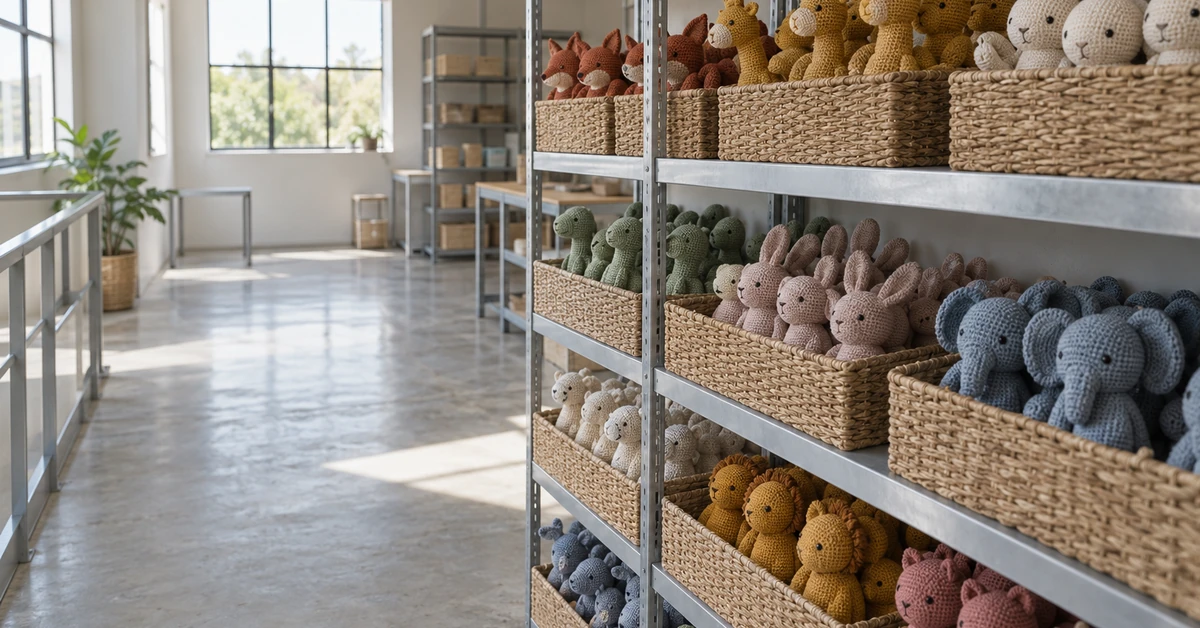

A craft supplies countertop display is a rental agreement with the shop, paid in square inches. Every centimetre it occupies is space that cannot hold something else, so the unit has to convert footprint into sales quickly. Onehourcrafts plans these fixtures by starting with the footprint and the restock path rather than the finished look.
Price the footprint before the fixture
Measure the counter area the shop is willing to give up, then estimate what that area currently earns. A display that cannot beat the space it displaces will be removed, however good it looks.
| Footprint | Suits | Watch for |
|---|---|---|
| Narrow strip | One product family | Becoming invisible |
| Corner wedge | Impulse items | Restock access from behind |
| Two-tier step | Two families at once | Losing the lower tier |
Size the fill before the frame
A counter unit is only as strong as its opening fill. Decide how many units each pocket, hook or shelf holds, then confirm the factory can supply that quantity as a single pack.
Fixtures that ship with awkward fill quantities push shops into underfilling them, which makes a good display look sold out or abandoned.
Design the restock path first
Someone with a tray of stock and limited time will refill this unit. If the restock action requires removing the display, reaching behind it or unpacking more than one carton, it will be done late and badly.
- Which face opens or lifts for refilling
- Whether the unit stays in place while being filled
- How a part-filled carton is stored nearby
- What the refill action looks like on a busy counter
Make the empty state part of the design
Every display spends time partly empty. The unit should still read as a category when two of its five openings are bare, and the shop assistant should be able to see what belongs in the gap.
Printed silhouettes, fixed dividers and labelled positions all help. A display that only looks correct when full will be judged on its worst day.
Set the reorder trigger from the fill
The fill quantity tells you the trigger. If the display holds twelve and the carton holds twenty-four, the reorder point is a specific number of units remaining, not a feeling.
| Fill per position | Carton multiple | Planning note |
|---|---|---|
| 12 units | 24 per carton | Reorder at half carton |
| 8 units | 24 per carton | Three positions per carton |
| 6 units | 36 per carton | Six positions per carton |
Test the unit loaded, not assembled
An empty fixture is a piece of furniture. A loaded fixture is a structure. Test it full, then test it with one heavy position and the rest empty, which is how it will actually be used.
Check that it does not rock, tip when a shopper leans on it, or bow under the weight of a full pocket.
Keep the footprint honest in the artwork
Branding on a counter unit should not add height or width that the shop did not agree to. Keep the footprint within the agreed dimension and put the graphics where they do not obstruct the stock.
A unit that quietly grows on the counter gets moved to a shelf, which is the beginning of the end for a counter display.
Match tabletop units to wall units
If the range also appears on a wall, the two formats should share a visual language: the same product blocks, the same order, the same colour naming. That is what lets a shopper recognise the family in two places.
Pairing a countertop format with a tabletop display solution in the same range is usually more effective than designing each fixture independently.
Decide what the fixture is not
Write down the exclusions: no loose products, no items that need fitting, nothing that requires an explanation longer than a line. A counter unit is an impulse surface, not a consultation desk.
Exclusions protect the fixture's turnover and make it easier to refill consistently across several shops.
Count the transit, not just the display
A fixture that travels badly arrives damaged and never gets used. Specify how it is packed flat, how edges are protected and whether a shop can assemble it without tools.
If the unit is shipped with stock, the carton identity should follow the GS1 barcode standard so the shop can receive and count it normally.
Give the shop a removal rule
Agree when and how the unit comes off the counter. A display with no exit plan lingers, collects dust and takes space from the next idea.
A short seasonal window, written into the agreement, keeps the fixture's status clear for both sides.
Record how the unit is returned, stored or recycled as well. A fixture with a known exit is easier for a shop to accept in the first place, because taking it on does not feel like a permanent commitment of counter space.
Pair the counter unit with a wall format
A counter unit sells impulse; a wall format explains a category. Running a craft supplies wall display alongside the counter unit gives a shopper somewhere to look after they have picked something up.
Keep the same product blocks, order and colour naming in both formats. Repetition is what turns two fixtures into one recognisable family on the shop floor.
What a display supplier must prove
- The unit stays stable when fully loaded
- One position can be refilled in seconds
- The printed positions match the stock list
- The unit assembles without tools
A sewing notions display supplier who can demonstrate all four avoids the most common outcome in this category, which is a fixture that is quietly removed after a single season.
Tabletop formats are not one category
A sewing notions tabletop display usually holds carded items at an angle, while a counter unit holds bulkier packs upright. They solve different problems and should not be specified from the same drawing.
When the range needs angled and upright formats, plus retail display solutions for craft products that can scale to a wall, plan the three as one family with shared blocks. Ordering sewing notions wholesale for a fixture means buying to the fill, so the carton multiple should match the number of positions on the unit.
A craft supplies countertop display is the hardest of the three to place, because counter space is offered grudgingly and withdrawn quickly.
Write the planogram before the artwork
The planogram decides what the shopper sees first. Sketch which product sits at eye level, which fills the corners and which position is allowed to run low, then design the artwork around that arrangement.
Artwork that is approved before the planogram usually needs reprinting, because the most prominent printed area rarely lines up with the most valuable position on the fixture.
- One position is the first read
- Two positions carry the volume sellers
- Corner positions hold the slower colours
- The lowest position holds the refill pack
How Onehourcrafts plans a counter fixture
Onehourcrafts starts from the footprint, the fill and the restock action, then designs the unit around them. That is what makes a counter display survive a real shop rather than a showroom photograph.
Merchandisers planning a wider set of formats can review buying guide notes or send counter dimensions through the inquiry form.
Frequently asked questions
How much counter space does a craft supplies countertop display need?
As little as the category can earn. A narrow strip suits one product family; anything wider has to justify itself against the sales the space already produces.
Should a counter display arrive filled?
Filled units launch faster and look right on day one. Empty fixtures often sit unbuilt, so shipping a defined opening fill is usually worth it.
How many product families can one unit hold?
One or two. Beyond that the unit stops reading as a category and starts looking like a clearance shelf.
What is the biggest cause of display failure?
A restock path that takes too long. If refilling is awkward, the unit runs empty and gets removed.
How do we set a reorder trigger?
Use the fill quantity and the carton multiple. If a position holds twelve and the carton holds twenty-four, the trigger is a countable number rather than an estimate.
Why does an empty display look worse than an empty shelf?
Because a fixture promises a category. Bare positions read as a product problem rather than a stocking problem.
Do counter units need to match the wall unit?
They should share blocks, order and colour naming, so a shopper recognises the same family in both places.
How should a fixture be tested?
Loaded, partly emptied and leaned on. That combination exposes tipping, bowing and stability problems that an empty display hides.
What should be excluded from a counter unit?
Anything that needs fitting, explanation or handling help. Counter space works best for items a shopper can judge in seconds.
What belongs in a display brief?
Footprint, opening fill, restock access, stack and tip limits, transit packing and trade terms, commonly written against Incoterms 2020.