A crochet stitch markers wholesale range should answer a tiny but important question: what does this marker help the maker notice next? Onehourcrafts treats closure, color, size, count and card language as one retail explanation. That keeps a small accessory from becoming a cup of anonymous plastic on the counter and gives a buyer evidence for the first assortment and the next reorder.
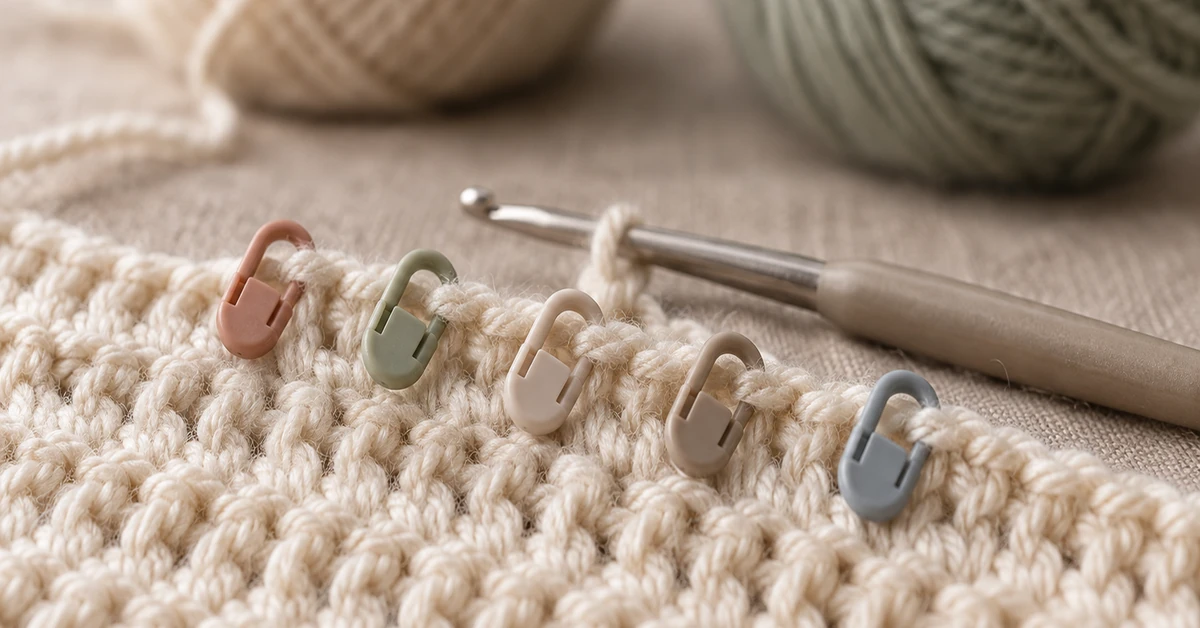
Start with the stitch, not the color
Ask a crocheter to use the proposed marker while beginning a round, joining a motif and marking a shaping point. The same object may be perfect for one action and awkward for another. Record the hand movement, the place it sits and whether the marker stays visible after the work is turned.
A useful brief names the project moment before it names a palette. Locking stitch markers can suit a fixed loop, while a split-ring or removable style may be easier when the maker needs to move the cue. Do not call every closure universal when its useful range is narrower.
| Project moment | Observe | Keep if |
|---|---|---|
| Round start | Visibility after turning | Cue stays readable |
| Shaping point | Opening force | No yarn snag |
| Motif join | Bulk at seam | Work lies flat |
Separate closure jobs
Lay the closure types on a work sample and ask a reviewer to open each one with one hand. The goal is not to crown a winner; it is to decide which closure belongs in which pack and how the card should describe it.
A buyer can then build a small family rather than a confusing wall of near-identical pieces. If the closure requires fingernail pressure or twists the yarn, mark that limitation in the assortment notes. Honest boundaries reduce returns and help staff recommend the right pack.
- Open with one hand
- Release without catching yarn
- Stay shut in a project bag
- Show its job on the card
Use color as an instruction
Color is valuable when it carries an operating cue: start-of-round, increase, decrease, or a customer's own project code. Test the cue under the shop's actual lights because a delicate shade can disappear beside variegated yarn.
For crochet accessories wholesale, keep the color system small enough for a shopper to remember. A four-color starter pack may explain more than a twelve-color assortment with no legend. Tie every color name to an approved material reference so reorders do not drift.
- Choose the cue
- Test under store light
- Print a short legend
- Tie colors to reorder codes
Build a pack someone can count
Count the markers in the customer's likely project, not only in the factory tray. A two-marker card may work for a small sample; a larger motif or teaching session may need a different count. Show the unit, pack and inner-carton levels separately.
If a mixed color pack is cheaper to assemble, make the mix intentional and visible. The buyer should not need to open every card to know whether there are locking and removable types inside. Use a small window, a photographed example or a simple diagram to make the pack count credible.
| Pack layer | Buyer question | Evidence |
|---|---|---|
| Card | What is included? | Visible count |
| Inner | How many cards? | Carton label |
| Case | How to reorder? | SKU map |
Try the counter conversation
Place three packs beside hooks and yarn, then ask a staff member to recommend one without a prepared script. Notice whether the explanation starts with a feature or with the customer's project. A useful recommendation usually names the next action first.
This short exercise turns a retail counter into a test site. If the staff member cannot explain the difference in one breath, change the card, the assortment or the placement. Do not solve a communication problem by adding more paragraphs to the back of the pack.
- Project named
- Closure understood
- Count repeated
- Price visible
Check the hand and the yarn
Run each closure across smooth cotton, fuzzy wool and a textured blend. A point that feels harmless on a table can lift a loop when the marker is removed. Inspect the yarn under normal tension and after the work has been turned several times.
The observation is not a universal performance guarantee. It is a bounded acceptance check for the yarn families the retailer actually sells. Save the sample yarn, marker code and reviewer note so a later material change can be compared with the original.
| Yarn | Look for | Decision |
|---|---|---|
| Smooth | Slip or scratch | Change edge |
| Fuzzy | Fiber catch | Change opening |
| Textured | Hidden cue | Change color |
Let the display show scale
A stitch marker is easy to lose visually. Place one open pack, one marker on a hook and one marker clipped to a real project. Photograph the fixture from the customer's standing distance so the size and function remain legible.
A craft store counter display should have a front-facing explanation, a small replenishment tray and a clear path back to the stockroom. Avoid a dense bowl where the shopper can see color but not closure. The display is part of the product promise.
- Open one pack
- Clip one marker to work
- Set the price cue
- Refill from a labeled tray
Price the decision, not the gram
Compare the marker pack with a hook, a small yarn ball and a project add-on. The relevant unit is the complete choice: pack, card, display space and staff time. A low component cost does not automatically create a good retail price.
Run a short counter pilot and record which pack is picked up, which question is asked and whether a second color is added. Treat the result as channel evidence, not a forecast for every shop. Keep the sample fixture with the pilot record.
| Signal | Record | Why it matters |
|---|---|---|
| Pick-up | Pack and time | First clarity |
| Question | Exact words | Card gap |
| Add-on | Adjacent item | Basket role |
| Return | Reason | Fit issue |
Protect the closure in transit
Small markers can be forced open when cards are stacked. Put the packed unit through a carton shake, a shelf transfer and a second handling pass. Check that every closure is still shut and the card has not bent into the working area.
Ask the supplier to show how the inner pack limits pressure and how the packed marker is counted. If the pack changes from a tray to a bag, repeat the hand test because the marker may arrive with a different opening force.
- Carton movement
- Inner pressure
- Card bend
- Closure after unpacking
Make variants findable later
A reorder should not depend on a phone photo. Give each marker a short code that carries type, color family and count, then print the same code on the card and carton. Separate customer-facing names from warehouse shorthand when the words would confuse the shopper.
Keep a discontinued color visible in the history rather than silently replacing it. A buyer can approve a substitute, but the decision should be visible. This matters when a class or kit uses the same cue across several deliveries.
| Field | Example | Owner |
|---|---|---|
| Type | Locking | Product |
| Cue | Round-start blue | Merchandising |
| Count | 12 pieces | Operations |
| Status | Core or seasonal | Buyer |
Write the RFQ around the cue
A useful inquiry names the project actions, closure mix, color legend, yarn tests, pack counts, card language and carton identification. It asks for a production-intent sample, not a generic accessory catalogue.
Use the buying-guide library for the buying context, the crocheted-products collection for related crochet references, and the GS1 barcode guidance to frame pack identity questions. The ISO quality principles can help assign corrective-action ownership without suggesting an unverified certification.
| RFQ block | Request | Approval |
|---|---|---|
| Use | Three project actions | Product |
| Closure | One-hand sample | Quality |
| Pack | Count and code | Operations |
| Display | Counter photo | Retail |
How Onehourcrafts keeps the marker useful
Onehourcrafts can align marker type, project cue, approved yarn tests, pack identity and counter replenishment in one buyer-readable file. That gives a tiny accessory a clear job and gives the buyer a defensible reason for each SKU.
Before approving the range, ask for a packed sample, a project-use observation and a reorder map. The crochet stitch markers wholesale decision is ready when a maker can choose the right cue and the store can restock it without decoding a mystery pack.
- Project cue
- Closure proof
- Pack count
- Reorder map
The final crochet stitch markers wholesale brief should keep locking stitch markers, crochet accessories wholesale pack logic and a craft store counter display in the same approval file. Keep the buyer's approval file linked to the company home so the commercial context remains visible without adding a new claim.
Frequently asked questions
Which closure is best for every crochet project?
None is universal. Match locking, removable or split-ring styles to the action, yarn and hand movement the customer will use.
How many colors should a starter pack contain?
Use the smallest palette that carries a clear cue. Four useful colors often explain more than a dozen unlabeled shades.
Should markers be sold loose or on cards?
Test both, but a counted card usually makes the retail choice and reorder quantity easier to understand.
What yarns should be used in testing?
Use the smooth, fuzzy and textured yarn families the target shop actually sells, with the sample yarn kept in the approval file.
What makes a counter display work?
Show one open pack, one marker in a real project, a visible price and a labeled backstock route.
How can a supplier prevent opened packs?
Use an inner pack that limits pressure, then check the closure after carton movement and shelf handling.
Should color names be customer-facing codes?
Keep a friendly cue for shoppers and a stable operational code for warehouses; connect both in the SKU map.
What should an RFQ include?
Name project actions, closure type, color logic, pack counts, tests, card language and carton identification.
How should a small pilot be measured?
Record pick-ups, questions, add-on purchases, returns and the exact fixture used.
Why keep a physical project sample?
It lets the buyer compare a later marker or yarn change with the original hand movement and visibility.