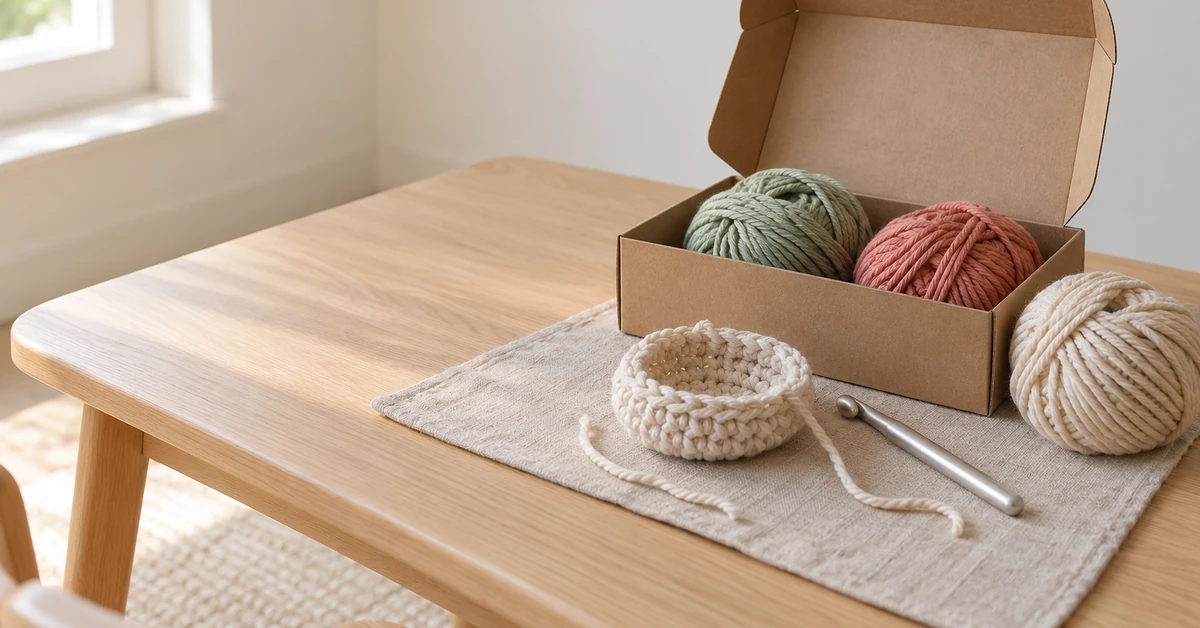

Evaluate a crochet tool kit manufacturer by removing one item from the approved assortment and watching what the project does next. Onehourcrafts uses this controlled absence to distinguish essential tools, convenient tools and decorative fillers. The experiment also reveals whether storage, instructions and retail copy describe each tool's real job.
Freeze the project before the experiment
Choose one realistic project segment and define its yarn, hook size, starting state and intended user. A tool cannot be called essential in the abstract; its role must be connected to an action the assortment promises to support.
Photograph the complete kit and write the expected sequence without naming the item that will be removed. This prevents the test from becoming a debate about personal tool preferences.
- Project segment
- Material
- User boundary
- Expected sequence
Assign every tool one primary job
Name the first job of each hook, needle, marker, gauge, scissors or measuring item. Secondary uses can be recorded later, but a clear primary role lets the buyer see whether two items are redundant or whether one hidden dependency carries the whole project.
Ask the factory to identify the physical feature that supports the job: size marking, point, eye, grip, closure or scale. Appearance alone does not establish function.
| Tool | Primary job | Physical cue |
|---|---|---|
| Hook | Form the stitch | Size and head |
| Needle | Finish yarn ends | Eye and point |
| Marker | Hold a location | Closure and visibility |
| Gauge | Read size | Legible scale |
Remove the least obvious item first
Begin with the item whose role is hardest to explain. Hide it before the reviewer sees the kit, then let the reviewer follow the stated project segment. Note whether the person notices the absence, borrows a personal item or changes the technique.
The observation is more informative than asking whether the reviewer likes a long list of accessories. It shows where the kit quietly depends on prior ownership or experience.
- Remove
- Observe
- Record substitute
- Restore and compare
Classify the response to absence
An absent tool can stop the project, slow it, change the finish or make no meaningful difference. Use these outcomes to discuss assortment roles rather than declaring every included item essential.
A crochet tools manufacturer should be able to connect the result to the exact tool specification. If a different point, size or closure changes the response, that feature belongs in the released identity.
| Response | Possible role | Buyer action |
|---|---|---|
| Stops | Required | Protect specification |
| Slows | Convenience | Compare value |
| Changes result | Quality support | Define boundary |
| No effect | Question inclusion | Retest or remove |
Observe the substitute
When the reviewer reaches for another object, record what it is and why it works. A household substitute may be acceptable for one audience and contradict a complete-tool promise for another. The buyer decides the boundary; the observation supplies evidence.
Do not add every imaginable substitute to the pack. Instead, decide whether the instruction names a reasonable alternative, the tool remains included, or the customer promise narrows.
- Borrowed object
- Changed movement
- Changed result
- Promise affected
Repeat with the hero tool
Now remove the item customers are most likely to notice, often the hook or a visually distinctive accessory. The contrast shows whether the assortment architecture matches the marketing hierarchy.
For a crochet hook set supplier, repeat the project with neighboring sizes rather than treating the whole set as one tool. Record which sizes support the proposed yarn and which are provided for future customer choice.
- Remove hero
- Try stated step
- Try neighboring size
- Compare outcome
Test identity without the tray
Empty the tools onto a neutral surface and ask an uninvolved reviewer to return each item to its role. Storage may create a false sense of clarity when molded silhouettes do all the explaining.
Labels, size marks and distinctive shapes should remain usable after ordinary handling. Photograph wear or glare that hides an important mark; do not rely only on pristine catalog images.
| State | Question | Evidence |
|---|---|---|
| In tray | Is the role visible? | Opened pack |
| Loose | Is identity retained? | Sorting attempt |
| After use | Are marks legible? | Handled sample |
Make storage earn its space
A case, pouch or tray should protect tools and help the next project begin. Check removal, replacement, closure and the space occupied by each item. An elegant case can still frustrate use when tools cannot be returned without a puzzle.
Run the missing-tool experiment again after carrying the closed kit. If the empty position is obvious, the user may detect loss early. If everything shifts, the storage system cannot communicate completeness.
- Protect
- Reveal absence
- Support return
- Survive carrying
Align instructions with actual jobs
Search the instruction for the first use of every included item. A tool that appears only in a component list has not been integrated into the making sequence. Add a concise job cue only when it helps at the moment of use.
Avoid turning the leaflet into an encyclopedia of tools. Link the selected project to the first-stitch contract guide and keep advanced possibilities outside the promised path.
- Find first use
- Name the job
- Show the cue
- Remove unused explanation
Review material and finish boundaries
Inspect edges, points, closures, surface finish and markings on the production-intent tools. Functional requirements depend on the exact design, user and market; visible smoothness alone is not a complete evaluation.
Use the ISO quality management principles to frame process consistency and corrective-action questions without implying certification. Ask how a tool reference is checked, recorded and changed.
| Feature | Use question | Process question |
|---|---|---|
| Edge | What touches yarn or hand? | How is it checked? |
| Mark | Can size be read? | How is print controlled? |
| Closure | Does it retain position? | What is the sample reference? |
Let retail copy survive the experiment
Read the front and side claims after completing the missing-tool tests. Words such as complete, beginner or all-in-one create different expectations. Keep only claims supported by the released assortment and intended project boundary.
For retail ready crochet accessories, give staff an opened reference with tool jobs rather than a dense feature list. The buying-guide library can connect the kit to broader assortment planning.
- Claim
- Project boundary
- Included role
- Evidence
Write the RFQ as an experiment
State the project segment, tool roles, required specifications, removal observations, acceptable substitutes, storage route, marking and inspection evidence. Request a production-intent set that can be used, emptied, carried and restored.
Ask suppliers to explain differences as choices, not as a universal ranking. A lower-cost tool may be appropriate when its role and limits remain honest; a premium feature should correspond to a customer action the buyer values.
- Freeze project
- Name roles
- Run absence test
- Approve matched set
Keep a before-and-after bench log
Photograph the complete tray, the empty position, the substitute chosen and the restored kit from the same angle. Add the project step and a plain description of the outcome. This creates a compact record a crochet tool kit manufacturer can repeat after a size, finish, case or component source changes.
Use the log with the crochet assortment proof guide. The GS1 barcode standards overview can orient identifier questions when a tool set or pack level changes, while identification rules remain the responsibility of the relevant organization.
| Frame | What it proves | Keep with |
|---|---|---|
| Complete | Released assortment | Sample ID |
| Empty | Missing role | Observation |
| Restored | Storage route | Approval |
How Onehourcrafts tests the empty space
Onehourcrafts can connect each tool position to a project action, physical specification, instruction cue and retail statement. This gives assortment decisions a visible reason instead of rewarding the longest component list.
Before approving a crochet tool kit manufacturer, remove one quiet tool and one hero tool from the sample. Keep the observed substitutions and changed outcomes with the quotation so later cost edits do not erase an essential job.
- Complete reference
- Two removals
- Observed substitutes
- Released roles
Frequently asked questions
Why remove a tool during evaluation?
Absence shows whether the project stops, slows, changes or continues without the item.
What makes a tool essential?
It performs a required job in the stated project and acceptable substitutes do not fit the customer promise.
Can a convenient tool still add value?
Yes. Name the time, handling or finish benefit honestly rather than calling it essential.
How should substitutes be documented?
Record the object, changed movement, result and whether borrowing conflicts with the pack promise.
Why empty the storage tray?
It tests whether tools retain identity when the organizer is no longer doing all the explanatory work.
Should every tool appear in the instructions?
Its first relevant use should be clear, but the leaflet need not explain unrelated advanced applications.
How are hook sizes compared?
Use the proposed yarn and project, then record how neighboring sizes change the observable result.
What should retail copy avoid?
Avoid broad completeness or beginner claims that exceed the released assortment and project boundary.
What evidence should a supplier provide?
Request identified samples, size and feature references, inspection records and controlled change ownership.
What belongs in the RFQ?
Include project, tool roles, specifications, substitution rules, storage, marking, sample use and acceptance evidence.