A latch hook cushion looks like a simple product until someone works out how many knots stand between the box and the finished pillow. That number is what decides whether a small first order is worth placing, and it is the question a low MOQ latch hook kit supplier should be able to answer before a single carton is discussed: it sets the retail price a shopper will accept, the evening count printed on the pack, and whether the kit gets finished or abandoned in a cupboard.
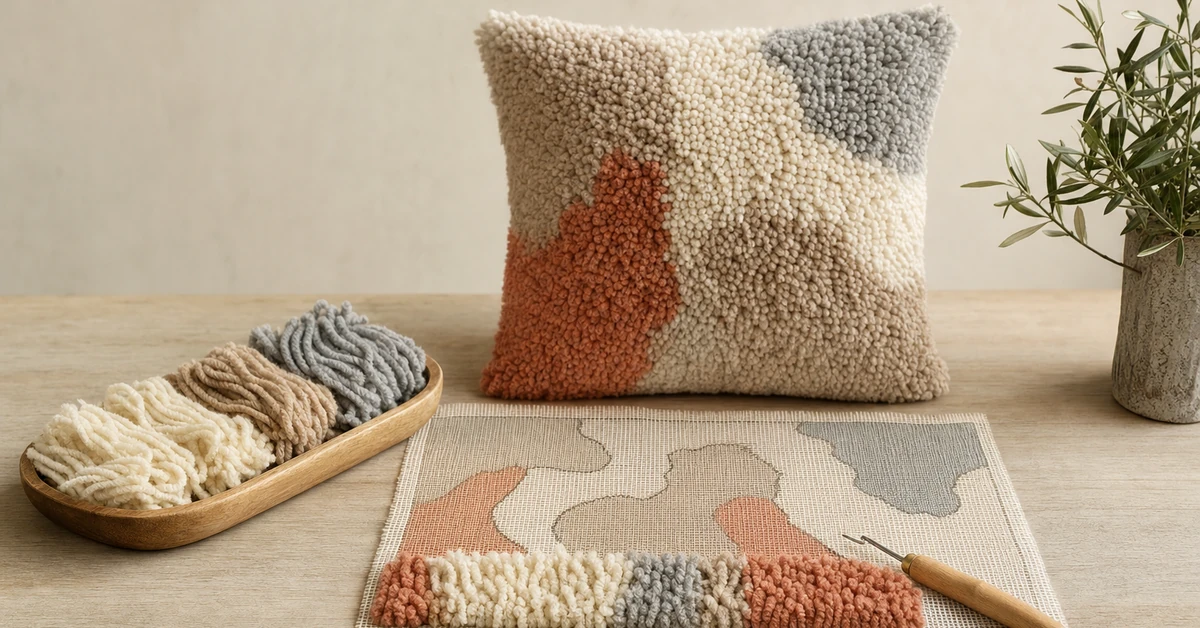
The mesh sets everything downstream
Latch hook canvas is sold by mesh count, which is the number of squares in a fixed length. Every square takes one knot, so the mesh count and the finished size together produce the knot count with no room for interpretation.
That single relationship is why the mesh belongs at the top of the specification. Choose the size first and the mesh second and you will pick a mesh that makes the project too long; choose a decorative mesh for a large cushion and the evening count runs away.
Work the knot count in the open
The arithmetic is short, and doing it in front of the buyer is the fastest way to settle a sample argument. Count the squares across, multiply by the squares down, and you have the knots for a solid front.
| Finished front | Mesh | Approximate knots on a solid front | Packaging claim that stays honest |
|---|---|---|---|
| 25 cm square | 3.3 mesh | A compact project | A single sitting for a confident maker |
| 35 cm square | 3.3 mesh | Roughly a season of short evenings | Two or three evenings |
| 40 cm square | 5 mesh | Substantially more knots per centimetre | A weekend project, not an evening one |
| 45 x 45 cm | 3.3 mesh | A large cushion front | A week of evenings, or a group activity |
The table deliberately avoids exact knot totals, because the honest figure depends on whether the design fills the canvas edge to edge. What matters is that the buyer and the factory use the same method to get there.
Density is a design decision, not a quality signal
A finer mesh produces a sharper image and many more knots. A coarser mesh produces a bolder, softer result in far less time. Neither is better in the abstract; they serve different shoppers.
- Coarse mesh suits bright, simple shapes and shoppers who want a visible result quickly.
- Fine mesh suits detailed motifs and shoppers who accept a longer project.
- Mixed designs use a coarse background with a finer motif, which costs the maker far less time than a uniformly fine front.
- Whatever the choice, the pack should state the mesh so the retail buyer can compare two kits fairly.
The latch hook range lists mesh and finished size together for exactly this reason.
Pre-cut yarn is where kits win or lose
A kit that asks the shopper to cut their own strands has quietly moved an hour of preparation into the project. Pre-cut bundles remove that step, but they introduce their own questions: strand length, bundle labelling and whether the bundle count matches the design.
| Yarn format | What the maker does | What the buyer should check |
|---|---|---|
| Pre-cut bundles by colour | Opens the box and starts | Bundle counts per colour against the chart, and clear colour naming |
| Skeins with a cutting guide | Cuts to length first | Whether the guide produces consistent strand length |
| Pre-cut and pre-sorted by row | Works without reading a chart | Sorting accuracy, and the added packing cost |
| Loose yarn by weight | Decides length and density | Whether the weight covers the design with any margin |
Strand length matters more than it appears. Slightly short strands pull out under a heavy footfall; slightly long ones waste yarn and look untidy on the reverse.
The evening budget belongs on the pack
Most abandoned craft projects are not abandoned because they were hard. They were longer than the shopper expected. Printing an honest evening range converts a surprise into a plan, and a shopper who planned for three evenings is not disappointed on the second.
- Time one real maker working at a natural pace on the sample, not a sped-up demonstration.
- Record the hours to the halfway mark separately; that is where most people stop for the day.
- Convert hours into evenings using the session length the target shopper is likely to have.
- Print a range rather than a single figure, and keep the wording consistent across the range.
A range of two to three evenings reads as honest. A single number reads as marketing and gets treated as such.
Beginner latch hook kits wholesale orders are chosen on the promise of an evening or two, so the printed evening range is doing more selling than the artwork is. A kit that states three evenings and quietly takes five is remembered for the difference long after the colours are forgotten.
Why the reverse side deserves a specification line
A latch hook front is knotted, and its reverse is a different surface. On a cushion the reverse is usually hidden by a backing panel, but on a wall piece or a rug it is visible, and the difference between a tidy and a rough reverse is mostly about how the maker finishes.
- State whether a backing panel is included, and what it is made of.
- Say whether the reverse is trimmed, glued or left as worked.
- Include the binding method if the piece will be used as a mat rather than a cushion.
- Show the reverse in at least one photograph, so the buyer knows what they are approving.
Gauge and canvas stability
Canvas that relaxes during work changes the finished size, and a cushion cover that will not sit square is a return. Buying canvas with a stable weave, and confirming how it behaves after a day of knotting, removes a problem that only appears at the end of the project.
Ask the factory how the canvas is tensioned during any pre-printing, and whether the printed grid lines stay aligned with the mesh after storage. Misalignment is easy to see on a finished front and impossible to correct later.
Canvas and pre-cut yarn are the two latch hook supplies wholesale buyers run short of first, because both get ordered against a design count rather than against a shelf quantity. Holding a small reserve of each turns a miscount into a quiet fix instead of a wait for the next shipment.
Printed or counted: a real fork in the range
Some makers want the design printed on the canvas; others prefer to count from a chart. The two formats appeal to different shoppers and they carry different costs.
| Format | Appeal | Cost and risk note |
|---|---|---|
| Printed canvas | Lowest barrier for a first-time buyer | Print alignment against the mesh has to be controlled per batch |
| Counted chart | Preferred by repeat makers | Chart accuracy carries the whole design; a single wrong symbol is costly |
| Both in one range | Covers two shopper types | Doubles the artwork and packing work, so price the range accordingly |
Publishing both formats is a reasonable strategy, but only if the design file is maintained in one place. Two artwork sets drift apart quickly.
OEM latch hook kits usually arrive with the buyer's own artwork, which sharpens the same question: who owns the chart, who may change a symbol after approval, and how a correction reaches the canvas printer before the next batch is run.
Where the risk sits in this category
The main risk is a kit that is complete but not finishable in the time the buyer promised. It looks like a quality problem in reviews even though every component is correct, and it is expensive to fix once stock is out.
The second risk is yarn coverage. Buying to the exact calculated length leaves nothing for a miscount, and most makers miscount somewhere. A small margin is cheaper than a replacement bundle programme.
Both risks trace back to one decision: whether a low MOQ latch hook kit supplier was briefed with a knot count and a timed sample, or with a picture and an assumption about how long the project ought to take.
A short evidence list for comparing suppliers
Two latch hook offers can look identical in a catalogue and differ on every number that matters. Ask for these six items in writing.
- Mesh count and finished size for each design in the range.
- Knot count per design using a stated method.
- Strand length, and the tolerance it is cut to.
- Yarn weight per colour with the margin included.
- Timed evening figures from a real maker, with the method noted.
- Backing panel material if one is supplied.
Send the list to every DIY latch hook kit manufacturer you are considering and compare the replies side by side. Where an answer is vague, ask who owns that decision; quality management principles are a reasonable frame for the question and settle nothing about any particular supplier or product.
Retail presentation for a bulky kit
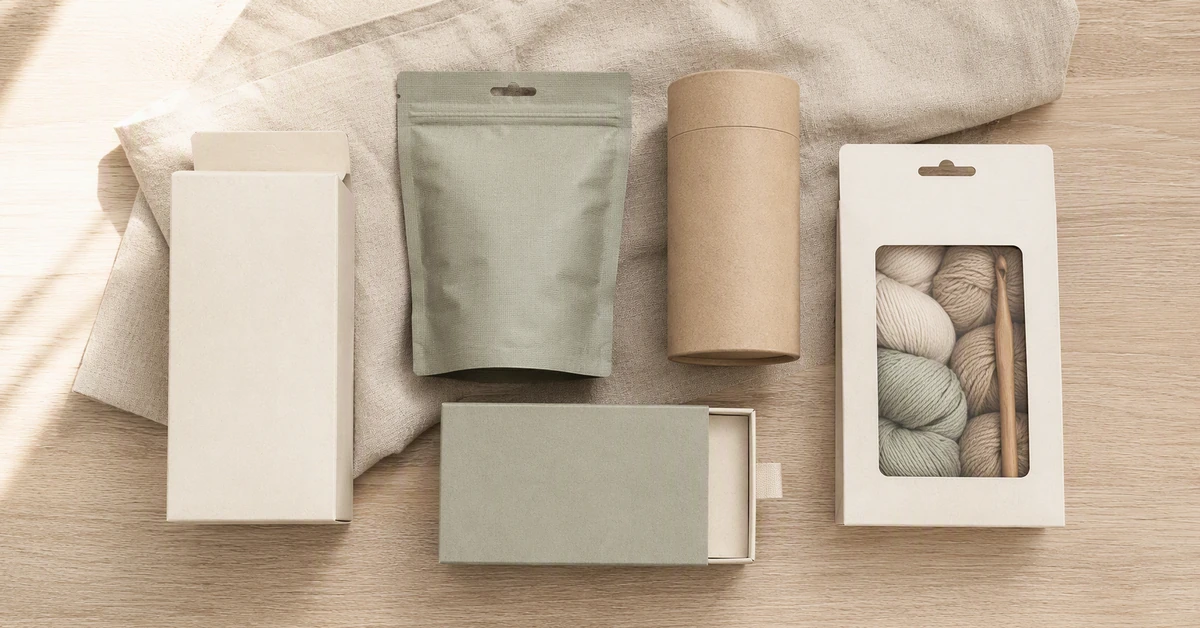
A latch hook cushion kit is physically bigger than most craft kits because the yarn and canvas take space. That shapes how it should be packed and where it can sit in a shop.
| Packing approach | Shelf behaviour | What to settle early |
|---|---|---|
| Flat bag with a header card | Hangs on a peg, reads well from the front | Header strength once the bag is full of yarn |
| Shallow box | Stacks and sits on a counter | Box depth against yarn volume, and how the lid closes |
| Bag inside a display carton | Refills a display unit | Carton footprint and how many faces the shop can see |
| Rolled bundle in a sleeve | Compact for a small shop | Whether the canvas creases in storage |
Where a range is meant to refill a display unit, the footprint matters as much as the artwork; the tabletop display options set out the usual unit sizes.
Retail ready latch hook kits are judged twice: once from the front, where the finished cushion has to read at a glance, and once in the hand, where the bag has to feel like it contains a project rather than a bundle. A shopper who cannot judge the finished size from the front tends to put the kit back.
Quantities that usually make sense
Because latch hook kits are bulky and design-led, the useful order pattern is narrower and deeper than for small accessories.
- One design in a small quantity to check the evening figure and the yarn coverage.
- Three to four designs in modest depth to test which motifs move.
- A repeat that drops the weakest design and deepens the strongest.
Depth per design is usually more valuable than breadth in the first season, because the second order is where the retailer learns which motif earns its shelf space.
Buyers ordering latch hook kits wholesale for the first time usually over-buy designs and under-buy depth. It is the reverse of what pays: four designs at three each teach less than two designs at six, because only the deeper lines generate enough sales to show which motif brought the shopper in.
Naming and labelling for a gift buyer
A latch hook cushion is often bought as a present, which raises the value of a clear finished-object photograph. The shopper is buying the finished cushion first and the activity second.
Put the finished piece on the front at a size the shopper can judge, with the mesh and evening range nearby. Size statements that only appear on the back tend to be missed at the shelf.
Where the range goes through a retail partner, the pack identity has to survive their systems as well as their shelf. GS1 barcode guidance covers the general numbering and symbol framework, while the assignment of a buyer's own codes stays with the buyer.
How Onehourcrafts prepares a latch hook brief
At Onehourcrafts the brief starts with the knot count and the evening figure, then moves to artwork, because a design that cannot fit the budget has to change before it is drawn, not after.
Samples are timed by a maker working normally, and the reverse side is photographed alongside the front so the buyer knows what they are approving. Buyers who already know the finished size and the number of evenings they want can price a range quickly.
Send the size, the mesh preference and the evening range, and the rest follows; a short brief is enough to start, and the wider buying guides cover packaging and quantity decisions.
A buyer comparing two low MOQ latch hook kit supplier offers can send those same three numbers and expect the same three numbers back. Two timed evening figures and one knot count are enough to make a fair comparison; two descriptions and a promise are not.
Frequently asked questions
How do I work out the knot count for a cushion front?
Multiply the squares across the canvas by the squares down. The result is the knot count for a solid front, and it is the only figure that lets you compare two designs fairly.
Is a finer mesh better quality?
It is higher density, not higher quality. Finer mesh gives a sharper picture and takes much longer. The right mesh is the one that matches the detail the design needs and the time the shopper will accept.
Why does stranding matter so much?
Strand length decides whether a knot holds. Slightly short strands work loose with use, and slightly long ones waste yarn and leave an untidy reverse, so the cut tolerance belongs in the specification.
Should the kit include a backing panel?
For a cushion, yes in most cases, because it protects the reverse and helps the cover sit square. If it is not included, say so clearly rather than letting the shopper discover it after opening the box.
How many evenings should a retail kit claim?
A range of two to three evenings usually reads as honest. Time a real maker at a natural pace and publish a range rather than a single figure.
Can the same design be offered printed and counted?
Yes, and it widens the audience, but keep both formats on one master artwork file. Separate files drift, and a chart error is one of the most expensive mistakes in this category.
How much yarn margin should I allow?
Enough to cover a miscount, because most makers miscount somewhere. Buying to the exact calculated length usually results in replacement bundle requests that cost more than the margin.
Does canvas stability really affect the finished piece?
It affects the finished size and how square the cushion sits. Confirm how the canvas behaves after a day of knotting and whether printed grid lines stay aligned with the mesh after storage.
How deep should a first order go?
Narrow and reasonably deep. Two or three designs with enough depth to cover a season tells you which motif earns its space, which a wide, shallow order cannot.
What should the pack show first?
The finished cushion, at a size the shopper can judge, with mesh and the evening range close by. The buyer is choosing the object first and the activity second.