
A mini sewing kit wholesale programme is not judged in a meeting room. It is judged by a shopper standing at a counter, holding a small case at arm's length, deciding within a few seconds whether this object solves a problem they can already picture. Onehourcrafts builds the format backwards from that moment: what the panel must say, what the case must survive and what one repair actually requires.
A mini kit is chosen at arm's length
The shopper is rarely seated and rarely patient. They are standing, often holding a basket, and the case is small enough that the front panel is the only information that registers.
Photograph the pack from the distance a customer actually stands, then read it back. Anything that cannot be read in that photograph is decoration rather than communication.
| Distance | What registers | Design task |
|---|---|---|
| Three feet | Shape and colour block | Name the repair |
| Two feet | Headline and count | State the pieces |
| In hand | Contents and sizes | Confirm the fit |
Read the pack from three feet first
Print a mock front panel, place it at counter height and step back. If the first readable line is a brand slogan rather than the job the kit does, the panel is in the wrong order.
Keep the layout to one dominant image and one dominant sentence. Small kits attract small type, and small type is the most common reason a good product underperforms on a busy counter.
- One dominant image
- One headline
- Count in large figures
- Price visible without lifting
Name the repair before the contents
Customers search for a problem, not a parts list. A button, a hem, a seam or a split toy tells the shopper what the kit is for far faster than a list of thread colours.
Where one case covers several repairs, put the most common one on the front and use the back for the rest. Naming three equal repairs on the front is the same as naming none.
| Repair | Likely buyer | Headline candidate |
|---|---|---|
| Loose button | Office and hotel | Strong first choice |
| Fallen hem | Travel and event | Good secondary |
| Split seam | Routine mending | Back panel |
Decide whether the case is part of the promise
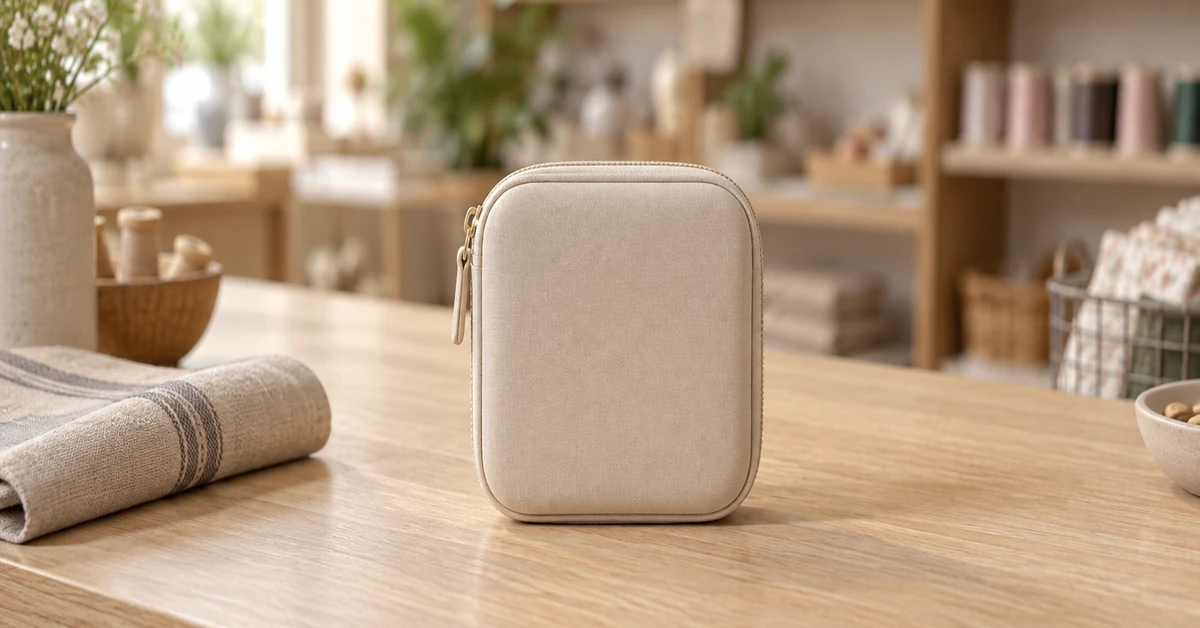
A rigid case implies the kit will live in a drawer or a glovebox, while a soft pouch implies it travels in a bag. The expectation set by the case has to match the life the kit is bought for.
Choose the format deliberately and price it accordingly. A rigid-looking case that flexes on the first squeeze creates a complaint about quality that no improvement in thread will fix.
- Rigid case for drawer use
- Soft pouch for travel
- Returnable shape
- Closure that stays shut
Count the pieces a real repair needs
Piece counts are easy to inflate and easy for a shopper to dismiss. A kit with forty items that cannot mend one button has a worse count than a kit with six that can.
Build the count from a completed repair and work backwards. Record what was used, what was handled but not used, and what was never touched, then remove the last group.
| Piece | Used in the repair | Keep in the count |
|---|---|---|
| Needle | Yes | Yes |
| Thread | Yes | Yes |
| Button | Yes | Yes |
| Thimble | Handled once | Reconsider |
Test the thread against a real button
Thread quality is the item most often reduced during costing and the one most likely to break at the worst moment. Run the supplied thread through a button shank by hand and note whether it frays or survives.
Record the thread type and its supplier so a later substitution can be compared with the original test. A cheaper thread may pass a visual check and still fail the only task the kit exists for.
- Thread through a shank
- Knot holds under tension
- Colour fastness noted
- Supplier recorded
Keep the needle visible and contained
The needle is the part that decides whether the case is safe in a handbag and whether the kit can be sold to a family channel. It needs a home that holds it in place and a way to check it is there.
A small sleeve, a folded flap or a magnetic strip all work. Count the needle at the end of the packing line so a missing needle is caught before the case leaves the building.
- Stated needle position
- Needle holder included
- Packing-line count
- Spare policy written down
Set the price step against neighbouring items
The mini kit competes with a keyring, a card, a small notebook and a pack of tissues on the same counter. Its price has to sit comfortably in that queue, not in the sewing aisle further into the store.
Test two steps and record which one moves. A step above the neighbours works when the panel communicates a job the neighbours cannot do.
| Comparison | Position | Read |
|---|---|---|
| Keyring | Below | Impulse range |
| Small notebook | Level | Reasonable step |
| Tissue pack | Level | Basket filler |
Prove the pack survives a pocket and a purse
A mini kit will be carried before it is used. Put a sealed unit in a pocket, a handbag and a glovebox, then open it and check the case, the needle and the thread spool.
Record the handling route and the result. Where the closure opens under load, change the closure rather than the marketing copy.
| Route | Check | Failure action |
|---|---|---|
| Case corners | Thicken the wall | |
| Handbag | Closure stays shut | Change closure |
| Glovebox | Heat and shape | Re-test the material |
Build a tier ladder from mini to standard
The mini format often introduces a customer to a larger kit later. A deliberate ladder turns a single counter purchase into a range relationship.
Keep the naming consistent across the steps and make the difference obvious without reading. Where steps differ only in piece count, the ladder is harder to understand than it needs to be.
- Mini for one repair
- Standard for a household
- Full set for a workshop
- Ladder naming kept consistent
Choose channels that match the format
A counter format succeeds where a purchase decision is quick and the item can be added without a trolley. It performs poorly where shoppers expect a section with staff advice.
Match the format to the channel and keep the merchandising simple. Hotels, pharmacies, supermarkets and promotional distributors all buy the same object for different reasons, and the case note should say which reason applies.
- Counter and checkout
- Hotel amenity route
- Promotional distribution
- Retail sewing aisle kept separate
Keep the mini kit from cannibalising the full range
A cheap mini kit placed beside a full sewing set will pull some sales away from the higher step. That is acceptable when the mini kit also attracts shoppers who would otherwise buy nothing.
Place the steps apart and give each a distinct job on the panel. Measure the effect on both steps rather than judging the mini format on its own sales alone.
- Separate the placements
- Give each a distinct job
- Track both steps
- Review after one season
Write the RFQ as a counter specification
A useful inquiry states the counter distance, the headline repair, the case format, the piece list, the thread type, the needle holder and the carton identity. It asks for a sealed sample that can be carried and opened.
Use the buying-guide library for the assortment context, the sewing-notions collection for related products, and the GS1 barcode guidance where the retail identity needs a scannable code. Distribution and delivery questions are easier to frame with the ICC Incoterms 2020 rules.
| RFQ block | Request | Owner |
|---|---|---|
| Panel | Headline and count | Brand |
| Case | Format and closure | Product |
| Contents | Repair-based list | Quality |
| Route | Carry test result | Operations |
How Onehourcrafts keeps the format readable
Onehourcrafts can line up the counter-distance layout, the repair-based contents list, the thread test and the carry route in one approval file, so the format can be judged the way a shopper will actually meet it.
Before approving the range, ask for a counter photograph, an opened sample and a carry-test note. The mini sewing kit wholesale decision is finished when the panel sells the repair before the case is opened.
- Counter photograph
- Opened sample
- Carry-test note
- Carton identity
The final mini sewing kit wholesale brief should keep the mini sewing kit panel rules, the promotional sewing kit manufacturer route and the broader sewing kits wholesale ladder in one record, linked from the company home so the commercial context stays attached.
Frequently asked questions
What should the front panel of a mini kit show?
One dominant image, one headline naming the repair, the piece count in large figures and a price the shopper can read without lifting the case.
How many pieces should a mini kit contain?
Build the list from a completed repair and remove anything that was never touched. A short list that works beats a long one that does not.
Rigid case or soft pouch?
Match the format to the life the kit is bought for: a rigid case for drawer use, a pouch for travel, and a closure that survives both.
Why test the thread by hand?
Thread is the item most often reduced during costing and the most likely to fail at the only task the kit exists for.
How should the needle be stored?
In a sleeve, flap or magnetic holder, counted at the end of the packing line so a missing needle never ships.
Where does a mini kit belong in store?
On a counter or at a checkout where the decision is quick, rather than in a staffed sewing section.
Will a mini kit reduce sales of full sewing sets?
It may pull a few sales from the higher step, so place the steps apart and measure both rather than judging the mini format alone.
How do you test carry durability?
Put a sealed unit through a pocket, a handbag and a glovebox, then check the case, closure, needle and spool.
What price step suits a counter format?
One that sits comfortably beside the neighbouring items and is supported by a panel that names a job those items cannot do.
What should an RFQ include?
The counter distance, headline repair, case format, repair-based piece list, thread type, needle holder and carton identification.