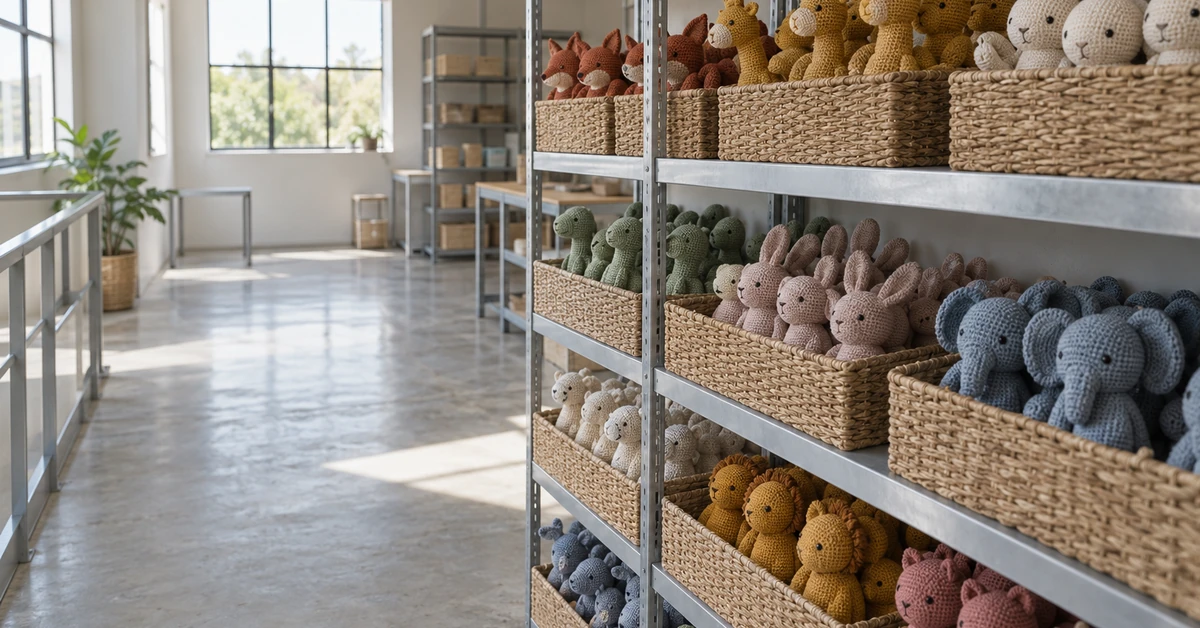
Yarn does not wait patiently for the season to arrive. A cone bought as wholesale crochet supplies in spring and sold in autumn has spent six months absorbing whatever the store room offered: humidity, sunlight on one face, a warm corner behind a compressor, and the occasional visit from something with wings.
Most buyers think about storage only when something goes wrong, which is why the same three problems recur: a shade that no longer matches its own label, a cone that has gone slack and soft, and a pallet at the back of a rack that nobody has touched since it arrived.
A bin of yarn is a batch, not a commodity
Two cartons of the same article number can behave differently if they were dyed a month apart, and the difference is usually invisible until they sit beside each other in a finished piece. Treating a bin as an interchangeable quantity is the root of most shade complaints.
The correction costs almost nothing. Every incoming carton gets a lot label, a receipt date and a bin number, and the picking rule becomes 'one order, one lot' wherever the quantity allows it.
Dye lots: a lock beats a shade card
| Practice | What it prevents | What it costs |
|---|---|---|
| Lot label on every carton | Mixed lots reaching one order without anyone noticing | A label and a minute of receiving time |
| One-lot picking where volume allows | Visible shade joins in a finished piece | Slightly more careful picking |
| Held reserve for an active colour | A mid-season break when the shade sells out | Cash tied up in stock |
| Photographed reference sample | Arguments about what was actually supplied | A sample bag per article |
| Written shade tolerance | A batch rejected on a subjective comparison | One conversation at the sampling stage |
A shade card is a reference, not a contract. What protects a buyer is a written tolerance plus a retained sample, because those two together turn a later disagreement into a comparison.
- State the colour in the words the factory uses internally, not in a marketing name.
- Keep the retained sample in the dark, because a sample that fades proves nothing.
- Record the lot number on the purchase order and on the packing list.
- Decide in advance how a substitution would be offered and who approves it.
A crochet supplies manufacturer that produces its own yarn usually has less lot variance than one that buys in, and a crochet supplies wholesale distributor usually has more, because it is holding stock from several production runs. Neither is automatically better; the buyer simply needs to know which situation they are buying into.
Moisture and the soft cone
Natural fibre takes on moisture from the air, and a cone that has absorbed it loses dimensional stability. It measures the same on the outside and works up differently, which is why a tension problem can appear in a batch whose yarn was never changed.
Simple controls cover most of it: keep stock off a bare concrete floor, keep it out of direct sunlight, avoid stacking against an external wall, and let a cold pallet come to room temperature before it is opened. None of these needs equipment. They need somebody whose job includes them.
| Condition | What it does to the stock | Cheapest control |
|---|---|---|
| Damp floor or wall | Slack cones and tension that will not repeat | Pallets and a gap of a handspan from the wall |
| Direct sunlight on one face | A visible shade shift down one side of the pallet | Opaque packaging or a shaded rack position |
| Warm corner near equipment | Drying out, then brittleness at the outer layers | A different position, plus a monthly check |
| Long undisturbed storage | Pest damage that appears only when the carton is opened | Sealed inner packaging and rotation |
Pests and the warm corner nobody inspects
Moths and beetles prefer the same conditions as a well-run store: quiet, warm and undisturbed. The risk concentrates in the places nobody photographs, such as the back of a low rack, the gap behind a pallet and the corner nearest a heat source.
A monthly check of those specific spots, with a written result, is more effective than a general clean. Where goods are held over a season, sealed inner packaging is worth more than any treatment applied afterwards, because the damage happens before it is visible.
Rotation rules that keep older stock moving
- Receive to a bin number and a date, and write both on the carton rather than on a system only.
- Pick from the oldest matching lot first, and record which lot left on which order.
- Keep a reserve quantity for any colour that is currently selling.
- Re-count the reserve at a fixed interval, not only when the shelf looks empty.
- Photograph and quarantine anything that has changed appearance before it is picked.
- Clear slow-moving lots before a new shipment arrives, even at a small margin cost.
The last two rules do the heavy lifting. A store that clears slow stock deliberately rarely finds it two seasons later, and a quarantine habit stops one bad cone from being crocheted into fifty purses.
Reordering before the shade breaks
The reorder trigger for a colour is not the reorder point in the system. It is the point at which the remaining quantity would leave an unfinished project if the next shipment arrived late, and that figure has to be calculated from the consumption of a finished piece rather than from an average.
Working from a finished piece also exposes the wastage assumption. If a project consumes more than the allowance because of joins, tails or a reworked row, the reorder trigger built on the theoretical figure will always fire too late.
What a storage clause should say
Storage promises are worth exactly what the clause says. A useful clause names the receiving condition, the labelling convention, the rotation rule and the retention of a reference sample, and it says who carries the loss if a lot is consumed out of order.
It should also say what happens at the end of a season. Leftover lots are the usual source of disagreement, because neither side planned for them, and a clause written in advance removes the argument rather than settling it.
Damage that shows up after receipt
Moisture, pest and light damage are slow, so they usually appear after the goods have been accepted and paid for. That makes the evidence trail the only protection: the receiving photographs, the bin history, and a record of the conditions the stock was held in.
Where a defect is found, quarantine the affected lot before testing further, because a contaminated carton next to clean stock turns a small problem into a large one within a month.
Handling the last pallet of a season
The final pallet is the most expensive yarn in the store. It is the stock that decides whether a late order can be filled, and it is also the stock most likely to sit under a leak or beside a heater because the good positions were taken earlier.
Give it the best position rather than the worst, count it at a fixed interval and price it for clearance as soon as the season turns. Carrying it into next year guarantees a shade mismatch against the new delivery.
Committing a colour for a whole season
Where a range is built from kits rather than from open stock, the commitment is larger and it happens earlier. A crochet kit supplier plans the yarn for the kits it packs, so an OEM crochet kits programme usually locks a colour for the whole edition rather than for a single order. Sourcing through a crochet supplier China listing often adds a layer between the buyer and the dye house, and that layer is where the commitment date quietly moves forward.
Weather, freight and the length of the selling season all shift the date by which a colour has to be committed, which makes the wholesale crochet supplies decision a forecast wearing the clothes of an order. Buyers who want a second season in the same shade should commit before the first shipment leaves, because a lot that stops being produced cannot be recovered by asking nicely.
That is the practical meaning of a wholesale crochet supplies arrangement: the colour is held, the lot is known in advance, and the next delivery can be matched rather than merely approximated. Test methods for the fibre content and colour claims that back this up are documented by OEKO-TEX, and the broader traceability vocabulary most buyers use comes from Textile Exchange.
How Onehourcrafts holds bulk crochet supplies
Onehourcrafts labels every incoming lot, picks one lot per order where the quantity allows and keeps a reference sample for any colour that is running. Buyers receive the lot numbers with the packing list, so a store can rotate what it already holds rather than guessing which cartons arrived first.
The yarn and tools this applies to are listed on the crochet tools and accessories page, and the wider sourcing notes are collected in the buying guide. Fibre traceability claims are handled separately, and the reference point most buyers use for that conversation is Textile Exchange.
The limits of any storage promise
Storage cannot make a natural fibre indefinite. It slows change rather than stopping it, and the honest position is that a lot held for two years will not match a lot made this month, whatever the room looks like.
That is a planning constraint rather than a defect, and it is worth writing into the order calendar. Send the colours, the quantities and the date the goods must be worked, and the reply can be built around a lot that will still match. Send the colour plan and the quotation will carry lot handling as a line item. More notes on seasonal planning are on the blog.
Frequently asked questions
How long can yarn be stored before it changes?
It depends on fibre, humidity and light rather than on a fixed date. Clean, dry, dark storage slows the change; a warm corner beside a machine will shorten it noticeably.
Should every carton be labelled with its lot?
Yes. Without a lot on the carton, the receiving record is the only place the information exists, and it disappears as soon as the pallet is broken down.
What is the practical difference between FIFO and FEFO?
FIFO rotates by arrival date and is fine when lots behave alike. FEFO rotates by the date a lot is expected to stop matching, which is what a colour-led range actually needs.
Can a shade difference be measured rather than argued?
It can be compared against a retained sample under fixed light. That is why the reference sample matters more than the tolerance figure on its own.
Does sealed packaging prevent pest damage?
It reduces the exposure substantially for the goods inside. It does not protect a pallet left open in a warm corner for a season.
What should happen to a lot that has gone slack?
Quarantine it and test a small worked sample before picking from it. Slackness often shows up as a tension change rather than as an obvious visual fault.
Who should pay for stock held over a season?
That is a commercial term and belongs in the clause. The important part is deciding it before the season ends rather than during the argument that follows.
Is humidity control necessary in a small store?
Not necessarily, but keeping stock off concrete, away from external walls and out of sunlight covers most of the same ground at almost no cost.
How often should a reserve colour be counted?
At a fixed interval tied to the selling calendar. Counting only when the shelf looks empty discovers the shortfall after the order window has closed.
Can leftover yarn be carried into the next season?
It can, with the expectation that it will not match the new delivery in the same colour. Plan for it as a separate shade rather than as the same one.