
Ask a buyer why a wholesale sewing supplies order arrived over budget and the unit price is almost never the answer. Freight is. Two orders can hold the same goods, travel on the same vessel and land a third apart on delivered cost, purely because one was packed into a shape that fits and the other was not.
Sourcing conversations usually run in the wrong order. Price gets argued per piece for weeks. Packing gets settled in the last afternoon before the truck is due. The per-piece figure sits on every quotation where anyone can see it, while the cube stays invisible until a rate arrives with a number nobody planned for.
Cartons are a counting unit, not a costing unit
Factories count in cartons. Warehouses pick in cartons. The packing list is written in cartons. None of that makes the carton useful for pricing movement. A carton of steel needles and a carton of polybags can carry the same number on the same page and behave nothing alike once a carrier looks at them.
Space is what gets priced, and weight only sometimes. Each route has a crossover where a load stops paying for the room it occupies and starts paying for how heavy it is. Cartons, pallet feet and inner packaging all nudge a light craft order toward that line, and the shift is quiet.
Two numbers that sit behind every quotation
A carrier weighs the shipment, works out what the volume would weigh, and bills whichever figure is larger. The conversion factor shifts with mode and carrier, so one pallet can carry two different prices with neither carrier making a mistake.
| What to measure | Where the figure comes from | Why a buyer should care |
|---|---|---|
| Carton dimensions | Measured on the floor, never copied from last season's list | Volume is built from these, so a copied box misprices the whole load |
| Carton gross weight | A scale, recorded once per carton type | Settles whether the load pays by volume or by weight |
| Pallet footprint and height | The stacking plan, before the truck is loaded | One extra layer is often enough to reach the next freight bracket |
| Volumetric divisor | Carrier and mode rules | Turns volume into a chargeable weight and rewrites the comparison |
| Chargeable weight | Whichever of the two figures is greater | The number the invoice is really built on |
The lesson is that packing belongs in the sourcing conversation, not the shipping one. A carton that is slightly larger and fills a pallet completely can cost less to move than a tidier carton that leaves a gap behind.
Plan the load backwards instead. Fix the pallet multiple first, then the container multiple, and let pack size follow from those two. Do that and the freight line becomes arithmetic rather than luck, which is how most wholesale sewing supplies orders should have been built from the start.
The point where sharing a container stops paying
Grouping a load with other importers makes a small order viable, since the buyer pays for the space used rather than for the whole box. That bargain fades as volume grows, and where it fades is a matter of arithmetic.
The test takes twenty minutes. Price the shipment both ways at the volume actually planned, then run both again with the order a fifth larger. If shared-load cost per cubic metre climbs while full-load cost slides, two orders merged into one shipment will soon beat two orders placed separately.
| Order size | Shared load | Full load | What to notice |
|---|---|---|---|
| Small trial | Cheapest per unit by a wide margin | Cannot be justified yet | the only affordable way to open a range |
| Mid volume | Cost per cubic metre creeping up | Close enough to argue about | the crossover hides somewhere in this band |
| Two consolidated orders | Usually the most expensive route | Cheapest per unit of the four | worth moving a buying date to reach |
| A full container, part loaded | Not available | Pays for space that sits empty | the costliest way to look organised |
Trade terms belong in the same meeting, because the term decides who books the space and who absorbs the cost of getting it wrong. The rulebook published by the International Chamber of Commerce is the vocabulary both sides should be using when that call is made.
The pallet pattern moves the answer before the rate does
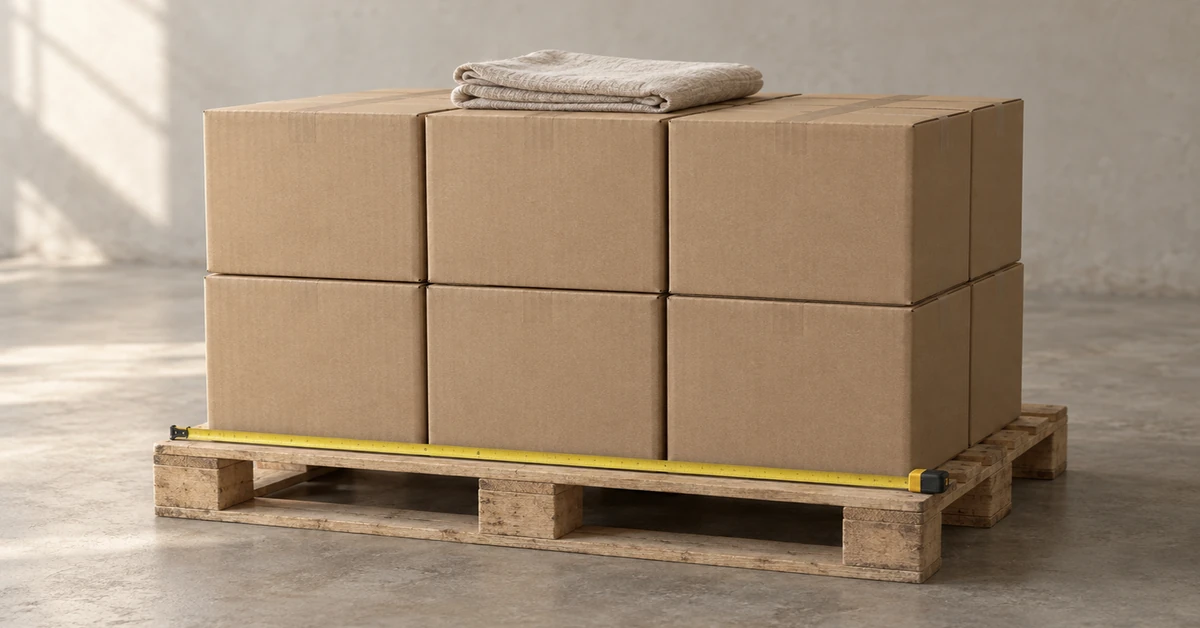
Plenty of factories perfect the carton and leave the pallet to whoever happens to load the truck. That is the wrong way round. How many cartons travel at once is decided by carton dimensions, stacking strength and whatever overhang the receiving warehouse will tolerate.
Two cartons holding identical units can land fifteen per cent apart on freight, because one stacks flush and the other leaves a void. On a sewing kits wholesale range, where retail packs are small and numerous, the pallet pattern is often worth more than the unit-price concession a buyer spends a month chasing.
A travel sewing kit manufacturer runs into this sooner than most. A small flat pack looks efficient in isolation and turns awkward the moment it is stacked. The number that matters is not the carton itself but how many of those cartons sit on one pallet with no overhang.
What one extra reference really costs
A line added to a shipment never costs only the space it takes up. It wants its own carton marks, its own slot in the picking sequence, its own row on the packing list and often its own tier on the pallet because it cannot sit beside something heavier.
Anyone building out private label sewing kits is choosing between two shapes of range. Ten references in modest depths fill a shelf and cost more per unit to move than four references bought deep. Neither is a mistake. The freight bill attached to each one should be on the table while the range is still being drawn, not discovered weeks later at booking.
Ranges of sewing kits for retailers tend to resolve it with two or three sizes that share a single carton footprint, so the pallet pattern holds steady even when the mix underneath it changes.
Two dates that never appear on a production schedule
Every shipment carries two dates that matter: the day the cargo must be at the port, and the day it had to be booked. The second one is always earlier than anyone assumes and it appears nowhere on a production plan.
Put the booking cut-off on the same calendar as the production milestones and treat it as one of them. When packing slips, the shipment does not slip by the days that were lost; it slips by a full cycle, because the next slot has already gone. That lost week is the most common hidden cost in retail sourcing, and no quotation ever carries it.
Insurance and the value you put on the form
Cargo cover is priced on declared value, which normally means invoice value plus freight. Writing that number down to save premium is a popular economy and a bad one, since a claim settles against the declaration rather than against what the goods would have sold for.
With craft goods the exposure rarely stops at the product. A damaged sewing kit factory China consignment can also ruin packaging that cannot be replaced in time, which converts a partial loss into a missed season. Nobody insures that second loss unless the buyer asked for it in advance.
Marks that let the dock work from outside the box
A shipment is either received quickly or counted twice, and the dock decides which. Marks carrying the destination, the reference and the carton sequence let a receiver work from the outside of the box, which is the only surface available to them.
Where cartons or pallets carry their own identifiers, GS1 standards are the usual reference so that scanning a pallet and scanning a carton do not produce the same answer. Buyers who plan for a handheld scanner get a faster dock and a cleaner inventory file.
Damaged cartons: what the photographs must show
- The whole carton, before anything is moved, with the marks readable.
- The damaged face in relation to the pallet and the load above it.
- The inner retail packs, because outer damage does not always reach the saleable unit.
- The count of affected units, not an estimate of how bad it looked.
- The container or trailer reference, so the claim can be tied to a movement.
A claim is a document-driven process. Photographs taken after the carton has been opened and emptied are the most common reason a legitimate loss is not recoverable.
Buying to the pallet rather than to the budget
Quantity is the last decision, and most buyers take it in the wrong sequence: fix a budget, then pick a number that fits it. Run it the other way instead. Work out the volume that fills a pallet cleanly, price that, and check the budget against the answer, because the tidy quantity frequently costs less per unit than a smaller order that leaves half the pallet bare.
- The pallet multiple, meaning the quantity that fills a pallet with nothing hanging over the edge.
- The container multiple, meaning the quantity that leaves no stranded corner in a load.
- The smallest run that still justifies the tooling and the artwork.
- What the shop can honestly sell before the next buying window opens.
A portable sewing kit supplier can usually shift the pack count to suit a pallet multiple without altering the product at all, which leaves this as one of the few variables still available late in the process. It is worth more than a token discount, because nothing about a discount can be revisited once the goods exist.
How Onehourcrafts plans a shipment before quoting freight
Onehourcrafts measures carton dimensions and weights from the real pack specification, tests the pallet pattern before anything is loaded, and puts chargeable volume next to the unit price. A buyer comparing quotations then sees what the goods cost and what moving them costs on one page, instead of two figures pulled from two different conversations.
The kits this applies to are listed on the sewing kits page, and the longer sourcing notes are gathered in the buying guide.
Four numbers that turn a quote into a route
Send the total units, the destination postcode, the date the goods must be on the shelf and how many separate references sit in the order. Those four lines give a supplier enough to estimate cube, choose a route and price the movement without assuming anything.
Say as well whether the order splits between a warehouse and a shop, because two destinations is a different exercise from one delivery to one dock. A wholesale sewing supplies buyer who sends all four numbers tends to get a route recommendation back rather than a rate card. Send the four numbers and the reply will carry the volume along with the price. More retail planning notes sit on the blog.
Frequently asked questions
Why did freight go up when the order itself did not change?
Typically because the chargeable weight moved. A carrier bills the larger of actual and volumetric weight, so a slightly different pallet pattern can lift a load into a higher bracket while the goods stay identical.
Is sharing a container always the cheaper route?
Only while the volume is small. The advantage thins out as the shipment grows. Price the order both ways at the planned volume and once more a fifth larger, and the crossover shows itself.
What does the volumetric divisor actually do?
It converts volume into a notional weight that can be priced. Because the divisor shifts with mode and carrier, two quotations for one pallet can both be correct and still disagree.
Which comes first, the carton or the pallet?
The pallet. A carton tuned on its own can leave a void that costs more across a container than the material saved on the box.
What does an extra reference cost in freight terms?
More than its own volume. It needs its own marks, its own line on the packing list and often its own pallet tier, and on a mixed craft order that shows up even at small quantities.
What belongs on the packing list of a bulky order?
Measured dimensions, gross weight for each carton type, pallet count and the marks applied. A list copied forward from an earlier order is the usual origin of a dock dispute.
How far ahead should space be booked?
Treat the booking cut-off as a production milestone. When packing slips, the shipment normally loses a whole cycle rather than the few days that packing actually lost.
Does declaring a lower cargo value save anything?
It cuts the premium and the eventual claim by the same proportion. The saving is real and so is the exposure, which is why the figure should reflect what replacement stock would cost on the shelf.
Do pallets need a barcode of their own?
If anyone scans at pallet level, an identifier that differs from the carton and retail barcodes stops the same stock being booked in twice.
What is the quickest way to compare two freight quotations?
Convert both to cost per cubic metre and per retail unit at one volume, then check which trade term each one assumes. Headline totals hide both differences.