

A craft kit batch traceability checklist should let a team answer two questions quickly: which finished kits contain a suspect component, and which materials were used in a reported finished kit? Build one connected genealogy from incoming lots through preparation, assembly, packing and shipment. Record only identifiers that support a real decision, test the chain in both directions, and keep retained evidence that can verify the record when a complaint appears.
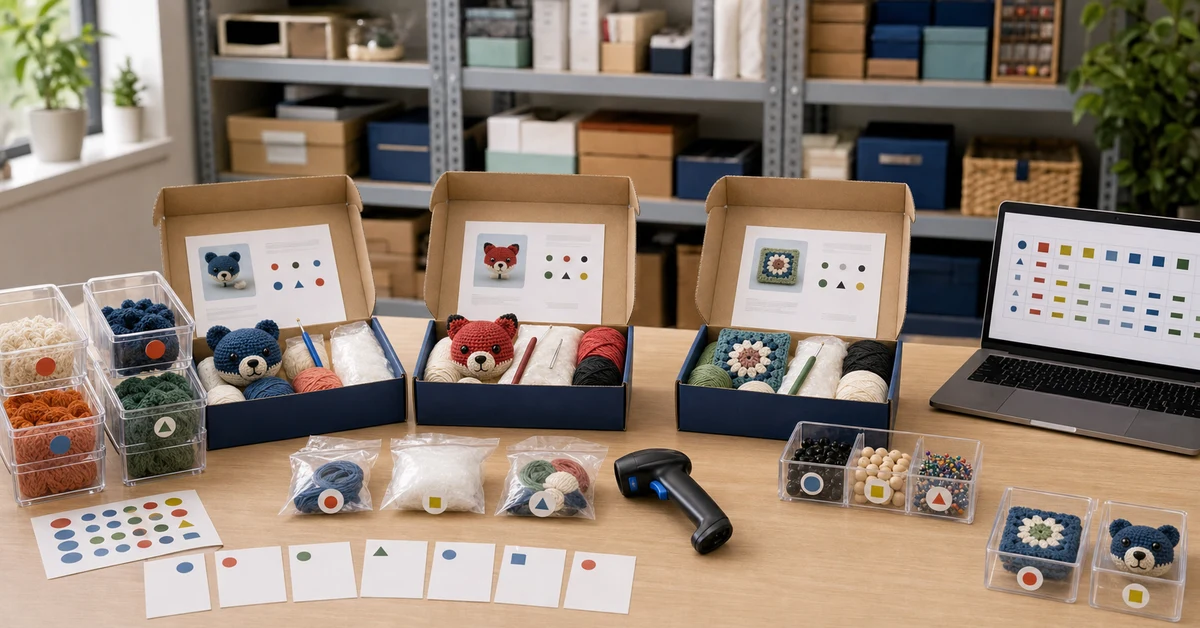
Define the traceability unit before making labels
A “batch” must have a practical boundary. It may be one supplier lot of yarn, one day of kitting, one work order, one packaging print run or a smaller controlled quantity. If the boundary is too broad, a problem affects more stock than necessary. If it is too narrow, workers spend time recording changes that do not improve containment.
| Level | Possible unit | Why it matters | Boundary trigger |
|---|---|---|---|
| Incoming material | Supplier lot or delivery lot | Separates shade, dimension or quality variation | Lot, supplier or receipt changes |
| Prepared component | Cut, wound or counted sub-batch | Links transformed material to source | Setup or input lot changes |
| Assembly | Work order, line and time window | Connects components and process records | Product, shift or material changes |
| Finished kit | Pack batch or case group | Defines inventory and shipment containment | Pack record closes |
| Shipment | Order, carton or destination group | Finds where affected goods went | Dispatch is confirmed |
Choose boundaries by risk and operational reality. Closely matched floss lots may need tighter separation than generic cardboard inserts. A regulated or market-specific requirement may demand additional records; confirm those obligations with qualified compliance support instead of assuming one checklist fits every product and country.
Create one identifier hierarchy
Identifiers should be unique, readable and hard to confuse. Avoid using a date alone when several products or lines can run on the same day. A short structured code can show product family and batch while the database or batch sheet holds the detailed meaning. Do not force workers to retype long supplier descriptions at every step.
- Material ID: the approved component specification, such as a yarn color or hook size.
- Source lot: the supplier's lot or the internally assigned receipt lot.
- Preparation batch: the lot created when material is cut, wound, sorted or bagged.
- Pack batch: the finished-kit group assembled under one controlled record.
- Shipment reference: the order, carton or dispatch record containing that pack batch.
Keep the hierarchy stable across paper and digital records. If the physical label says one code while the spreadsheet uses an unrelated nickname, the trace will depend on memory during a real issue.
Record the minimum incoming evidence
At receipt, connect the physical goods with purchasing and inspection evidence. The record should show what arrived, from whom, in what quantity, under which source lot and what disposition followed inspection. Photograph or retain the supplier label where practical, especially if it contains information that may disappear when outer packaging is removed.
- Verify purchase order, component ID and supplier.
- Assign or confirm the incoming lot identifier.
- Record quantity, receipt date and storage location.
- Link inspection status, nonconformance and release decision.
- Label split containers so identity survives warehouse movement.
- Prevent rejected or unreviewed material from entering kitting.
The supplier quality checklist gives a useful model for defining what evidence belongs at component approval. Traceability does not prove that a lot is good; it proves where the lot came from and where it went.
Preserve identity through preparation
Craft-kit materials are often transformed before packing. Yarn may be rewound into mini balls, floss may be cut and mounted on organizers, fabric may be cut into panels, and stuffing may be portioned into bags. These steps can break the trace if the source label stays on an empty master carton while prepared components move forward without identity.
| Preparation step | Trace risk | Required link | Useful control |
|---|---|---|---|
| Yarn rewinding | Lots mixed in one bin | Source lot to wound sub-batch | Line clearance and labeled containers |
| Floss cutting | Shade or lot swapped | Floss lot to organizer batch | One shade station at a time |
| Fabric cutting | Offcuts lose identity | Roll lot to cut-panel batch | Traveler retained with stack |
| Hardware bagging | Similar sizes mixed | Hardware lot to bag batch | Count and measurement verification |
| Instruction printing | Wrong revision packed | File revision to print lot | Approved master and issue control |
When two input lots must feed one preparation batch, record both and define the quantity or time boundary if possible. Avoid silent mixing. It expands the affected population and makes later comparison harder.
Connect every pack batch to its inputs
The kitting record is the center of the genealogy. It should identify the product and revision, pack batch, date or time window, work area, responsible team, input component lots, packaging lots, quantity started, quantity completed, rejects and reconciliation. It should also record any approved substitution.
- Scan or write the input lot when it is introduced to the line.
- Close the previous lot before opening a new one.
- Record the exact change point when practical.
- Verify line clearance between product or revision changes.
- Reconcile high-risk or easily omitted components.
- Link final inspection and release to the pack batch.
Pair this record with the controls in preventing missing parts in craft kits. Completeness control asks whether every kit contains the right items. Genealogy control identifies which material and work record produced those items.
Put a retrievable code on finished goods
A code is useful only if it survives distribution and customer handling long enough to support the intended response. Choose a location that can be found without destroying the product, such as the outer box, a label, an insert or a component bag retained with the project. The code does not need to expose internal supplier information, but customer service must know where to find it.
Check the finished identifier for:
- Legibility at normal size and contrast.
- Resistance to rubbing, sealing and ordinary pack handling.
- Clear distinction from SKU, artwork revision and other numbers.
- Correct mapping to the internal batch record.
- Consistent placement shown in customer-service guidance.
For marketplace or retail shipments, keep the internal batch-to-order relationship even if the consumer-facing code remains compact. A sales order number alone is insufficient when the same order contains several production batches.
Maintain retained samples that answer questions
A retained sample turns the paper trail into physical evidence. Keep an unopened finished kit from defined pack batches and, where risk justifies it, small material samples from important input lots. Label them with the same identifiers used in the records and store them away from conditions that could change color, moisture or shape.
- Define which batches require a finished retained kit.
- Define which component lots require a material swatch or specimen.
- Record retention location, quantity and disposal date.
- Control access when a sample is opened for investigation.
- Photograph the sample and update remaining quantity after use.
Retention periods should reflect product life, reorder cycle, complaint timing and applicable obligations. Keeping everything forever is not automatically better; uncontrolled storage can create unlabeled material that looks useful but cannot be trusted.
Run backward and forward trace drills
Do not wait for a defect to discover that the record chain stops at a spreadsheet tab or unlabeled bin. Select a finished kit code and trace backward to its component lots, inspection results and approved product revision. Then select one incoming lot and trace forward to every preparation batch, pack batch, storage location and shipment that used it.
| Drill | Starting point | Required endpoint | Failure signal |
|---|---|---|---|
| Backward trace | Finished kit code | All input lots and release evidence | Unknown component or ambiguous revision |
| Forward trace | Incoming component lot | All affected stock and shipments | Unbounded quantity or destination |
| Quantity check | Received or prepared amount | Used, rejected, remaining and sampled amount | Unexplained balance |
| Record retrieval | Complaint time | Evidence within target response time | Dependence on one person's memory |
Time the exercise and record gaps. The goal is not a ceremonial pass. It is to reduce the affected population and support a reliable decision. Repeat after system, supplier, label or process changes.
Use complaint evidence without losing the batch link
Customer service should request the finished code, order reference, product photos and a concise description of the issue. Preserve the original wording, then classify the problem. Compare the report with retained samples, batch records and other complaints from the same or neighboring batches.
- Confirm product and finished batch identity.
- Check whether the issue could affect safety, compliance or broad containment.
- Review retained and current stock from the same genealogy.
- Search for related reports by component lot, pack batch and shipment.
- Document containment, investigation and disposition decisions.
- Feed verified causes into the product or process control.
The craft kit return reduction checklist explains how to turn recurring complaints into corrective action. Traceability narrows the evidence set so teams can distinguish an isolated packing error from a lot-related pattern.
Where Onehourcrafts fits
Onehourcrafts can work with retail buyers to define practical batch records for custom craft-kit components, preparation and packing. A useful inquiry identifies product revisions, high-risk components, required markets, expected order size, packaging code location and the retailer's own order references. Buyers can request retained samples and trace records as part of pilot and bulk approval. The craft kit batch traceability checklist should remain linked to the current bill of materials and packaging revision.
For new programs, define the record chain while the bill of materials and packing process are being built. Adding codes after production starts can label finished cartons without recovering the missing connection to input lots. A controlled craft kit unboxing test can also verify that the customer-facing code remains findable after the package is opened and components are removed.
Frequently asked questions
Does every craft-kit component need a separate lot code?
Not necessarily. Use risk, variability and containment value to decide the level. Important materials, visually sensitive lots and components tied to compliance or common failure modes may need tighter control than low-risk generic packaging.
Can a spreadsheet provide adequate lot tracking?
It can for a simple, controlled operation if identifiers, access, versioning, backups and physical labels remain reliable. The system should be tested by trace drills rather than judged by software complexity.
Where should the finished batch code appear?
Place it where warehouse, retailer, customer service and the customer can locate it without confusion. Confirm legibility and durability through normal packing and distribution handling.
How many retained samples are needed?
Set the plan by product risk, batch structure, reorder cycle, investigation needs and applicable requirements. Define what is retained, where, for how long and how use of a sample is recorded.
How often should a traceability drill be run?
Run drills at planned intervals and after meaningful changes to suppliers, systems, batch boundaries, labels or processes. Repeat sooner when an exercise exposes gaps or retrieval depends on informal knowledge.
Keep the genealogy usable under pressure
A practical craft kit batch traceability checklist connects component identity, transformation, packing, retained evidence and shipment without recording data that nobody can use. Validate the chain backward and forward, measure retrieval time and correct every ambiguous boundary. When a problem occurs, the team can then contain the right goods and investigate with evidence instead of assumptions.