
Plan embroidery kits for craft stores by letting a staffer name the next stitch. Shoppers rarely arrive with a complete product specification; they bring a project idea, a time boundary, a gift need or a concern about starting. Onehourcrafts uses short recommendation rehearsals to test whether the range, packaging and training language help staff guide a real choice.
Collect shopper cues before product names
Write four short shopper openings: “I have never embroidered,” “I need a small gift,” “I want a project for the weekend,” and “I need a refill for a project.” Ask staff what they would need to know before naming a kit.
This keeps the range anchored in questions rather than in internal SKU language. A recommendation is useful when it reduces the shopper’s next uncertainty.
- Experience level
- Time or occasion
- Finished-object preference
- Support needed
Create a three-sentence recommendation
Ask a staffer to describe one kit in three sentences: what it makes, who it suits and what the shopper does first. Record words that feel natural and words that require an expert translation.
For embroidery kits wholesale, keep the sentence card beside the physical sample. The goal is not a script every employee must recite; it is a shared floor for comparing pack claims with spoken advice.
| Sentence | Should answer | Evidence to keep |
|---|---|---|
| Outcome | What will I make? | Finished reference |
| Fit | Is it for me? | Skill and support cue |
| Start | What happens first? | Opened pack and first step |
Test skill language at the shelf
Replace vague labels such as “easy” with observable cues: count of colors, first action, tool included, chart style or expected support. Language should guide without promising a universal experience.
A beginner may prefer a simple image but still need help with thread control. When comparing an embroidery starter kit manufacturer, capture the support question instead of hiding it behind a rating word.
Use the same cue across pack, shelf card and staff note. Inconsistent wording creates a second product story at the point of recommendation.
Let the staffer compare two adjacent kits
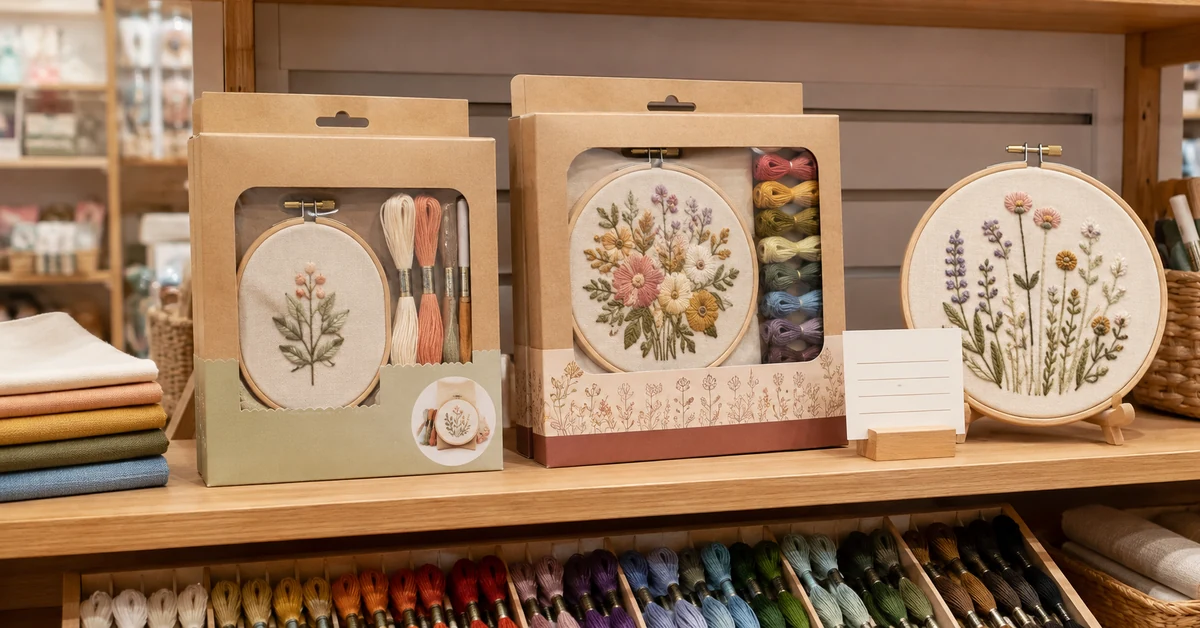
Place a starter kit beside a more detailed kit and ask staff to explain the difference without mentioning price first. Listen for whether the comparison is about project scale, chart density, color count or finishing.
The exercise exposes whether the range has progression or merely multiple designs. A good ladder lets staff recommend a next step without implying that one level is “better” for every shopper.
Keep the comparison grounded in the actual contents. An attractive finished photo should not do all the explanatory work.
Use the opened pack as a training object
Open one production-intent unit and mark where staff find the project image, thread, needle, hoop and instructions. Ask a new employee to reset the pack and explain the order.
The reset matters because retail teams change. A pack that only makes sense to the person who first opened it will create support friction and inconsistent recommendations.
If the unit is not designed for reopening, document the boundary. Do not ask a supplier to make a retail promise that the packaging cannot physically support.
Rehearse the gentle objection
Practice responses to “I do not have much time,” “I am buying for a child,” “I only need a small project,” and “What if I get stuck?” The answer should draw from the released range and support boundary.
A good response can be honest about what the kit includes, what the store can explain and what remains the customer’s choice. It does not need a dramatic assurance to be useful.
Record unanswered objections as product or training gaps. Do not turn every question into a reason to add another SKU.
Build the add-on boundary
Decide which add-ons genuinely help the project: a storage pouch, extra fabric, a frame or a gift card. Place them beside the kit and ask whether staff can explain why they are optional.
For embroidery kits for retailers, optionality is part of trust. A shopper should know whether the add-on is required, helpful or purely decorative.
| Add-on type | Staff wording | Buyer check |
|---|---|---|
| Required | Needed to begin | Confirm not hidden from pack |
| Helpful | Supports a declared use | Keep choice visible |
| Decorative | Changes presentation only | Avoid implying necessity |
| Refill | Extends a named project | Match identity and variant |
Check the shelf from a new employee view
Give a new staffer the shelf for five minutes without a product briefing. When reviewing embroidery kits for craft stores, ask them to find a starter option, a gift option and a next-step option. The search route shows whether pack cues carry enough meaning.
Do not score the person as if this were an exam. The useful output is the shelf language and product identity that failed to travel.
Use the result to adjust placement, card wording or training. A wholesale change is not always the answer; sometimes a small identity cue closes the gap.
Record questions as range evidence
Create a simple question log with date, kit, shopper cue, answer used and unresolved point. Review it with the buyer and supplier at an agreed interval.
A question log is not a demand forecast. It is evidence about where the product story needs clarity, and it can reveal a missing progression or an instruction detail worth revisiting.
Keep the log tied to the exact version. A changed artwork or component list can make an old question irrelevant or create a new one.
Use authoritative guidance carefully
The CPSC business guidance can frame why product and audience questions deserve documented review. It does not classify or approve a particular embroidery kit.
For identity and retail data, the GS1 barcode standards overview offers a reference point. Implementation remains the buyer’s responsibility for the destination market.
Keep legal, safety and age claims within qualified review. Staff language should describe the released product and support boundary without making unsupported assurances.
Make training fit the store rhythm
Choose a five-minute rehearsal that can run before opening or during a range reset: one shopper cue, two kits, one add-on and one honest limitation. Short practice is more likely to survive a busy retail day.
Ask staff to rotate roles so the product story is not owned by one enthusiastic specialist. The range should remain explainable when the usual expert is absent.
Keep a dated card with the approved wording and version. Update it when the supplier changes a component, instruction or pack claim.
Plan the shelf reset after a sale
Observe what happens when a kit is removed, opened for demonstration or returned to the wrong place. The next staffer should be able to restore the shelf without losing progression or variant identity.
Reset evidence connects recommendation to replenishment. A kit that sells well but repeatedly returns to the wrong slot can create avoidable stock and customer confusion.
Use the 30-second shelf-clock guide, the craft-kit skill-level guide and the project inquiry page as internal context, then document the store’s actual shelf boundary.
Write the buyer brief from the conversation
State shopper cues, skill language, progression, staff cards, add-on boundaries, opened-sample rules, shelf reset and question-log ownership. This turns training observations into a supplier conversation.
Request pack copy and finished-object references that support the exact recommendations the store intends to make. Do not ask the artwork to carry a promise that staff cannot explain.
- Collect real cues
- Rehearse three sentences
- Compare adjacent kits
- Log questions and resets
- Approve the explainable range
How Onehourcrafts helps staff recommend honestly
Onehourcrafts can align kit contents, finished references, skill cues, optional add-ons and staff questions into a retail file. The range becomes easier to explain without overclaiming what every shopper will experience.
Before approving embroidery kits for craft stores, ask a new staffer to recommend a starter, gift and next-step option from the released shelf. Keep the response card with the pack reference and update it when the product changes.
- Shopper cue card
- Three-sentence recommendation
- Opened-pack reference
- Question log
Frequently asked questions
What should staff know before recommending an embroidery kit?
They should know the finished outcome, fit cues, first action, included tools and the boundary of store or instruction support.
Why use shopper cues instead of SKU names?
Cues reflect how people ask for help and make the range easier to compare across packs and channels.
Are “easy” and “beginner” good shelf labels?
They can be vague. Use observable cues about first action, support, tools, colors or chart style instead.
How should two adjacent kits be compared?
Explain the actual differences in project scale, chart density, color count, tools and finishing without assuming one suits everyone.
What is a three-sentence recommendation?
It states what the kit makes, who it suits and what the shopper does first.
Should every add-on be displayed as required?
No. Mark add-ons as required, helpful, decorative or refill so shoppers can choose with accurate expectations.
How can a store train new staff quickly?
Use short, repeatable rehearsals with real packs, two shopper cues, one comparison and one honest limitation.
What belongs in a retail question log?
Record the shopper cue, kit version, answer used, unresolved point and date for review.
Does CPSC guidance approve an embroidery kit?
No. It can frame documented product and audience review questions, while the buyer remains responsible for the specific market requirements.
What belongs in an embroidery kit RFQ for stores?
Include shopper cues, skill progression, pack language, finished references, add-ons, staff training, reset rules and question ownership.