
A useful craft kit cost breakdown starts with one comparable finished unit, then separates materials, kitting labor, instructions, packaging, quality controls and logistics. The goal is not to force every supplier into the lowest number. It is to expose what each quotation includes, what it excludes and which assumptions could change after sampling.
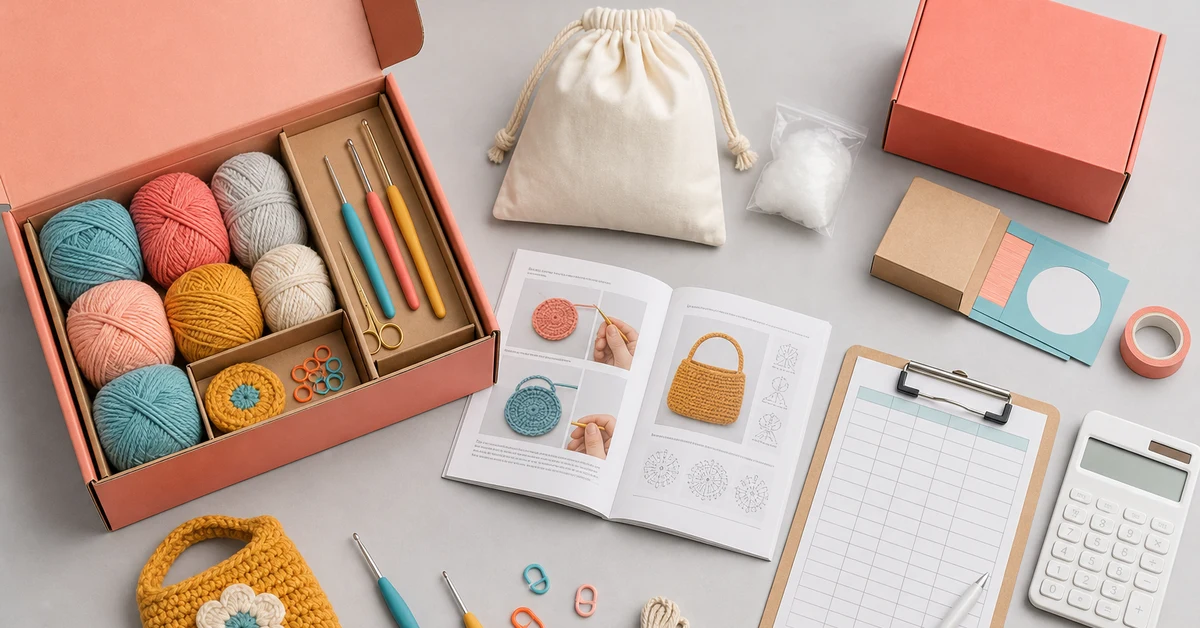
Buyers often receive quotations that look comparable because each line ends with a unit price. They may still describe different products. One quote may include a printed manual, barcode label, inner protection and final inspection. Another may assume a plain insert, generic bag and buyer-arranged labeling. The difference appears later as a sample revision, packaging surcharge or quality dispute.
Start with a comparable finished unit
Write a one-page commercial definition before asking for price. It should describe the product that reaches the retailer, not only the loose components leaving a workbench. For a crochet kit, that definition may include yarn specification and color count, hook material and sizes, accessory list, finished-project reference, instruction format, retail packaging, label requirements and shipping configuration.
Use three boundaries to keep quotes aligned:
- Product boundary: every component required for the user to complete the stated project.
- Presentation boundary: the package, inserts, protective materials and retail identification applied before shipment.
- Delivery boundary: the agreed point at which responsibility and cost transfer from supplier to buyer.
If a supplier cannot identify the assumed boundary, the price is not yet decision-ready. Ask for exclusions in writing. A clear exclusion is easier to manage than an attractive number built on an unstated assumption.
Build the seven-block cost tree
| Cost block | Main drivers | Evidence to request |
|---|---|---|
| Core materials | Yarn fiber, weight, color count, hook material, accessory grade | Bill of materials, specifications and approved samples |
| Conversion | Cutting, sorting, winding, printing, assembly and finishing steps | Process flow and operations included in the quote |
| Kitting labor | Part count, count method, compartments, manual insertion and sealing | Pack-out standard and component checklist |
| Instructions | Writing, diagrams, photography, translation, page count and revisions | Instruction scope, file ownership and revision allowance |
| Packaging | Box or bag format, print coverage, inserts, labels, case packing | Dieline, material specification and packing configuration |
| Quality and compliance | Incoming checks, in-process controls, final inspection and required testing | Inspection plan, test scope and responsibility matrix |
| Logistics | Carton size, unit cube, case quantity, palletization and delivery term | Carton data, gross weight and named delivery term |
This tree prevents a common error: treating visible materials as the whole product cost. A kit with many inexpensive parts can require more counting, line clearance and pack verification than a kit with fewer expensive parts. The labor and defect-risk profile matters alongside the material total.
Use a should-cost range, not a fictional perfect price
A should-cost model is a range of reasonable cost, not a claim that the buyer knows the supplier's exact margin or factory efficiency. Build it from quantities and observable requirements. Separate known inputs from assumptions, and label the confidence of each line.
A practical worksheet can use this logic:
Expected unit cost = specified components + conversion and kitting + instructions and packaging + quality requirements + allocated setup + delivery-scope costs.
Keep setup charges separate when they do not repeat on every order. Artwork preparation, printing plates, molds, testing and translation may be one-time, periodic or revision-based. Spreading all setup across the first small order can make the unit price look unusually high; hiding setup inside a future volume promise can make the first quote look artificially low.
Compare an indexed scenario before using currency
An indexed model helps a team discuss priorities without pretending to know confidential supplier costs. Set the current product at 100 cost points. Then model changes relative to that base.
- A second yarn color increases material handling and may add a new winding or picking step.
- A compartment tray may add packaging cost but reduce movement, presentation damage and missing-part risk.
- A longer instruction manual may add print cost while reducing customer service contacts and negative reviews.
- A smaller carton may require packaging redesign but improve storage and freight efficiency.
The decision is not whether every enhancement reduces the factory price. It is whether the total product economics improve after customer experience, returns, freight, shelf presentation and replenishment are considered.
Find the cost changes that appear after sampling
Late cost movement usually comes from an incomplete brief or an untested assumption. Review these items before sample approval:
- Material substitution: confirm whether the quote is tied to an exact specification or a general description.
- Color and print approvals: define the number of colors, finishes and proof rounds included.
- Component count: lock the master list and acceptable spare quantities.
- Retail labels: specify barcode, country, warning, language and customer-specific labels.
- Carton assumptions: confirm units per case, dimensions, weight and protective method.
- Inspection scope: state which checks are routine and which require an external service or laboratory.
The OEM craft sampling timeline guide explains why commercial assumptions should be closed during sampling rather than after purchase-order release.
Normalize supplier quotes on one page
Create a comparison sheet with one row per requirement and one column per supplier. Do not compare only total price. Record specification accepted, included quantity, packaging format, setup charge, sample allowance, inspection scope, carton data, delivery term, lead-time assumption and validity period.
Add a status for each line:
- Confirmed: supported by the quotation, specification or sample.
- Assumed: reasonable but not yet documented.
- Excluded: buyer or another vendor must provide it.
- Open: the answer can still change cost, timing or risk.
This makes negotiation more productive. Instead of asking a supplier to reduce an unexplained total, the buyer can ask whether a packaging feature can change, whether a setup charge can be amortized, or whether a component specification is stronger than the customer actually needs.
Protect value while removing unnecessary cost
Cost reduction should preserve the reason the product exists. Remove duplication before removing user value. Examples include combining inserts, standardizing color ranges, using a common organizer across several kits, simplifying decorative print coverage or aligning case quantities with the retailer's replenishment pattern.
Be cautious with changes that make the product harder to complete or verify. Reducing spare yarn, deleting a sizing tool, replacing clear diagrams with dense text, or removing count controls may lower a visible line while increasing complaints or returns. Review the craft product compliance requirements guide before treating required labels or testing as optional savings.
Review the cost after the first retail cycle
The quotation is only the opening version of the model. After launch, update the craft kit cost breakdown with real receiving, storage, damage, return, replacement and markdown evidence. A packaging choice that looked expensive may prove valuable if it reduces damage and keeps components organized. A decorative feature may prove unnecessary if customers do not notice it or retailers cannot display it.
Keep supplier performance separate from product-design performance. Late delivery, incorrect labels and unstable quality require supplier action; low conversion or customer confusion may require changes to the concept, instructions or presentation. This distinction prevents price negotiations from being used to solve the wrong problem.
Use the updated model for the next reorder or range extension. The result is a learning loop: specification creates cost, retail evidence tests value, and the next specification preserves what matters while removing what does not.
Where Onehourcrafts fits
Onehourcrafts supplies OEM/ODM crochet DIY kits with options for component combinations, instruction manuals, custom packaging, private labels and barcode labeling. A productive quotation starts with the target user, channel, project outcome and pack-out standard.
Buyers can also review the private-label sourcing plan, OEM packaging options and crochet kit MOQ guide before sending an inquiry.
Final decision rule
A strong craft kit cost breakdown lets the team explain why two prices differ and what tradeoff each difference creates. Approve the quote that defines the product, evidence and delivery scope clearly enough to survive sampling, production and retail use. If a low price cannot be traced to a controlled specification, it is an unresolved risk rather than a saving.
Frequently asked questions
What should be included in a craft kit supplier quotation?
Include the component specification, quantities, kitting, instructions, packaging, labels, inspection scope, setup charges, carton data, delivery term, lead-time assumption and quotation validity. List exclusions separately.
Why do two craft kit suppliers quote very different prices?
They may be quoting different materials, quantities, packaging, quality controls or delivery scopes. Normalize the assumptions before deciding that one supplier is simply cheaper.
Should testing and inspection be included in unit cost?
Show them as separate cost blocks first. Some checks repeat with every order, while laboratory testing or third-party inspection may apply only to specific products, markets or production lots.
How should setup charges be compared?
Identify whether each charge is one-time, revision-based or recurring. Compare both the initial cash requirement and the unit economics at realistic order volumes.
Can a buyer reduce cost without reducing quality?
Often yes, by standardizing components, simplifying decorative packaging, improving carton efficiency or removing duplicated inserts. Validate any change against user completion, presentation, compliance and defect risk.