
Review a felting starter kit manufacturer by reading the project shadow before admiring its face. A finished animal can look charming because color and details distract from a body that is flat, unstable or difficult for a beginner to reproduce. Onehourcrafts uses silhouette cards, rotation views and staged fiber evidence to make three-dimensional recognition testable before decoration begins.
Choose the shadow that must remain recognizable
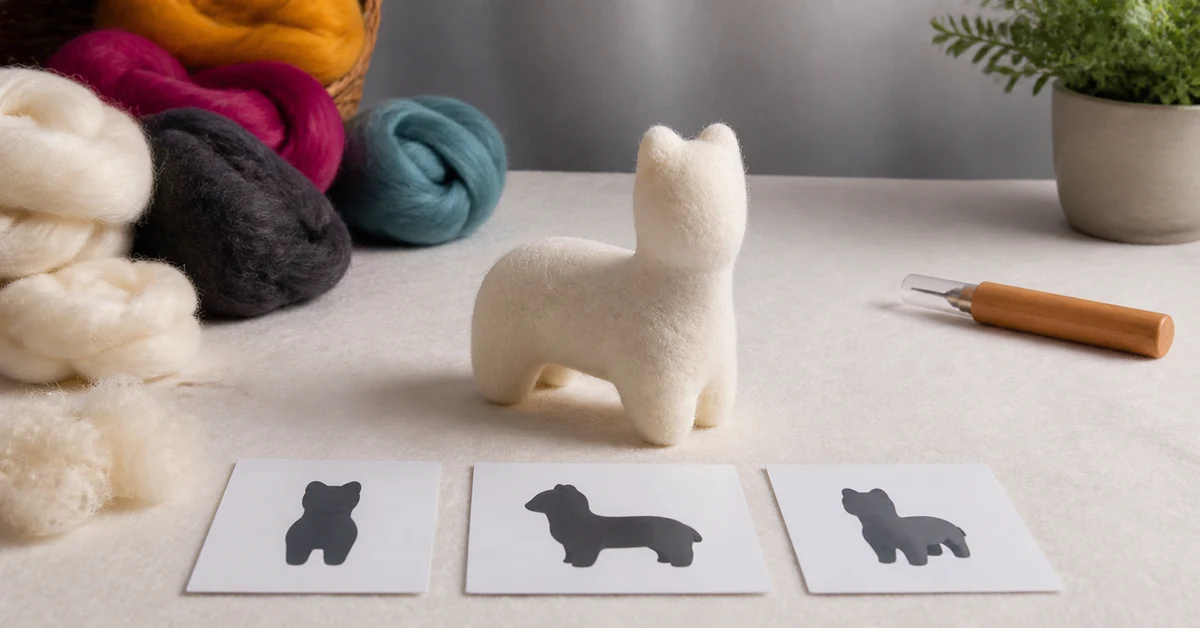
Place the approved model against a simple background and capture its front and side silhouette. Remove color and facial cues from the review, then ask which masses make the subject recognizable.
The silhouette is not a universal beauty standard. It is a controlled reference for this design, audience and finished-size promise.
Divide the form into buildable masses
Break the subject into body, head, limbs, ears, tail or other meaningful forms and show the order in which they join. Each mass needs a visible checkpoint before the next layer hides it.
A beginner should not need to infer a complex sculpture from one polished photograph. Staging reduces the number of proportions held in memory at once.
Use three rotations instead of one hero angle
Approve front, side and three-quarter views of the same physical model. A form can match from the front while being too thin, unbalanced or misplaced in depth.
Keep camera height and scale consistent enough for comparison.
| View | Question | Common hidden issue |
|---|---|---|
| Front | Are width and symmetry readable? | Head or limbs drift sideways |
| Side | Is depth sufficient? | Body becomes flat or nose projects too far |
| Three-quarter | Do joined masses relate? | Appendages sit on different planes |
| Base view | Can the object rest as promised? | Balance or finish remains unresolved |
Weigh fiber by stage, then preserve a physical cue
Allocate fiber to structural masses and surface colors using project-specific sample evidence. Keep labeled stage bundles or photographs beside the completed reference.
The staged fiber-weight guide explores quantity control. For felting silhouette calibration, the important question is whether each stage has enough material to reach the approved mass without stealing from later details.
Let the core become firm before it becomes pretty
Define a tactile and visual checkpoint for the basic body before adding color patches, eyes or accessories. Surface decoration should not conceal a core that is too soft, thin or uneven for the intended form.
Avoid prescribing one universal firmness value. Use physical references and handling observations tied to the chosen fiber, tool and design.
Put appendages on a coordinate system
Show the attachment positions relative to stable landmarks such as centerline, head base or body midpoint. A close-up of one ear does not explain its relationship to the other ear and the whole silhouette.
Use temporary placement checks before full attachment where the technique allows. The learner needs a low-cost correction moment before the form becomes difficult to change.
Design the needle-access map
Identify where the felting tool must enter, at what general working orientation and which areas become difficult after assembly. Arrange the instruction sequence so one appendage does not block the next required working area.
Tool selection, sharp-point handling, age positioning and destination requirements need configuration-specific review. Do not generalize from a studio prototype.
Build a safe pause state for unfinished forms
A partly felted mass, loose fibers and sharp tool need defined containment when the maker stops. Test how the work returns to packaging or another declared storage method without losing stage identity.
The retail-ready felting needle-custody guide focuses on the tool handoff. A beginner needle felting kit should make both the tool and the fragile unfinished shape recoverable.
Delay the eyes until proportion passes
Faces attract attention and can create false confidence. Ask testers to approve body and head silhouettes before eyes, nose, mouth or blush are added.
This gate helps reviewers discuss proportion rather than taste. Keep one undecorated reference for training and production investigation.
Turn common shape drift into correction cards
Collect the few errors that most affect recognition: flattened body, oversized head, misaligned ears or thin connection. Show the symptom, likely stage and a bounded correction path.
Do not promise every form can be rescued. State when adding fiber, compressing further or restarting a component is appropriate for the approved method.
- Flat silhouette
- Uneven paired appendages
- Weak mass connection
- Surface detail added too early
Test recognition without telling the subject
Show unfinished and finished silhouettes to uninvolved observers and ask what form they see, which direction it faces and whether it appears stable. Record unprompted answers.
Recognition testing cannot guarantee one interpretation, but repeated confusion exposes reference or construction problems before packaging locks the promise.
Keep color from rewriting the approved form
Color patches can visually widen, shorten or divide a mass. Review the same physical model in neutral silhouette and full color so design and structure remain distinguishable.
Use the fiber color-recipe guide when color identity matters. A change in fiber shade or placement may require renewed recognition review.
Inspect stage evidence, not only completed animals
The ISO quality management principles supports process discussion without approving a product. Agree checks for fiber identity, quantities, tool condition, instructions, component containment and sample-stage consistency.
Retain core, pre-detail and completed references where practical. The evidence helps locate whether drift begins in allocation, shaping, attachment or surface work.
Write the RFQ as a shape-learning route
State audience, destination, subject, finished dimensions, fiber stages, tool and surface, pause method, instructions, packaging, quantity scenarios and evidence. Use the other-crafts collection for category context.
Ask for front, side, three-quarter and undecorated samples as starter felting kit evidence, not only a finished beauty image.
- Freeze the approved silhouette
- Divide the build masses
- Place rotation checkpoints
- Test beginner shape drift
- Release the staged kit file
Pass the unfinished form to a second beginner
Stop the first maker after the core and one appendage have reached their checkpoints. Give the contained project, current instructions and stage references to a second beginner without an oral briefing, then observe whether the new maker can identify the front, the next attachment and the remaining fiber roles.
This relay exposes continuity problems that a single uninterrupted session can hide. Record mistaken orientation, lost stage identity, fiber mixing, tool-parking confusion and any instruction image that the second maker must reinterpret.
Sharp tools and intended-user decisions need configuration- and destination-specific assessment. The CPSC business education resources can frame relevant US business questions but does not approve a product or replace qualified review.
For a felting starter kit manufacturer, the handoff evidence connects three-dimensional shape learning with pause containment. The goal is not to prove that every beginner works identically; it is to show whether the released kit preserves a readable next step when the original maker is no longer present.
Photograph the project exactly as the second maker receives it and again after the next checkpoint. Those paired views help reviewers separate inherited shape drift from a new instruction or handling problem without relying on memory.
How Onehourcrafts keeps detail behind the shape gate
Onehourcrafts can align silhouette views, staged fiber, attachment landmarks, access order, pause state and correction cards in one approval record. Shape learning remains visible beneath decorative appeal.
Before approving a felting starter kit manufacturer, remove the eyes and color from the conversation. If novice testers can build and recognize the intended form from several angles, the kit has a stronger foundation for packaging, sampling and quotation.
- Neutral silhouette
- Three rotation views
- Undecorated mass reference
- Finished approved model
Frequently asked questions
Why evaluate a felting kit by silhouette?
Silhouette removes color and facial distraction, making proportion, depth, appendage position and recognition easier to compare.
Which views should a sample include?
Front, side and three-quarter views are useful, with a base or resting view when stability is part of the promise.
How should fiber be divided for beginners?
Use project-specific staged allocations tied to buildable masses and keep physical or photographed references for each stage.
When should facial details be added?
After the main silhouette and mass relationships pass the approved checkpoint, so decoration does not hide structural drift.
What is a needle-access map?
It identifies where the tool must work during each stage and orders assembly so completed parts do not block later access.
How should an unfinished project be stored?
Define containment for the sharp tool, loose fiber and fragile form and test the actual pause-and-return sequence.
Can every misshapen felt piece be corrected?
No. Provide bounded recovery guidance for likely errors and state when a component should be rebuilt under the approved method.
Does recognition testing prove all customers will agree?
No. It reveals repeated confusion under a controlled review and helps compare design or instruction revisions.
What should incoming inspection prioritize?
Prioritize fiber and tool identity, quantities, containment, instruction revision and risk-based comparisons with staged references.
What belongs in a starter-kit inquiry?
Include audience, destination, subject, dimensions, fiber stages, tools, working surface, pause method, pack, quantities and evidence.