
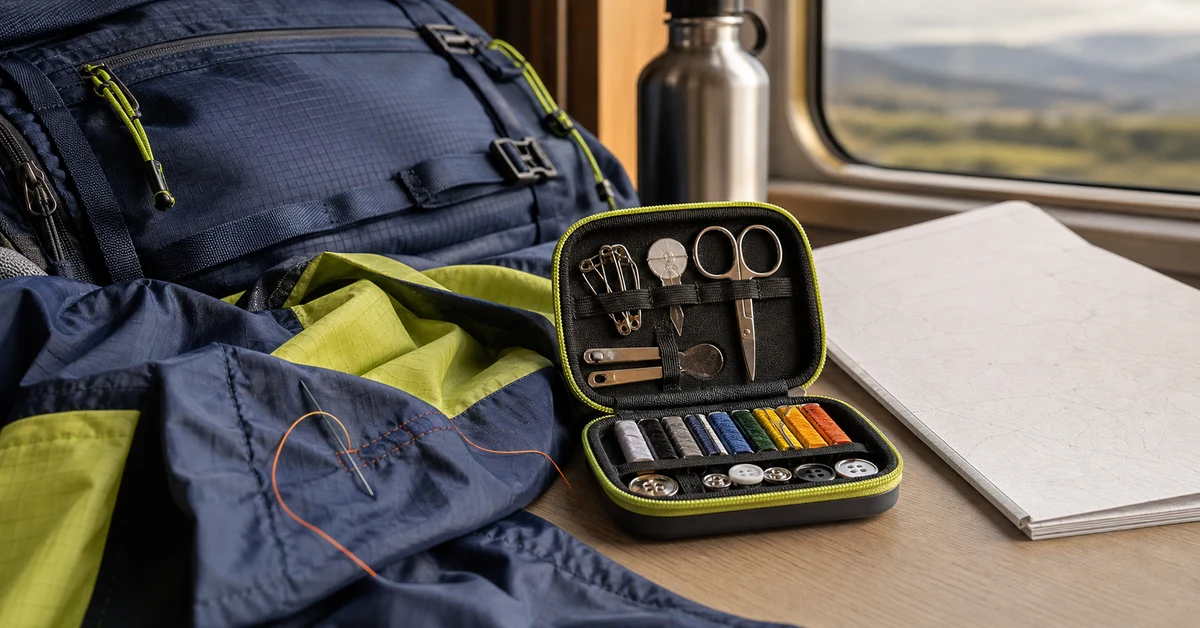
Travel sewing kit product design should start with repairs a traveler can realistically complete, then assign limited pack space to the tools that make those repairs possible. A compact case is not valuable because it contains many pieces. It is valuable when the user can identify, handle and store the right pieces under imperfect conditions.
Write the repair jobs before the parts list
Choose the settings and failures the product promises to address. A hotel clothing repair, a loose backpack seam, a missing button and a camping garment tear impose different demands. Define what the user is likely to repair, how much time is available, the lighting conditions and the skill assumed. Exclude jobs that require specialist equipment or create an unsafe expectation.
A useful brief may include four primary jobs: reattach a shirt button, close a short opened seam, secure a small hem and make a temporary tear repair. Secondary jobs might include removing a loose thread or fastening fabric with a safety pin. This hierarchy prevents the assortment from expanding into unrelated tools simply because they fit.
- Hotel: clean surface and moderate light, but limited time before an event.
- Transit: restricted space, movement and a strong need for secure storage.
- Outdoor: thicker fabrics, dirt, wind and reduced dexterity.
- Everyday carry: small faults found at work, school or during a commute.
Give every component a pass-fail job
Create a matrix with components on one side and repair scenarios on the other. A needle passes only if it can handle the intended thread and fabrics. Thread passes if its strength, length and colors support the defined jobs. Buttons should match plausible garment use rather than adding decorative count. Safety pins need usable closure and suitable size.
Items that fail every primary job should be removed. Items that solve the same problem can be compared for effectiveness, storage burden and cost. A small pair of scissors may improve clean trimming, but it also changes protection, age grading, transport and compliance considerations. A thread cutter or another solution may be more appropriate for a given market and positioning.
| Component | Job evidence | Common design risk |
|---|---|---|
| Needles | Pass through target fabrics with supplied thread | Too small to thread or loose in case |
| Thread | Completes defined repairs with reserve | Weak strand, impractical colors or tangling |
| Threader | Assists setup under ordinary light | Fragile wire or unclear use |
| Safety pins | Provide secure temporary fastening | Weak closure or unsuitable sizes |
| Buttons | Replace common garment fasteners | Holes incompatible with supplied needle |
Set a pack-volume budget
Measure usable internal volume and reserve space for retention, finger access and closing tolerance. A case packed to its geometric maximum may be difficult to use and impossible to repack. Define zones for sharps, thread, flat accessories and small loose parts. The user should see the first required tool without emptying the case.
Allocate space according to job importance. Primary repair tools receive protected, accessible positions. Secondary items may share compartments only if they remain identifiable. Test the case after vibration and inversion to see whether needles, pins or buttons migrate. Compactness is useful only when organization and safe retention survive normal travel.
- Measure the open and closed case.
- Map component positions and removal paths.
- Shake, invert and carry the packed sample.
- Open it in a confined space and complete a repair.
- Return every item and close the case without forcing it.
Run four scenario field tests
Prepare consistent damage samples and ask target users to complete the same tasks. For the hotel scenario, reattach a common button and close a light woven seam. For transit, open the kit on a small tray or lap and perform a temporary repair without losing parts. For outdoor use, test a heavier fabric patch or secured tear within the kit's stated limits. For everyday carry, repair a hem or loose seam under ordinary office lighting.
Measure time to find the first tool, time to thread, repair completion, tool loss, user errors and successful repacking. Collect comments after observation so the team does not rely only on stated preference. A user may say the case looks organized while still struggling to remove a needle or distinguish black from navy thread.
Choose thread colors by consequence
Many compact kits include several thread colors, but quantity should not replace usefulness. Start with common garment neutrals and channel-specific needs. A travel apparel kit may favor black, white, navy, gray and a few practical additions. An outdoor-oriented range may need different earth or performance-garment colors. The selected shades should be distinguishable in the case and in instructions.
Test thread strength and handling on the intended repairs. Confirm length per color and how the thread is wound or retained. Small coils that look neat can unravel after opening. Pre-threaded needles may improve speed for some jobs but require stronger retention and careful decisions about exposed sharps, color choice and storage after partial use.
Design for low light and limited dexterity
Travel repairs rarely happen at a perfect workbench. Use contrast between tools and their holder, adequate finger clearance and simple orientation. A threader should be easy to locate. Needle eyes and supplied thread should be compatible. Very small accessories may create the impression of value while being difficult to manipulate.
Instructions can be concise, but key actions need visual clarity: safe needle removal, threading, basic stitch direction and storage after use. Do not overpromise complex repairs. A compact kit can support temporary or basic hand sewing; it does not automatically replace professional repair, specialized outdoor patches or a sewing machine.
Test case durability and retention
Inspect hinges, latches, zippers, elastic loops and molded positions through repeated opening and closing. Carry the kit inside a loaded backpack or suitcase, then check for migration and damage. Apply realistic temperature and handling conditions where relevant to the channel. A case that performs on a desk may open or crack when pressed among travel items.
Define pass criteria for closure, sharp retention, component count, label legibility and saleable appearance. Packaging should describe the actual contents and repair scope. Buyers must separately confirm applicable product, sharp-object, material, labeling and market requirements; a functional field test is evidence of usability, not a complete compliance assessment.
Create a good-better-best range
Different price points should reflect stronger job coverage, not arbitrary piece counts. A basic kit can address buttons and light seams with a protected needle set, practical thread colors and a threader. A mid-tier kit might improve case organization, thread quantity and fabric coverage. A premium travel or outdoor kit could add validated tools and stronger packaging where regulations and channel needs allow.
Keep the same scoring logic across tiers: repair success, setup speed, organization, repacking and carry durability. This approach to travel sewing kit product design gives merchants a credible reason for each assortment level. It also exposes duplicate components that inflate count without improving a customer outcome.
Sign off the field-test dossier
Retain the damaged test fabrics, completed repairs, final packed sample and scored observations. The dossier for travel sewing kit product design should make four decisions visible:
- Which repairs the kit is intended and not intended to handle.
- Which components passed each scenario and why they remain.
- How sharps, thread and loose parts stay organized during travel.
- Which case, label or component changes require another field test.
Review this evidence with compliance requirements and commercial targets before signing the specification.
Where Onehourcrafts fits
The Onehourcrafts portable travel and camping sewing kit page describes a compact case with multicolor thread, hand needles, safety pins, a threader and small accessories, plus private-label and packaging customization. Buyers can use the scenario matrix to specify which of those elements are required and how they should be organized.
Compare the broader portable sewing kit factory guide, the sewing kit supplier quality checklist and small repair product ideas for retailers. Then send target scenarios, case dimensions, component priorities, packaging, destination and estimated volume through the contact page. Request a complete packed sample for field testing before approval.
Frequently asked questions
How many pieces should a travel sewing kit include?
There is no ideal count. Include the minimum set that completes the defined repairs with practical reserves, safe retention and easy access. More pieces are useful only when they improve job coverage or reliability.
Which thread colors are most useful for travel?
Start with garment colors common to the target customer and channel, often including several neutrals. Validate the actual assortment against likely clothing and make close dark shades easy to distinguish.
Should a compact kit include scissors?
That depends on repair scope, case protection, user group, transport context and destination requirements. Compare cutting performance with safer or simpler alternatives and confirm applicable rules before inclusion.
How should needle retention be tested?
Pack the final needles, carry, shake and invert the case, then open it in several orientations. Needles should remain secured, visible and removable without exposing the user to uncontrolled loose sharps.
What is the best way to compare prototype kits?
Use identical damaged fabric samples and target users. Measure setup time, completed repair, lost components, handling errors, repacking and case condition instead of comparing appearance or component count alone.