
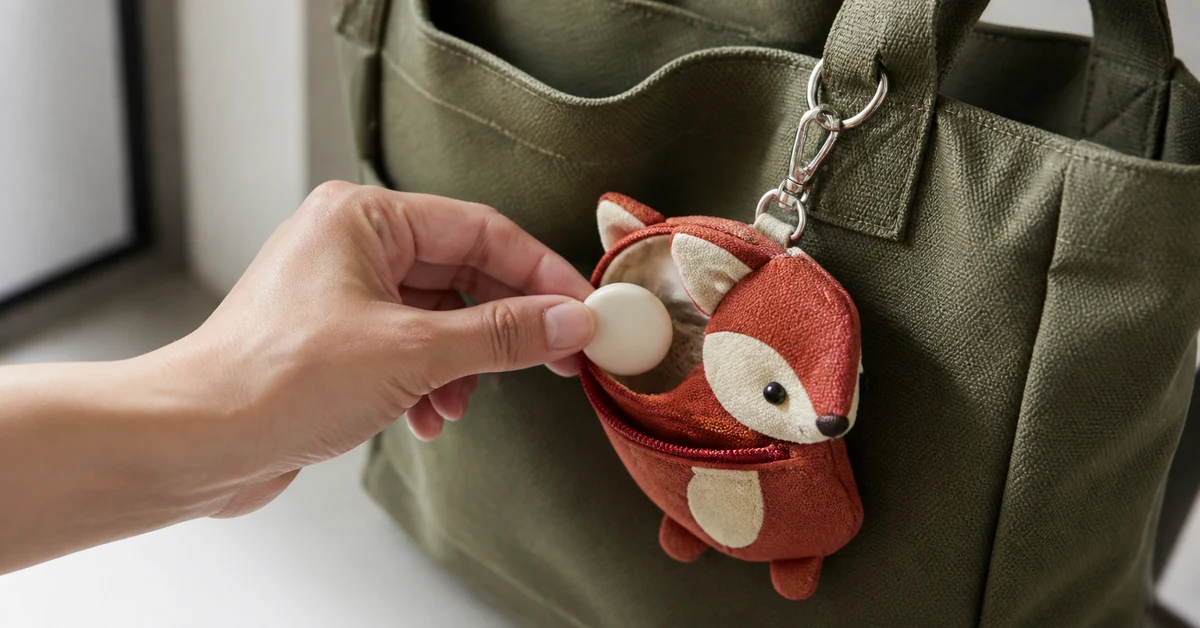
Assess an animal keychain pouches supplier with the pouch attached to a representative bag, not resting politely on a sample table. A character face, zipper and ring can each work alone while the hanging product rotates, hides its opening or needs two hands to retrieve one small item. Onehourcrafts treats attached access as the main use state, then connects orientation, closure, lining, load and packaging to one reviewable journey.
Choose the host object before judging the pouch
Name the representative bag, zipper pull, backpack loop or other attachment selected for the intended channel. Record the hardware dimensions, orientation and surrounding surfaces that may restrict movement.
The host is a test fixture, not a universal compatibility claim. Use several plausible attachments only when the product is positioned for several clearly defined uses.
Let gravity decide the first view
Hang the empty pouch and observe which side faces outward, where the opening settles and whether ears, tails or accessories fold over the closure. A tabletop photograph often hides this orientation.
Define the acceptable resting view for both character recognition and access. If the face consistently turns inward, the attachment point or body balance may need revision.
Run one hand from touch to closure
With the host object held or worn as intended, use one hand to locate the pouch, stabilize it, open it, retrieve the item and close it. Record hand changes, dropped contents and moments when the user must see the opening.
The trial reveals interaction among ring, body, closure and lining rather than producing a universal accessibility promise.
| Access moment | Failure to observe | Product question |
|---|---|---|
| Locate | Pouch turns or hides | Can shape and attachment guide the hand? |
| Open | Body collapses or zipper catches | Is stabilization possible with one hand? |
| Retrieve | Lining or opening blocks the item | Does usable access match the claimed job? |
| Reclose | Slider or snap becomes hidden | Can closure state be confirmed? |
Define one reference load, then add a near-miss
Choose a small item that represents the intended pouch job and another plausible item that should not be promised. Record dimensions, shape and weight for consistent trials.
This boundary prevents the product from becoming a vague miniature storage claim. An animal coin pouch wholesale brief may prioritize coins or tokens, while another channel may specify a key, earbud case or small keepsake.
Make the opening visible without erasing the character
The closure should be discoverable while the face, ears and decorative features remain coherent. Review slider position, pull size, seam direction and color contrast on production-intent samples.
A decorative tassel can look like the zipper pull; a tail can cover it. Use unprompted handling observations to decide which cues are intuitive rather than relying on the designer's knowledge.
Measure usable access, not just internal volume
An internal cavity can hold an item when fully spread on a table yet block it through the real opening. Test insertion and removal while attached, including the effect of lining, seam allowance and body compression.
State the intended item class or dimensions carefully. Avoid claiming capacity for every object that technically fits inside an unassembled shell.
Watch the lining during every retrieval
A loose lining may follow the item out, cover the zipper teeth or twist after repeated use. Record attachment points, depth, seam condition and recovery after the reference-load cycle.
For crochet keychain pouch closure review, inspect lining and zipper together. A smooth slider test on an empty shell does not represent a loaded, handled product.
Turn closure state into a visible signal
Decide how the user knows the pouch is fully closed while it hangs. Slider endpoint, snap alignment or another physical cue should remain observable or tactile in the intended orientation.
Run a partially closed near-miss and inspect whether contents can escape during ordinary movement. The appropriate method and acceptance boundary depend on the design and intended use.
Separate attachment security from access convenience
A short, rigid connection may hold the pouch close but make opening difficult; a longer connector can improve access while increasing swing, snagging or collision. Compare configurations using the same host and load.
The crochet organizer inversion guide examines how movement changes containment. This article keeps the focus on opening and retrieval while the pouch remains connected.
Carry the loaded pouch through a movement loop
Use a scoped movement route such as walking, sitting, placing the bag down and lifting it again. Inspect closure, item position, lining, character shape and contact with the host.
Do not infer universal durability from one route. Use the loop to compare samples and identify where movement disrupts access or presentation.
- Attach and load the released sample
- Complete the defined movement route
- Retrieve with one hand
- Reclose without detaching
- Inspect the final state
Package the pouch in its natural hanging orientation
A unit pack that forces the connector behind the body or compresses the opening can train the product into an awkward first-use state. Review ring access, character view, closure visibility and removal sequence.
The pack should state the intended pouch role and avoid styling props that look included. Test peg display and online thumbnail separately where both channels matter.
Control identification across look-alike characters
Different animals may share body construction while colors, ears, face embroidery and closure orientation vary. The GS1 barcode standards overview can frame identity questions while implementation remains market- and configuration-specific.
Link unit, case, artwork and physical sample to the same released variant. Inspect mixed assortments for correct character, hardware and pack pairing.
Review small parts and claims by destination
Hardware, decorative parts, age positioning and labels need product-specific review. The CPSC business education resources can frame relevant US questions but does not approve a particular pouch.
Ask for materials and evidence tied to the exact configuration. Do not transfer a general supplier statement across variants or destinations.
Write the RFQ as an attached-use scene
Share host objects, intended load, access method, closure, lining, dimensions, character variants, unit pack, display, destination, quantity scenarios and evidence. Use the crochet collection and buying-guide library for category and sourcing context.
Request a production-intent one hand pouch access test with the pouch hanging throughout, not a detached zipper demonstration.
- Named host attachment
- Reference and near-miss loads
- Attached access sequence
- Post-movement closure evidence
Repeat the sequence after changing the host
Move the same loaded pouch from the primary host to one clearly different but still intended attachment. Do not change the load or teach the tester a new grip. Compare resting angle, opening visibility, stabilization, swing and the ability to confirm closure.
This comparison shows which behavior belongs to the pouch and which depends on the host geometry. It does not create a universal compatibility statement. An animal keychain pouches supplier should link every supported host scene to the same released hardware and body sample so buyers can see the boundary of the evidence.
How Onehourcrafts keeps the pouch on the bag
Onehourcrafts can align host fixtures, attachment orientation, reference load, access observations, lining sample, closure cue and pack presentation in one buyer-readable record. The character and storage job remain connected.
Before approving an animal keychain pouches supplier, run the complete touch-open-retrieve-close sequence with one hand while the pouch hangs. A strong sample remains recognizable, reachable and securely closed without borrowing a tabletop state the customer will not have.
- Hanging reference view
- Loaded access sample
- Closure near-miss
- Released character variant
Frequently asked questions
Why test a keychain pouch while it is attached?
Gravity, host surfaces and connector length change orientation, stabilization, opening and retrieval in ways a tabletop sample cannot show.
Can every keychain pouch be opened with one hand?
Do not assume so. Define the intended use, host and closure, then observe production-intent samples and state the boundary honestly.
How should pouch capacity be described?
Use an intended item class or controlled dimensions and test through the actual opening while attached, not only against internal volume.
What should buyers inspect on the lining?
Inspect attachment, depth, seams, bunching, zipper interaction and whether the lining follows the item out during retrieval.
How can users tell a pouch is closed?
Use an observable or tactile endpoint appropriate to the closure and hanging orientation, then test a partially closed near-miss.
Does a longer connector improve the product?
It may improve access but increase swing, collision or snagging. Compare configurations using the same host, load and movement loop.
What should retail packaging show?
Show the character, attachment, closure, intended pouch role, contents boundary and any added item without making styling props appear included.
How should animal variants be controlled?
Use a variant index linking character details, hardware, closure orientation, artwork, pack and approved physical sample.
What destination questions matter?
Materials, small parts, age positioning, labels, claims and test expectations require configuration- and destination-specific review.
What belongs in the first supplier inquiry?
Include host, intended load, dimensions, opening, lining, closure, attachment, variants, packaging, destination, quantities and evidence needs.