
A crochet kit stitch tension guide should define a usable range, not demand that every customer crochet with identical force. Product teams need to know how tight and loose hands change gauge, fabric feel, yarn consumption, tool movement and finished dimensions. The practical answer is to build a small tension ladder with the approved yarn and hook, identify the first unacceptable result on each side, and transfer those visible limits into the pattern, component specification and instruction checkpoints.
Why tension is a system variable
Tension is often treated as a maker habit, but a retail kit turns it into a system variable. Yarn construction affects drag. Hook finish affects feeding. Stitch choice amplifies or hides small differences. A tightly packed amigurumi fabric reacts differently from an open accessory panel, while a beginner may grip harder during an unfamiliar step. The kit must tolerate that variation without producing a result that looks unrelated to the box image.
This is also why gauge alone is incomplete. Two swatches can reach a similar width while differing in row height, flexibility, edge curl or the force needed to insert the hook. Product approval should describe the fabric customers are meant to create, then use measurements to protect that fabric.
| Variable | Tight-hand effect | Loose-hand effect | What to observe |
|---|---|---|---|
| Stitch width | More stitches per area | Fewer stitches per area | Width across a fixed stitch count |
| Row height | Compressed rows | Elongated rows | Height across a fixed row count |
| Hand feel | Firm or board-like | Soft or unstable | Bend, squeeze and recovery |
| Yarn use | Can rise through dense work | Can shift with longer loops | Mass used for the same section |
| Hook access | Difficult insertion | Easy insertion but weak control | Snagging, splitting and dropped loops |
Build a five-swatch tension ladder
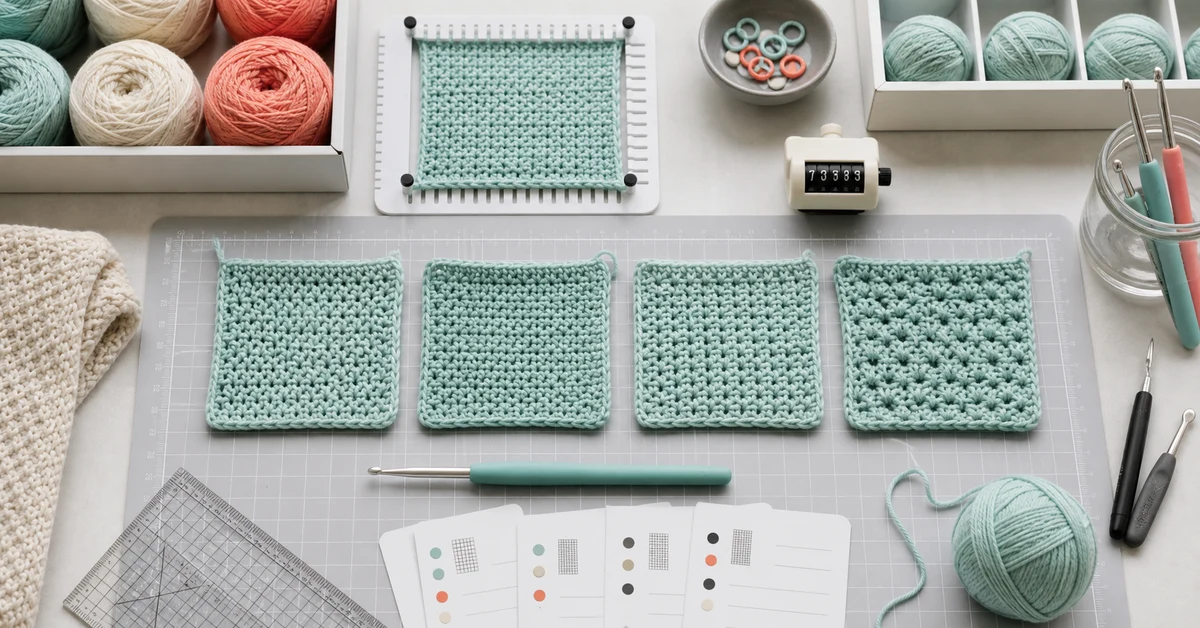
Begin with one approved yarn lot, one hook and one stitch section that represents the product. A plain square is useful for baseline measurement, but the most revealing sample often includes the actual increase, decrease, color change or textured area that creates customer difficulty. Keep stitch and row counts constant so the main changing factor is hand tension.
- T1, intentionally tight: the maker uses a firmer grip than normal without forcing the hook.
- T2, slightly tight: the fabric remains workable but shows reduced stitch opening.
- T3, reference: the approved sample maker follows their normal controlled method.
- T4, slightly loose: loops lengthen while the structure still holds its intended shape.
- T5, intentionally loose: the sample shows the likely failure edge for an uncertain beginner.
Use at least two makers when possible. One person imitating five tension levels may still reproduce the same grip rhythm and yarn-feed habit. A second maker exposes assumptions that the first person cannot see. Record the condition rather than trying to assign a universal numeric force to a handmade action.
Measure what changes the customer result
Condition the swatches in the same way before comparing them. Let them rest, place them without stretching and use the same measuring frame. If the product will be blocked or shaped, measure both before and after that step. For three-dimensional crochet, add a small constructed section because flat gauge does not fully predict circumference, stuffing pressure or seam alignment.
- Count stitches and rows within a defined window, avoiding distorted edges.
- Measure finished width, height and diagonal skew.
- Weigh the remaining yarn or the completed sample to compare consumption.
- Rate hook insertion, yarn splitting and hand strain during the test.
- Photograph each swatch under the same light with the same orientation.
- Check whether the fabric recovers after folding, squeezing or light stretching.
The approved window might include T2 through T4, but that decision depends on the product. A decorative coaster may need precise dimensions and a flat edge. A soft scarf can accept wider gauge variation if drape and yarn reserve remain acceptable. Do not copy a tolerance from another project without testing the current stitch, yarn and use case.
Separate component problems from hand problems
When a swatch fails, do not immediately tell the customer to change tension. Repeat the test after changing one component. A hook with a rough throat can make a moderate grip behave like a tight one. Highly split-prone yarn can slow the user and encourage overcontrol. Dark fuzzy yarn may hide the next insertion point, indirectly changing rhythm.
| Symptom | Possible hand cause | Possible kit cause | Useful trial |
|---|---|---|---|
| Hook will not enter | Loops pulled too tight | Hook head or shaft mismatch | Test one adjacent hook size |
| Fabric is unexpectedly open | Loops held too high | Yarn too thin for the pattern | Compare approved yarn diameter |
| Edges shrink inward | Turning chain is restricted | Instruction cue is unclear | Film the row transition |
| Yarn splits repeatedly | Insertion angle varies | Twist or hook finish is unsuitable | Run a feeding comparison |
Pair this review with a documented crochet kit yarn selection process and a clear hook-size decision. Tension advice cannot compensate for components that do not work together.
Place checkpoints before errors compound
A customer should not discover a tension problem only after finishing the project. Place checks at moments where correction is still cheap. The first check may be a short foundation section; the second may follow a shaping sequence; the third may occur before assembly. Give a physical comparison that a beginner can recognize, not only a specialist gauge statement.
- Early width check: show the expected measurement after a small fixed number of stitches.
- Fabric check: describe whether the piece should bend, stand, stretch or conceal stuffing.
- Hook check: explain that stitches should slide without forcing or falling open.
- Yarn check: state which completed section should correspond to a visible remaining quantity.
- Recovery action: say when to change grip, remake a short section or try the approved alternate hook.
Visual support should use the actual yarn color and stitch structure whenever possible. The approach in crochet kit video instructions is helpful here: film the hand, hook and loop path closely enough that the viewer can compare movement rather than merely watch a finished row appear.
Convert the ladder into an approval rule
The specification should identify a target and two boundaries. Record stitch and row ranges, finished dimensions at the checkpoint, fabric appearance, measured yarn use and any approved recovery action. Add photographs of one acceptable tight-side swatch, the reference and one acceptable loose-side swatch. Images of only the perfect center sample do not teach inspectors or customer-support teams where acceptance ends.
A practical decision rule can be written in this order:
- Does the sample remain within the dimensional checkpoint?
- Does the fabric perform its intended function?
- Can the hook move without excessive force or loss of loop control?
- Does yarn consumption remain inside the kit allowance?
- Can a beginner correct the issue using an instruction already included?
If the answer is no at the tight or loose boundary, decide whether to narrow the instruction window, change a component or add yarn reserve. The yarn quantity calculation should use tested variation rather than a flat percentage that is unrelated to the project.
Run a beginner transfer test
Controlled swatches establish the range; beginner trials show whether customers can remain inside it. Give the kit to several people who have the intended experience level. Do not coach them during the first attempt. Observe grip changes, pauses, repeated insertion failures and the moment they decide a fabric is acceptable. Compare their checkpoint samples with the ladder.
Record whether the instruction language changes behavior. A cue such as “keep the loop relaxed” is vague. A cue such as “the hook should pass through the next stitch without pushing” gives an observable test. Likewise, “check your gauge” helps only if the user knows when, where and what action to take after a mismatch.
Where Onehourcrafts fits
Onehourcrafts can help retail teams connect yarn, hook, pattern and approved sample during product development. A useful inquiry includes the project image, intended skill level, target dimensions, material preference, packaging format and any known customer difficulty. Buyers can request tension-ladder samples, component comparisons and checkpoint evidence before bulk approval rather than relying on one presentation sample. The completed crochet kit stitch tension guide then becomes part of the approval record.
This work also supports a more accurate gauge swatch specification. Gauge defines the dimensional window; tension testing explains how real users move toward its edges and whether the kit remains usable there.
Frequently asked questions
Should every crochet kit include a gauge swatch?
Not every small project needs a separate swatch, but every product team should test gauge and tension before approval. For size-sensitive projects, include an early customer checkpoint. For forgiving projects, a fabric-feel or width comparison may be enough.
How many makers should test stitch tension?
Use at least two controlled sample makers and several target-level users when practical. Multiple people reveal grip and yarn-feed differences that one expert imitating loose and tight tension may miss.
Does changing hook size solve a tension problem?
Sometimes, but not automatically. A hook change also affects stitch geometry, hand feel, yarn use and finished size. Approve any alternate size with the same yarn and pattern section before recommending it.
What tolerance should a crochet kit use?
Set tolerances from the product function and tested sample ladder. A rigid decorative shape may need a narrow range, while a draping accessory may accept more dimensional variation if appearance and yarn reserve remain suitable.
When should the tension test be repeated?
Repeat it when yarn lot characteristics, yarn construction, hook geometry, stitch pattern, finished size or instruction sequence changes. A visually small component change can alter feeding and user behavior.
Use the guide as a product-control document
A strong crochet kit stitch tension guide links human variation to measurable product decisions. Keep the swatch ladder, photos, consumption record, component trials and beginner observations together. That evidence gives suppliers a reproducible target, gives inspectors meaningful boundaries and gives customers checkpoints they can actually use.