
A crochet kit yarn quantity calculation should start with an approved project made from production-equivalent yarn, then separate net stitch consumption from handling loss, color-specific risk and a deliberate user reserve. Multiplying a catalog skein weight by a rough project estimate is not enough. Retail buyers need a repeatable mass-balance record that explains why each color quantity is in the box.
Define the quantity decision before weighing yarn
Write down the decision that the test must support. A development team may need enough yarn for one finished item, while a retailer may promise spare material for practice, repairs or tension differences. A multi-project learning kit has another requirement because early exercises consume material before the main piece begins. The quantity target must reflect the product promise shown in the instructions and listing.
Separate the finished-project requirement from commercial pack choices. The project may consume 62 grams, but yarn could be supplied as mini balls, wound cards or full retail skeins. Winding loss, minimum ball size, color assortment and packing efficiency can change the supplied quantity without changing the stitch requirement. Record both values so a packaging change does not quietly alter the usable reserve.
- Net project use: yarn incorporated into the approved finished sample.
- Process loss: tails, joins, trimming, tangles and winding residue.
- User allowance: variation caused by gauge, technique and corrections.
- Commercial rounding: the final practical weight or length packed per color.
Build a controlled prototype baseline
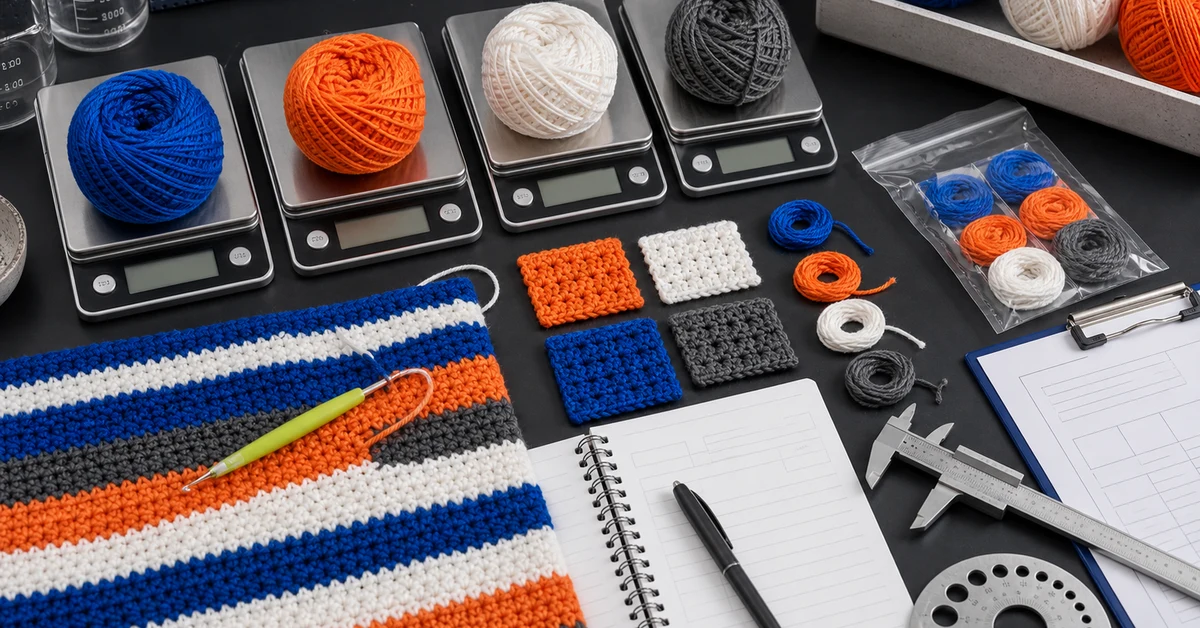
Use the approved pattern, hook, stitch construction and target dimensions. Condition the yarn and scale in a stable environment, and weigh each color separately before the maker starts. Record the yarn lot, scale resolution, starting mass and any wrappers or cores that are excluded. The same maker should complete the baseline sample without changing the pattern to conserve material.
After finishing, weigh the remaining yarn by color. Also collect trimmed tails and rejected pieces when practical. The difference between starting and remaining usable yarn is the operational consumption. Compare that result with the finished object's mass as a reasonableness check, allowing for accessories, stuffing and any yarn pieces that were removed.
- Calibrate or check the scale with a known reference.
- Weigh every color in its ready-to-use form.
- Complete the full project and document deviations.
- Weigh usable leftovers and separated waste.
- Repeat the build to see whether the result is stable.
Create a color-by-color consumption ledger
Total project weight can hide the most important shortage risk. A main body color may have a large reserve while a small accent color finishes with almost nothing left. Track each shade as its own line. For stripes, motifs and repeated limbs, note the pattern section that consumes the color so an artwork change can be translated into a quantity change.
Use both mass and practical length information when available, but do not convert between them without a verified yarn specification. Two yarns with the same nominal weight can provide different lengths because fiber, twist, moisture and thickness differ. Production control should be based on the unit the supplier can measure consistently and the design team can verify.
| Ledger field | Why it matters | Typical evidence |
|---|---|---|
| Starting usable mass | Defines the material issued to the maker | Scale record and yarn lot |
| Remaining usable mass | Shows what a customer could still use | Separated, untangled leftover |
| Trim and join loss | Prevents waste from being mistaken for reserve | Collected tails and notes |
| Pattern section | Connects consumption to design changes | Row, motif or component reference |
| Approved pack amount | Freezes the commercial quantity | Rounded weight and tolerance |
Measure loss instead of hiding it in one percentage
Generic allowances often conceal different causes. Joining frequent color changes creates more tails. A yarn that splits may be cut away more often. Mini-ball winding can leave residue on equipment. A beginner may undo a section and damage fibers that cannot be reused. Identify these loss modes during prototypes and decide which belong in the kit allowance and which require a process correction.
If winding loss is material, compare input bulk yarn with the total accepted mini-ball output rather than estimating from finished kits. If tail loss is high, review color sequence or instructions. A large buffer should not become a substitute for resolving avoidable waste. It increases material cost, pack weight and the chance of leftover colors confusing a customer.
- Long starting tails required by the technique.
- Frequent joins or color changes.
- Trimming after assembly and embroidery.
- Winding residue, knots or damaged yarn.
- Practice pieces promised in the instructions.
Test user variation with several makers
One expert prototype is a useful baseline but not a retail allowance. Ask several people near the intended skill level to make the same project from pre-weighed yarn. Keep the tool, instructions and target size constant. Measure finished dimensions, project mass, remaining yarn, corrections and completion notes. Do not coach testers toward unusually economical tension.
Review the distribution by color. A maker with tight tension may create a smaller but denser object, while a loose maker may use more yarn because the finished dimensions expand. Repeated corrections may affect a difficult accent section more than the main body. Choose a reserve that covers the approved user range, then state limitations if the project depends on matching a gauge or checkpoint.
| Trial result | Likely interpretation | Possible response |
|---|---|---|
| All makers have generous leftovers | Pack may be over-allocated | Reduce cautiously and retest |
| Only one color runs short | Color split or pattern section is unstable | Increase that color or redesign the section |
| Finished sizes vary widely | Gauge guidance is insufficient | Add an early size checkpoint |
| Loss follows repeated undoing | Instruction or skill mismatch | Simplify the step or add practice material |
Convert trial data into a pack allowance
This is where the crochet kit yarn quantity calculation becomes a purchasing rule. Start with the accepted high-use result for each color, add documented production or handling loss that the customer will encounter, then round to a packable amount. Avoid using the average alone because half the tested users may consume more than it.
The reserve does not need to be identical for every shade. Main colors, embroidery accents and safety-critical assembly yarn have different consequences if they run out. An accent that uses two grams may need a high percentage allowance but only a small absolute increase. A main body color may need a smaller percentage with more grams. Approve the absolute supplied amount and tolerance for every line.
- Select the accepted high-use trial for each color.
- Add verified process loss that remains in the retail workflow.
- Add any promised practice, repair or technique reserve.
- Round upward to a stable winding and packing quantity.
- Confirm the complete kit still meets cost and weight targets.
Scale the rule into production controls
A correct development number can still fail during bulk packing. Define how mini balls will be weighed, what scale resolution is required, whether checks use net or gross mass, and how many pieces are sampled. Packaging materials, bands and labels should not be included unless the inspection method consistently subtracts them.
Set a lower acceptance limit that protects the approved usable quantity. A wide plus-or-minus tolerance can permit underweight components even when the average looks correct. Where multiple small colors are packed together, a total bag weight cannot prove that each shade is present in the right amount. Use individual checks or a controlled pre-kitting process for high-risk colors.
- Approved yarn identity, lot controls and substitution rules.
- Net quantity and lower limit for each color.
- Winding form, banding and color identification.
- Sampling frequency and scale verification.
- Action for an underweight or incorrect-color result.
Challenge the quantity with edge cases
Repeat the calculation when a component, size, yarn or pattern changes. A small increase in a repeated round can multiply across the project. Dark yarn may lead to more corrections for beginners. Brushed or loosely spun fibers may not survive repeated undoing. Mixed production lots can change measured length per gram even when the label description remains the same.
Also test the way customers receive and use the yarn. Tight winding may distort a soft yarn, while very loose mini balls may tangle in transit. Confirm that the quantity remains usable after packing, drop handling and normal storage. The goal is not merely to place enough mass in the box; it is to deliver enough usable material for the promised outcome.
Where Onehourcrafts fits
The Onehourcrafts crochet DIY kit page describes customizable yarn, tools, patterns and retail packaging. Buyers can bring the crochet kit yarn quantity calculation, per-color ledger and lower-limit rules into sampling discussions instead of requesting an undefined amount of extra yarn.
Use the crochet kit yarn selection guide to freeze the material first, then connect quantity decisions with the hook size guide, crochet sampling process and missing-parts controls. Send the pattern, approved sample, yarn specification, color ledger and target order assumptions through the contact page. The final allowance still needs validation with the actual product and production yarn.
Frequently asked questions
Should yarn quantity be specified by weight or length?
Use the unit that can be controlled reliably for the approved yarn. Weight is often practical for production, but length can vary per gram across different constructions. Record both only when the conversion has been verified for that material.
How many prototype builds are needed?
Complete enough builds to show repeatability and user variation. One controlled expert sample establishes a baseline, while several target-level users reveal whether the reserve covers realistic tension, corrections and handling.
Can one reserve percentage be applied to every color?
It is safer to assess colors separately. Small accents, main body yarn and assembly colors have different consumption patterns and different consequences if they run short.
Why should leftover yarn be separated from waste?
Only usable leftover yarn protects the customer. Trimmed tails, damaged strands and winding residue are real consumption, but they should be identified so the team can reduce avoidable loss.
When should the yarn quantity be recalculated?
Recalculate after changes to yarn, hook, stitch construction, dimensions, pattern repeats, color placement, instructions or winding method. Validate the full kit again when several small changes occur together.