
A low MOQ embroidery kit supplier can reduce the number of finished units ordered at one time, but it cannot make every setup task, control activity and material minimum disappear. Onehourcrafts recommends asking what actually becomes smaller, what merely moves to another line of the quotation and what must remain fixed to protect product identity. That distinction turns a low-volume offer into a testable commercial model.
Draw three boxes before asking for a number
Put finished units, purchased inputs and setup events in separate boxes. The supplier may assemble 300 finished kits while fabric, thread cards or printed packaging are purchased in larger quantities. Artwork preparation, color matching, pattern proofing and test work may occur once regardless of order size. A credible quotation shows all three boxes instead of presenting one attractive unit count without its dependencies.
| Quantity layer | Typical example | Buyer question |
|---|---|---|
| Finished units | Complete retail kits | How many are assembled and shipped now? |
| Purchased inputs | Printed boxes, fabric or thread | What surplus remains and who owns it? |
| Setup events | Artwork, sampling or testing | Which fixed work is charged once? |
Let the first constraint fall
Choose the proposed finished-unit minimum and trace what it affects. A smaller run may reduce purchasing leverage, increase unit assembly cost, limit custom dyeing, narrow pack formats or increase the proportion of setup cost in each unit. These effects form a constraint cascade. Write them in sequence so the team can decide which tradeoffs are acceptable rather than discovering them after artwork approval.
- State the requested finished-unit quantity.
- List every input with a larger purchase minimum.
- Allocate fixed setup events transparently.
- Identify choices that must be standardized.
- Show the route for surplus material and reorders.
A low MOQ embroidery kit supplier should expose leftovers
Surplus is not automatically waste. Standard fabric, thread colors or hoops may support later orders or other approved products. Custom-printed cartons and unique branded components are harder to redirect. Ask for a residual inventory schedule showing quantity, value, storage condition, ownership, shelf life and disposal authorization.
The schedule prevents two opposite errors: charging the buyer for material that is quietly reused elsewhere, or promising future availability for material that was never reserved. Link every leftover to a version and batch identity.
Reduce choice before reducing control
Low-volume production becomes more workable when buyers limit interchangeable choices. Standard hoop diameters, proven fabric counts, available thread palettes and existing inner-pack structures can reduce procurement complexity. Approval criteria, component identity and workmanship tolerances should not become vague merely because the run is small.
Use the embroidery kit component checklist to define what remains inside the kit. Standardization is useful when it is deliberate and visible, not when substitutions appear after the order.
Turn design variety into a modular equation
A range can feel varied without making every component unique. Keep a shared hoop, needle pack, instruction format and inner protection, then vary pattern, thread palette or sleeve artwork. Model the range as common modules plus controlled variant modules. This can improve purchasing efficiency and simplify receiving while preserving a meaningful customer choice.
| Module | Shared or variable | Control method |
|---|---|---|
| Hoop and needle | Shared | One approved specification |
| Fabric cut | Shared where possible | Dimension and count check |
| Thread palette | Variable | Variant-coded thread card |
| Pattern and cover | Variable | Matched artwork release pair |
Make setup cost visible but not simplistic
Ask the quotation to separate reusable setup from order-specific setup. A validated instruction layout may support later designs, while a unique illustration or test requirement may belong to one SKU. Avoid assuming that every setup fee should disappear on reorder; changes in artwork, materials, market or claim can reopen work.
The craft kit cost breakdown helps buyers identify component, assembly, packaging and control costs. Use it as a question map, not as a promise that all factories structure prices identically.
Do not shrink the sample question list
A small order can still carry pattern errors, missing thread, poor fabric cuts or unclear instructions across every unit. Sample depth should follow uncertainty and consequence rather than order value alone. Define what each sample proves: concept appeal, stitchability, material compatibility, finished appearance, pack protection or production repeatability.
For beginner embroidery kits wholesale, test with users who match the declared starting skill. Experienced stitchers may silently repair an unclear instruction or unsuitable strand count and hide the difficulty from the buyer.
Use a choice budget for customization
Give every custom decision a cost in coordination, purchasing, artwork or verification. Buyers can then spend a limited choice budget on the features customers notice most. A distinctive pattern and sleeve may be more valuable than a unique hoop color, printed inner tray and custom fastener that each create another minimum.
- Rank choices by customer visibility and usefulness.
- Identify the supply minimum behind each choice.
- Prefer shared components where they do not weaken the concept.
- Reserve verification effort for functional and claim-sensitive differences.
Compare packaging routes as systems
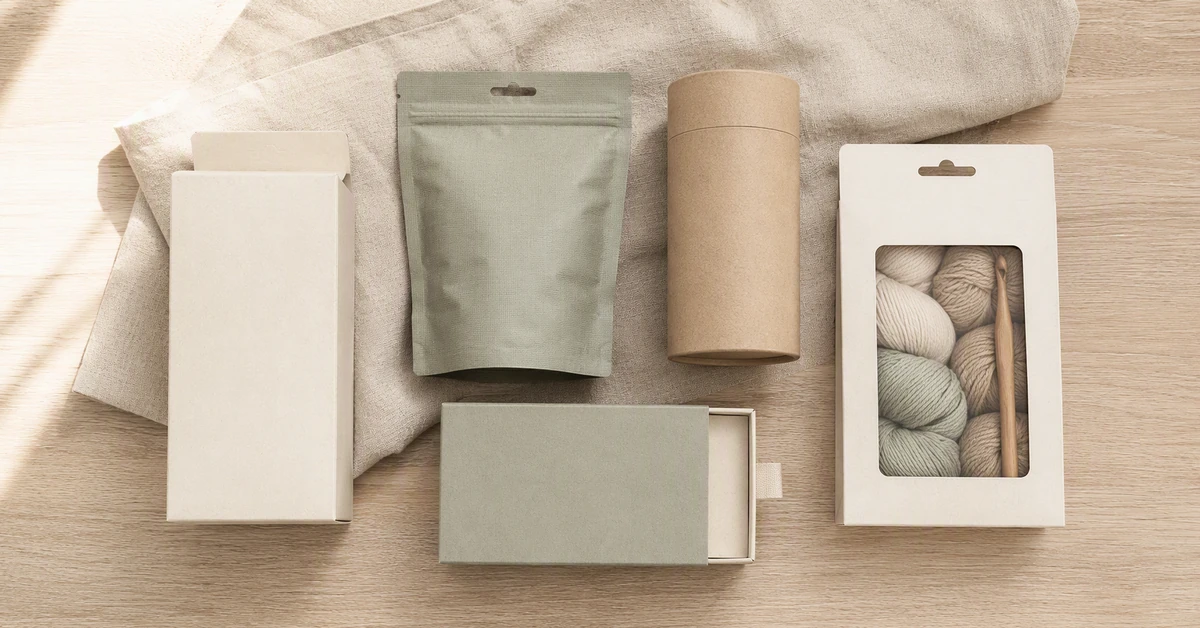
Custom packaging embroidery kits may use a printed box, standard box with sleeve, label-applied pouch or shared carton with variant insert. Compare total system cost, not only print price. Include assembly time, protection, label application, freight volume, remaining print stock and the ease of correcting artwork.
The FTC explains that advertising must be truthful and supported through its advertising and marketing guidance. Low volume does not reduce the need to verify pack claims. Destination-market rules and legal advice should be assessed for the actual product.
Ask how craft-store assortments will reorder
Embroidery kits for craft stores often begin as a mixed design trial. Define whether reorders can replenish winning designs individually or must repeat the original mix. A low opening quantity loses much of its value if a retailer must buy slow variants again to obtain the best seller.
Set a reorder decision date, reporting format and material reservation period. If common components are held for a future run, state the conditions that preserve availability and when the reservation expires.
Measure the quality cost of fragmentation
Many tiny variants can create more line changes, picking errors and artwork mismatches than one larger run. Ask how the supplier separates components, verifies changeovers and reconciles packed quantities. A small quantity does not guarantee careful handling; it can increase the proportion of manual decisions per unit.
ISO summarizes broad quality management principles, including process and evidence thinking. Certification alone does not prove a specific embroidery kit is suitable, so retain product-level acceptance records.
Price the pilot against a learning objective
A pilot order should answer named commercial or product questions. It might test price acceptance, pattern preference, package clarity or channel response. Set the measurement before launch. Otherwise, the buyer may treat weak sales as a product failure when distribution, display or timing was the real variable.
Use the craft kit inventory planning guide to connect trial quantity with review cadence and replenishment. The cheapest pilot is not necessarily the one with the lowest invoice; it is the one that produces reliable learning without creating unusable residual stock.
What Onehourcrafts needs to model the cascade
Onehourcrafts can evaluate a low-volume request when the inquiry states the number of designs, units per design, shared components, custom elements, destination markets, packaging route, target price and expected reorder timing. Mark which choices can use standard components and which carry the brand promise.
- Design count and quantity by variant
- Fixed versus flexible component requirements
- Artwork, language and market versions
- Target packaging and display method
- Residual-material ownership and reorder plan
Frequently asked questions
Does low MOQ mean every component has the same minimum?
No. Finished assembly, fabric, thread, printing and accessories may each have different purchasing constraints.
Why can unit cost rise on a smaller run?
Fixed setup is spread across fewer units, purchasing leverage may change and manual handling can represent a larger share.
Can several designs share one minimum?
Sometimes, when they use common components and compatible processes. The supplier should state the minimum by shared and variant input.
Who owns surplus printed packaging?
The quotation and agreement should identify who paid, where it is stored, how it is counted and when it may be disposed of.
Should a pilot use final packaging?
Use final or representative packaging when packaging is part of the question being tested. Document any difference from future production.
Can testing be reduced for a small order?
Test depth should follow product risk, claims and market requirements, not only quantity. Obtain appropriate professional advice.
What is a useful customization priority?
Prioritize a customer-visible feature that supports the concept while keeping less visible components on proven shared specifications.
How should mixed variants be labeled?
Give each variant a stable identifier that appears on artwork, component records, cartons and receiving documents.
When should a reorder be discussed?
Before the first order, because material reservation, lead time and variant flexibility affect the value of the initial minimum.
What should the first quotation show?
It should show finished quantities, input minimums, setup charges, surplus ownership, assumptions, lead time and change conditions.
Make the minimum a transparent design choice
The best test of a low MOQ embroidery kit supplier is not the smallest number printed on a quotation. It is whether the supplier can explain the cascade behind that number and preserve clear specifications, samples, claims and receiving evidence. When quantities, inputs and setup events are visible, a small run can become a controlled learning investment instead of an expensive collection of exceptions.