
A sewing basket manufacturer should turn a soft, decorative object into a durable storage product with controlled dimensions, stable panels, reliable hardware and useful internal organization. Buyers need to specify what the basket will carry, how often it will open, the target retail tier, fabric and reinforcement, tray layout, handle load, packaging and repeat-order tolerances before approving a sample.
Define the storage job and retail position
Start with the intended user and load. A compact beginner basket for thread and needles differs from a large organizer holding scissors, rulers, yarn and works in progress. The sales channel also changes priorities: gift retail values coordinated fabric and presentation, while ecommerce requires efficient pack dimensions and transit protection.
| Program | Typical contents | Design priority | Commercial risk |
|---|---|---|---|
| Starter sewing basket | Basic notions and small tools | Simple organization and value | Too little usable space |
| Premium gift basket | Curated notions or empty storage | Fabric, finish and opening experience | Cosmetic inconsistency |
| Large home organizer | Tools, thread and project materials | Structure, handle load and tray access | Panel collapse or excessive weight |
| Private-label range | Multiple sizes and patterns | Shared platform and SKU clarity | Assortment and repeat-order drift |
State whether the product is sold empty or with notions. Including tools creates a second bill of materials, more count checks and potentially different safety or labeling questions.
Freeze dimensions around usable volume
External measurements do not reveal how much storage remains after padding, wall thickness, hinge structure and the internal tray. Specify overall length, width and height alongside internal clear dimensions, tray depth, lid clearance and opening angle.
- External dimensions and tolerance.
- Internal base and top clear dimensions.
- Tray compartment sizes and removal clearance.
- Maximum tool length for scissors or rulers.
- Closed height with intended contents.
- Handle clearance and hand comfort.
Use physical load dummies during development. A tray that fits an empty prototype may interfere with thread spools or tools once the basket is used.
Engineer the panel structure
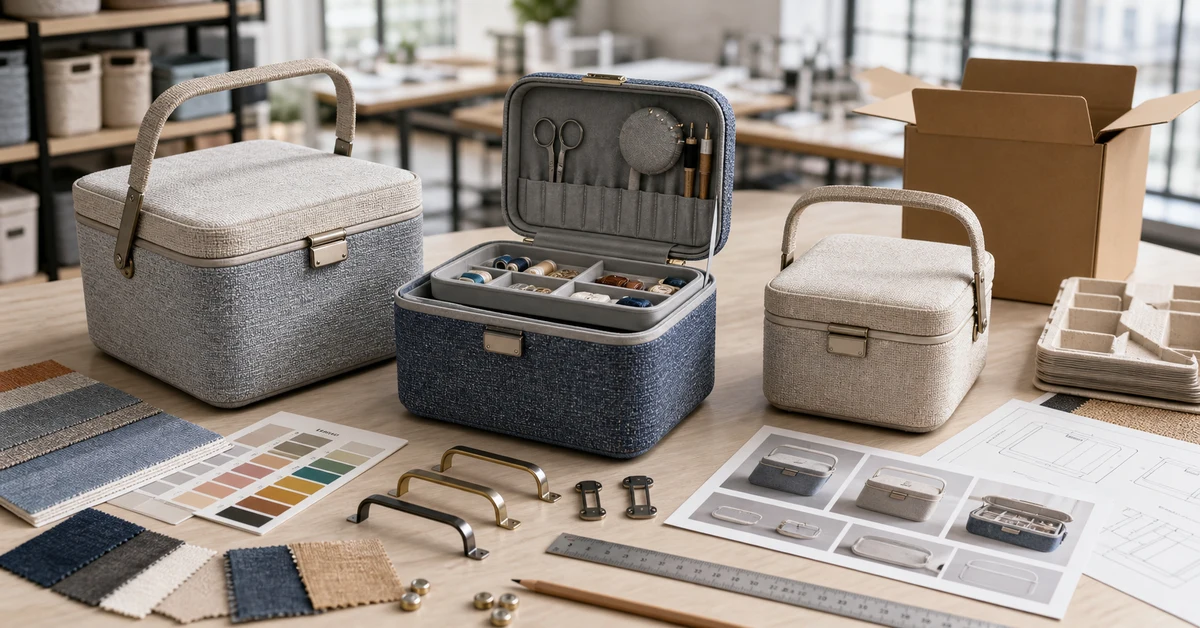
Fabric-covered baskets depend on hidden materials: board, molded shell, foam, adhesive, lining and edge construction. Define thickness, density, moisture behavior and bonding method. Side walls should resist bowing, and the base should remain stable when the handle is lifted.
| Layer | Buyer decision | Verification | Failure mode |
|---|---|---|---|
| Outer textile | Fiber, weave, print, color and finish | Approved swatch and appearance standard | Shade drift, abrasion or skew |
| Structural core | Material, thickness and density | Dimensional and compression trial | Collapsed wall or warped lid |
| Padding | Thickness and recovery | Compression and surface review | Lumpy or uneven appearance |
| Lining | Material, fit and cleanability | Seam and stain review | Loose fabric or trapped debris |
| Adhesive | Application and material compatibility | Heat, odor and bond observations | Delamination or visible marks |
Control fabric, pattern placement and color
Printed textiles create placement decisions on lid, sides, handle and seams. Define whether pattern matching is required, which motif areas must appear, permitted rotation and how repeat size affects cutting yield. A random cut may be acceptable for small prints but damaging for directional or character artwork.
Private label sewing baskets need signed fabric artwork, placement rules, brand colors and permitted-use terms before cutting begins.
Approve fabric by physical swatch under agreed lighting. Check rubbing at corners and handle contact points. Where fibre naming or textile labeling may apply, confirm the destination-market scope with a specialist; the EU publishes Regulation (EU) No 1007/2011 on textile fibre names and related labelling.
Specify hinges, closures and handles as systems
Hardware performance depends on attachment to the basket structure. A strong handle can still fail if its anchors pull through the side wall. Define material, finish, dimensions, fasteners, reinforcement plates, opening travel and load requirement.
- Cycle the lid through representative repeated openings.
- Lift the loaded basket by the handle and inspect anchor movement.
- Check closure alignment after load and temperature conditioning.
- Inspect sharp edges, burrs, pinch points and finish wear.
- Confirm hardware color against approved standards.
- Repeat tests on production-intent components, not showroom hardware.
Use a defined test load based on intended contents with a documented safety margin chosen by qualified product engineers.
Design the tray around tool access
An organizer tray should lift out without spilling, flexing or catching the lining. Compartments need to match realistic notions rather than an abstract grid. Scissors, needles, bobbins, thimbles, seam rippers and thread spools have different retention needs.
Test the tray with a representative kit. Check whether fingers can reach small items, whether elastic loops stretch appropriately and whether the tray remains stable when only one side is loaded. If a pin cushion is built into the lid, specify needle penetration depth and the barrier behind it.
Review safety, chemical and market requirements
The applicable route depends on destination, intended user, materials, included tools and claims. For EU consumer products, the European Commission's GPSR overview explains the general framework. If the basket includes art or sewing materials, the U.S. CPSC Art and Craft Safety Guide provides useful hazard and labeling background.
Ask specialists to confirm scope for textiles, coatings, adhesives, metal hardware, included sharp tools and any child-directed claims. Supplier declarations should identify the actual material and SKU, not only a generic factory statement.
Build a durability validation plan
Test the complete production-intent basket under expected loading and use. Include lid cycling, handle lifting, closure operation, tray removal, abrasion, seam pull, corner impact and base stability. Condition samples where storage heat or humidity may affect board, adhesive or fabric.
| Test | Purpose | Pass evidence |
|---|---|---|
| Loaded handle lift | Assess handle anchors and structure | No pull-out, cracking or harmful deformation |
| Lid cycle | Assess hinge, lining and closure | Continued alignment and function |
| Corner and base impact | Assess hidden core and finish | No structural collapse or exposed sharp part |
| Tray removal cycle | Assess fit and grip points | Stable removal without crack or spill |
| Surface rub | Assess fabric and print durability | Within approved appearance limit |
Record the method, load, cycle count, condition and result. “Passed durability” is not useful without a reproducible test definition.
Approve workmanship with visual boundaries
Soft products naturally vary, so workmanship standards need photographs and measurement points. Define acceptable seam straightness, lid alignment, fabric tension, pattern placement, adhesive visibility, corner shape, piping consistency, hardware position and tray fit.
- Critical: sharp exposed hardware, dangerous defect or prohibited material.
- Major: failed handle, non-closing lid, broken tray, severe warp or wrong artwork.
- Minor: limited cosmetic variation within an agreed viewing standard.
Inspect both empty and loaded baskets. Some distortions appear only when the tray and contents are installed.
Plan packaging for shape retention
The retail carton or protective bag should prevent crushing, abrasion and moisture exposure while avoiding unnecessary volume. Nesting may reduce freight, but it can mark fabric, deform lids or mix accessories unless separators and removal instructions are defined.
For parcel distribution, the International Safe Transit Association's ISTA 3A overview describes a general simulation for packaged products moving through parcel delivery systems. Select a representative test plan for the basket's size, mass, carton and route. Validate the production pack, not an overprotected laboratory sample.
Create a range platform without hiding differences
A family of sizes can share fabrics, hardware, tray architecture and packaging style. Platform design reduces development time and strengthens shelf coherence, but each size still needs load, access and pack validation. Scaling every dimension by the same percentage rarely produces the best organizer.
Use a matrix showing external size, usable volume, tray layout, handle, closure, intended contents, retail target and carton quantity. Give every fabric and hardware combination a unique SKU to prevent assortment errors.
Separate MOQ, tooling and material commitments
MOQ may be driven by custom printed fabric, dyed textiles, molded trays, hardware finishes, cartons or manual assembly. Ask the supplier to identify which elements are stock, shared, custom or subject to leftover inventory.
For sewing baskets wholesale, align material commitments with the forecast by size and fabric rather than quoting one total range quantity.
Sampling should progress through structural prototype, appearance sample, loaded-use sample, packaging sample and pre-production sample. A beautiful fabric sample should not be approved before the handle, core, tray and closure have passed their functional checks.
Compare total landed risk
Unit price does not capture carton volume, nesting labor, shape recovery, cosmetic rejects, hardware failure, markdowns or replacement shipments. Compare candidates against one signed specification and the same validation plan.
- Materials, structure, hardware and labor.
- Custom print, tooling and sample costs.
- Inspection, rework and spare policy.
- Retail carton and master-carton cube.
- Transit damage and storage deformation.
- Returns caused by size, function or appearance mismatch.
Where Onehourcrafts fits
Onehourcrafts can support buyers evaluating a sewing basket manufacturer through concept development, fabric and hardware selection, internal organizer design, samples, private-label packaging and production controls. A useful RFQ includes intended contents, dimensions, target load, fabric artwork, tray layout, handle and closure preferences, destination markets, forecast, retail target and carton constraints.
A custom sewing basket supplier should also provide a signed construction cross-section and approved hardware schedule so decorative revisions do not change hidden performance.
Buyers can review the Onehourcrafts sewing baskets category, sewing notions range and storage stability guide. Manufacturer experience supports qualification, but every basket platform still needs material, load and packaging approval.
Frequently asked questions
What information is needed for a sewing basket quote?
Provide dimensions, intended contents, target load, fabric, structure, tray, handle, closure, packaging, quantity, destination and target date.
Can custom fabric prints be used?
Yes, subject to artwork rights, repeat size, color approval, print minimums, cutting yield, placement rules and lead time.
How should handle strength be tested?
Test the fully assembled basket with a defined representative load and method, then inspect anchors, panels, seams and deformation.
Should the basket be sold empty or filled?
Either model can work. Filled baskets require an additional component specification, count control, safety review and more complex replenishment.
What drives MOQ?
Custom textiles, molded trays, hardware finish, cartons and assembly can set different minimums. Ask for each component's commitment.
How long does development take?
Allow time for structure, fabric, hardware, organizer, load tests, workmanship revisions, packaging and pre-production approval.
Can several sizes share one design?
Yes, but tray access, load, handle position, proportions and packaging should be validated separately for each size.
How is cosmetic quality controlled?
Use approved samples, physical color standards, measurement points and defect photographs for seams, alignment, pattern placement and hardware.
What packaging prevents crushing?
The answer depends on basket structure and route. Test supports, separators, nesting, bags and cartons with production-intent materials.
How should design ownership be protected?
Document rights to prints, shapes, organizers and packaging; define confidentiality, file access, permitted use and disposition of excess branded materials.
Approve structure before decoration
A capable sewing basket manufacturer should prove that the hidden core, fabric, tray, hardware and packaging remain functional through realistic loading and repeat use. When buyers freeze measurable construction and workmanship standards before bulk production, the finished range can stay attractive without sacrificing storage performance or repeat-order consistency.