
Compare a sewing basket manufacturer by mapping use frequency before filling every compartment. A basket can look generous while placing scissors under fabric, hiding needles behind decorative trim or leaving the handle to carry more weight than the customer expects. Onehourcrafts treats the basket as a moving work surface with repeated pickup, pause, refill and return moments.
List the actual sewing moments
Write five short tasks the target customer performs: repair a hem, replace a button, mark a seam, store an unfinished piece or carry supplies to a class. The list should contain movements, not just product categories. It becomes the demand map for every pocket and tray. Keep the named sewing basket manufacturer configuration beside the task list.
A gift basket, classroom basket and home repair basket have different rhythms. State the channel, user and likely work surface before judging dimensions, because capacity only means something inside a named routine. Record the intended craft basket compartment design beside each task so the layout has a use-based reason.
- Repair a visible fault
- Prepare a new seam
- Pause an active project
- Carry and reset
Rank tools by hand frequency
Mark each tool as every-task, often, occasional or reserve. Place the highest-frequency items in the easiest reach zones, then test whether the arrangement still protects points, thread and fabric. A compartment is successful when it supports the next pickup without a search.
For sewing basket wholesale briefs, keep the frequency map with the sample. It lets a buyer compare two footprints honestly even when one basket has more nominal pockets but a slower working path.
Load the basket with a real assortment
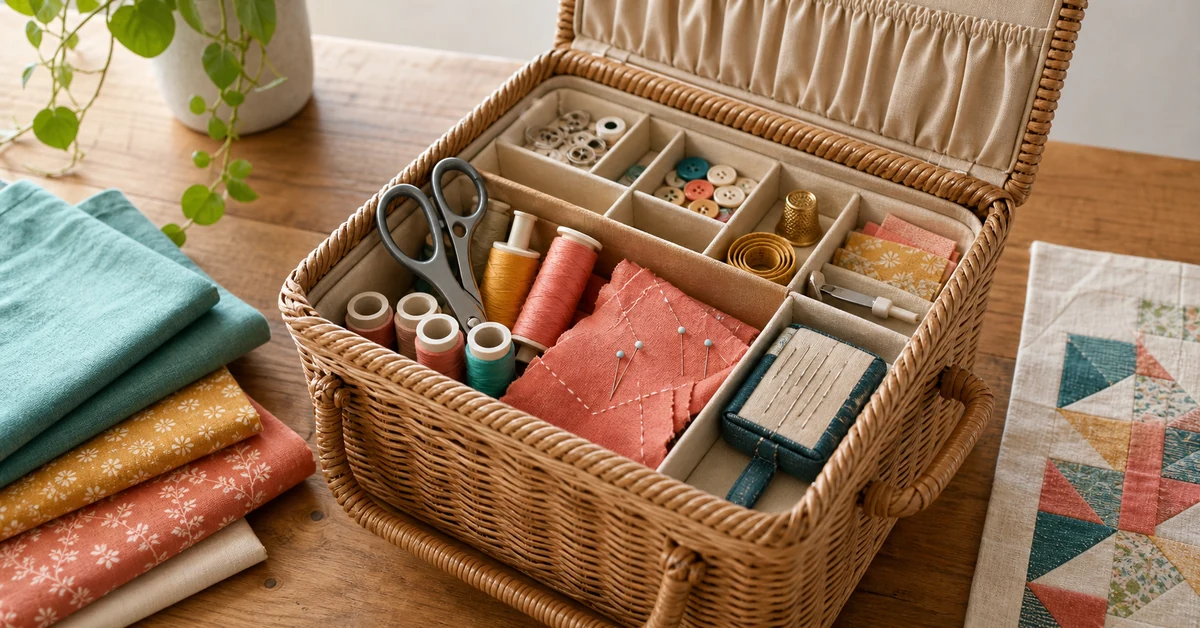
Use a production-intent assortment rather than generic props. Include thread, needles, scissors, tape, pins, markers, small repair pieces and one active project. Photograph the loaded basket from above and from the user’s seated angle.
| Zone | Primary job | Check |
|---|---|---|
| Quick reach | Daily tools | Can the hand identify and lift one item? |
| Protected | Needles and points | Does the cover or case stay engaged? |
| Active work | Fabric and thread | Can a project pause without collapse? |
| Reserve | Occasional extras | Can capacity grow without blocking access? |
Open the lid with one hand busy
Hold fabric or thread in one hand and open the basket with the other. Observe lid resistance, hinge travel, handle interference and the first exposed tools. This gives a more truthful picture than an empty-basket open-and-close demonstration.
Record the exact fixture and load. The goal is to compare configurations, not to make a universal ease claim. A change in lining, trim or insert can alter the opening path enough to require a new sample.
Make compartment identity survive clutter
Partly use the basket, then ask a second person to find a named tool. Loose thread, folded fabric and a half-empty spool should not erase the role of the compartment. If labels or colors help, tie them to the released instruction or pack language.
Decorative dividers are not automatically functional dividers. Check whether a pocket can hold the intended object without bending it, and whether the object remains visible after the basket has moved from shelf to worktable.
Test the carry handle after the work session
Load the basket, complete a short task and carry it a documented distance to a second surface. Watch handle grip, lid security, shifting contents and the first item that migrates. A full basket often behaves differently after thread and fabric have been handled.
A portable sewing storage promise should describe the tested load and destination rather than imply that every configuration carries the same way. Preserve the loaded reference for later inspection.
Give active work a temporary home
Place an unfinished seam, thread tail and selected tools into the basket without cleaning the table first. Close it, reopen it later and ask the maker to resume. This catches baskets that organize new supplies but cannot contain a living project.
If the basket is not meant to store active work, say so in the product boundary. Buyers can still position it as a supply organizer, but the customer should not discover the limitation after a project is trapped under the lid.
Measure refill behavior
Remove half-used thread, add a new spool, replace needles and return a marker. Record whether the refill changes the reach, balance or visible capacity. The basket should support replenishment without requiring a complete empty-and-reset ritual.
Refill evidence helps distributors explain the product after the first sale. It also shows where a large pocket becomes a dumping zone and where a smaller, stable compartment is worth more than a bigger unstructured cavity.
Use the reverse to check hidden strain
Turn the basket over after loading and carrying. Inspect base, seams, feet, lid edge and handle attachment for visible stress or distortion. Do not convert one short walk into a lifetime promise; use the evidence to define inspection points for the approved configuration.
The reverse view is especially useful for private-label packaging. It shows whether a styled image has hidden the parts that buyers and inspectors need to identify during receiving and returns.
Place the basket on the retail fixture
Put the loaded basket on the intended shelf, counter or gift display. The replenishment-clock guide connects assortment decisions to repeated store behavior.
Show the customer what is included, what is a prop and how the basket opens. A clear role card can explain the most-used zone without turning the pack into a long technical manual or an unsupported capacity claim.
Let the basket survive a quiet reset
Ask the user to put tools away in the order they naturally finish a task, then leave the basket for a day or a shift. Reopen it and compare the intended frequency map with the actual return pattern. Real users often create a useful second arrangement.
Treat the changed arrangement as evidence, not failure. It may show that the compartment design is intuitive, or that the buyer should revise the insert, photos or role of a pocket before scaling.
Keep identity aligned through revisions
Use the GS1 barcode standards overview to frame questions about unit, case and variant identity. Leave implementation to the buyer and destination, and inspect mixed revisions during any packaging change.
When lining, pocket count or handle hardware changes, update the loaded sample, dimensions, copy and service notes together. A correct label cannot rescue an old photograph that shows a different working capacity.
Write the RFQ as a frequency map
Share user, tasks, frequency ranking, dimensions, compartments, handle, active-work boundary, refill route, packaging, quantity scenarios and evidence. The ISO quality management principles can frame process questions without certifying a basket.
Connect the brief to the buying-guide library and the sewing-tool storage guide. Request loaded, carried and reopened samples, and ask the supplier to identify which evidence supports each capacity and storage statement.
- Define the work rhythm
- Rank the tool frequency
- Load the real assortment
- Carry and reopen the basket
- Release the matched evidence
How Onehourcrafts turns capacity into a routine
Onehourcrafts can align frequency map, compartment roles, handle load, active-work boundary, refill behavior and retail proof in one approval record. Capacity becomes a sequence a buyer can observe, not a decorative number.
Before approving a sewing basket manufacturer, ask for the same real assortment in sealed, working, carried and returned states. Keep those images with the quotation so future variants can show whether they preserve the routine or create a new one.
- Frequency map
- Loaded basket view
- Carry-state note
- Refill and return evidence
Frequently asked questions
Why rank tools by frequency?
Frequency shows which items need the fastest reach and which can occupy protected or reserve zones, making capacity more useful than pocket count.
What is a real assortment?
It is the production-intent set of tools, materials and an active project that the target user is expected to store and use.
Should a basket store unfinished work?
Only if that is part of the promise. Test the active-work state and state clearly when the basket is intended only for supplies.
How should handle load be reviewed?
Use an agreed loaded configuration, carry route and surface, then record shifting, lid security, grip and visible strain without making universal claims.
What makes a compartment useful?
It gives a named tool or material a stable, reachable home that remains identifiable after partial use and movement.
Can a larger basket be less useful?
Yes. A larger cavity can create a dumping zone if frequent tools become buried or the basket loses balance when carried.
What should refill testing include?
Remove half-used items, add replacements, return tools and observe whether access, balance or visible capacity changes.
Why inspect the basket reverse?
The base, seams, feet and handle attachment can reveal strain that a styled top view hides and can inform receiving checks.
How can retailers explain capacity honestly?
Use a loaded reference, named assortment and clear prop boundary instead of relying on an empty-basket photograph.
What belongs in a basket RFQ?
Include tasks, frequency, assortment, dimensions, compartments, handle, active-work boundary, refill, packaging, quantities and evidence.