
A private label craft kit manufacturer should be judged by what one randomly selected inbound carton can prove. Onehourcrafts recommends designing a receiving simulation before production: open one master carton, select one selling unit and verify identity, counts, condition, instructions and traceability without relying on development-team memory. The exercise works backward into manufacturing controls that warehouses and retailers can actually use.
Choose the box without warning
The supplier should not prepare a special carton for the exercise. Select from completed, identified stock using a documented random or representative method. Record order, item, batch, carton number, seal condition and selector. The objective is to see ordinary release quality, not presentation quality.
If several market, color or project variants exist, plan coverage across them. One box cannot statistically represent every risk, but it can expose whether the receiving evidence is usable and whether basic identities agree.
Read the carton before cutting the seal
Ask a receiving employee to identify the supplier, buyer item, description, variant, quantity, batch and handling information from the visible marks. Compare those fields with the purchase order and packing list. Ambiguous abbreviations or inconsistent item codes should be corrected before discussing internal product quality.
- Photograph every external face.
- Record damage, moisture, compression or retaping.
- Compare marks with shipment documents.
- Confirm the carton can be routed without opening.
Turn the first cut into a containment test
Open the carton as a normal warehouse would. Check whether cutting tools can contact selling units, whether void fill shifts and whether inner packs remain stable. Packaging that only survives careful laboratory opening may not survive routine receiving.
Record the position and condition of the top, middle and bottom units. Damage patterns can reveal excess headspace, weak dividers, compression concentration or an unsuitable carton count.
A private label craft kit manufacturer needs one-box proof
The proof is a compact record linking shipment identity to observable product evidence. It includes external marks, count reconciliation, pack condition, selected-unit identity, component verification, instruction version and disposition. The record should be repeatable by someone who did not attend sampling.
| Checkpoint | Evidence | Release question |
|---|---|---|
| Carton identity | Photos and label transcription | Does it match the order? |
| Quantity | Inner and selling-unit count | Does physical count reconcile? |
| Condition | Damage and placement record | Did transit affect saleability? |
| Selected kit | Component and document check | Is the approved promise present? |
Count in three different units
Verify master-carton quantity, inner-pack quantity and selling-unit contents separately. These counts have different owners and failure modes. A correct total can hide one short inner pack and one overfilled pack, creating problems later.
- Count unopened inner packs.
- Select and count selling units from more than one position.
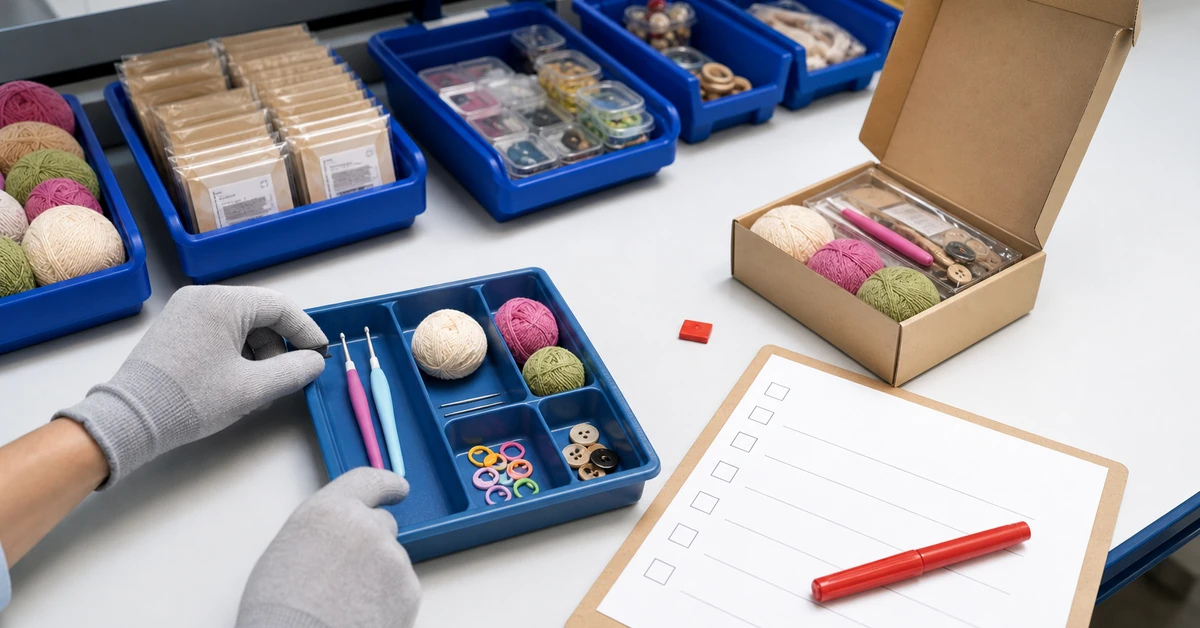
- Open the chosen kit and inventory every stated component.
- Reconcile all units with labels and documents.
Make the component inventory user-readable
The kit contents list should use the same names as the instructions and support records. Quantities need clear units. For materials measured by length or weight, define tolerance and test method rather than expecting warehouse staff to estimate visually.
The craft kit unboxing checklist offers a user-centered view. Combine it with receiving evidence so the first customer experience is not disconnected from warehouse acceptance.
Check identity at every packaging level
Master carton, inner pack, selling unit and product record should distinguish close variants. Check item code, description, color or design, destination-market version, batch and barcode where applicable. Do not assume a front image is sufficient identity.
GS1 provides general information about Global Trade Item Numbers. Buyers should define the identification system required by their retail, warehouse and market context.
For broader quality-system context, ISO summarizes quality management principles. Receiving evidence still needs product-specific criteria and a clear disposition route.
Open the instructions at a random page
Confirm title, product version, component names, diagrams, quantities, warnings, support route and print legibility. Then compare one material or tool mentioned on that page with the physical item. This catches version mismatches that a cover-only review misses.
If digital content is linked, verify the link under normal conditions and confirm it reaches the correct language and version. Essential information should not disappear when a short-lived campaign page changes.
Inspect protection where components touch
Look for dye transfer, abrasion, bent tools, crushed fibers, leaking adhesives, sharp-part migration and pressure marks. Contact damage may occur inside an undamaged selling unit. Protection design must reflect the real component combination.
Use the storage stability test to identify materials that need longer-term observation. Receiving condition is only one point in the product life.
Compare the kit with the approved promise
Place the selected unit beside the released specification and approved sample under defined conditions. Compare dimensions, colors, materials, finish, pack architecture and visible artwork. Do not reject acceptable natural variation by relying on memory, but do not dismiss meaningful drift as handmade character without criteria.
| Attribute | Reference | Receiving method |
|---|---|---|
| Color | Approved standard or sample | Controlled light comparison |
| Dimensions | Released specification | Named measuring method |
| Contents | Bill of materials and pack copy | Physical inventory |
| Workmanship | Acceptance criteria | Visual and functional check |
Give defects a route, not a photograph folder
Classify issues by identity, quantity, condition, component, instruction, artwork, function and traceability. Record extent and affected units, then define hold, sort, rework, accept or reject authority. Photographs support the record; they do not replace disposition.
A recurring defect should reach the process owner. If an item arrives short because the packing method permits miscounts, inspecting more cartons without correcting the process only finds defects later.
Set escalation thresholds before receiving begins. One damaged selling unit may trigger a wider position-based check; one wrong instruction version may justify holding the entire identifiable batch. The threshold should follow the consequence and likely common cause, not the inconvenience of additional inspection.
Repack the carton before closing the trial
Ask the receiving team to return inspected units, retain any required sample and reseal the balance for storage or movement. This exposes whether the original pack-out is recoverable after inspection. A carton that cannot be restored may create new damage or identity loss during a routine partial check.
Document the permitted repack method, replacement tape or labels and any quantity change. If the carton must remain on hold, its status should be visible without obscuring original item and batch information. The trial ends only when inspected stock has a controlled next state.
Design production controls backward from receiving
For every receiving check, ask where the supplier can create and preserve the evidence earlier. Carton labels come from an item-data release. Component counts come from kitting controls. Instruction versions come from document control. Condition comes from packing validation and handling.
The batch traceability checklist can help connect these records. The goal is not paperwork volume; it is an uninterrupted identity from components to shipped carton.
Separate brand customization from product release
Private label craft supplies require consistent identity and claims, but brand approval does not release technical quality. A craft kit manufacturer should keep product, packaging and artwork evidence connected while allowing specialists to approve their own domains.
Custom packaging craft supplies may change carton efficiency or protection even when product contents stay fixed. Re-run relevant one-box checks after pack structure, material, quantity or item-mix changes.
What Onehourcrafts needs to build the receiving record
Onehourcrafts can align manufacturing and receiving when the buyer provides purchase-order fields, item hierarchy, carton rules, destination requirements, component tolerances, approved references and disposition authority. Include the warehouse's practical constraints, such as available space, tools and inspection time.
- Item and variant master data
- Pack quantities at every level
- Required carton marks and documents
- Product acceptance criteria and references
- Hold and release responsibilities
Frequently asked questions
Why test one box?
One box reveals whether ordinary receiving evidence is coherent, even though broader inspection may be required for statistical confidence.
Who should select the carton?
Use a documented method controlled by the buyer, inspector or agreed independent party rather than supplier presentation choice.
Should the carton be opened before label review?
No. First determine whether the closed carton can be identified and routed correctly.
How are kit contents counted?
Use the released bill of materials, consistent component names and defined methods for pieces, length or weight.
What if total quantity is correct but inner counts vary?
Treat it as a packing-control failure because downstream handling expects the declared inner quantity.
Do digital instructions need receiving checks?
Yes. Confirm the link, version, language and availability, while keeping essential information accessible.
How should natural material variation be handled?
Define acceptable ranges and comparison conditions before receiving rather than judging from memory.
What happens after a defect is found?
Record scope, classify the issue, place affected stock on hold and follow the agreed disposition route.
When should packaging be revalidated?
Revalidate after structural materials, quantities, component mix, dimensions or distribution conditions change.
What closes a receiving simulation?
Close it when evidence is repeatable, discrepancies have dispositions and factory controls address the identified causes.
Let one ordinary box tell the truth
The most persuasive evidence from a private label craft kit manufacturer is a normal carton whose identity, counts, protection and product promise agree without explanation from the development team. Design that proof before production, and receiving becomes a confirmation of controlled work rather than the first place anyone discovers how the product was packed.