
A cross stitch needle size guide should match the tapestry needle's shaft diameter, eye capacity, length and point profile to the actual fabric count, floss bundle and target user. The number stamped on a needle is only a starting reference. Retail kit approval requires a working test that confirms easy threading, clean passage and controlled handling without enlarging the fabric grid.
Define the needle's job inside the kit
List the stitches, fabric, strand counts and finishing actions the needle must support. A main cross-stitch needle may not be ideal for backstitch, metallic accents or assembly. If the product includes more than one needle, assign a clear role to each and show how users can distinguish them.
Consider target skill and project duration. Beginners need an eye that is practical to thread and a profile that finds the fabric openings without splitting fibers. A very large needle can be easy to hold but distort the grid. A small needle may pass smoothly yet create avoidable frustration during threading.
- Fabric type and count.
- Number and construction of floss strands.
- Main stitches, outlines and special threads.
- Target user dexterity and experience.
- Needle storage and replacement expectations.
Measure the production needle, not the catalog label
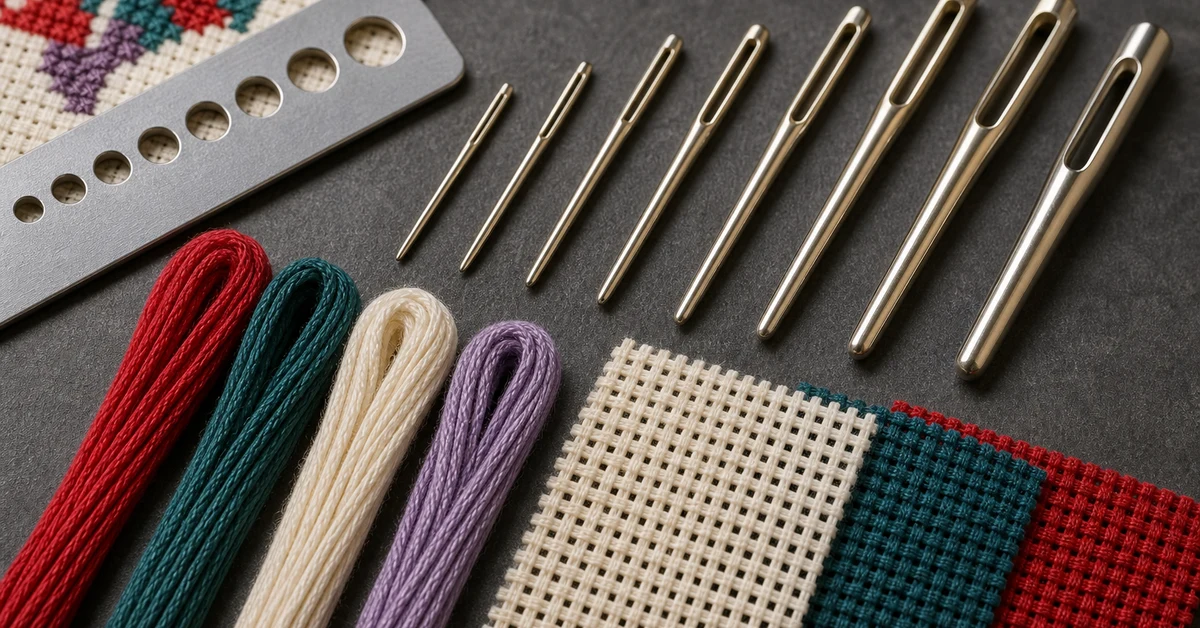
Compare actual samples for overall length, maximum shaft diameter, eye opening, eye finish and point shape. Needle numbering systems can vary across product types and suppliers, and two pieces with the same stated size may not feel equivalent. Use measured dimensions and retained physical samples in the specification.
Inspect surface quality under magnification. Burrs, rough plating, incomplete polishing or sharp eye edges can damage floss. Check straightness and consistency across several pieces. A needle that performs well once does not prove that bulk production will maintain the same eye and point geometry.
| Needle feature | What it affects | Failure signal |
|---|---|---|
| Shaft diameter | Fabric opening and drag | Grid distortion or difficult passage |
| Eye dimensions | Threading and floss compression | Fraying or repeated failed threading |
| Point profile | Finding openings without splitting | Fabric or floss damage |
| Needle length | Grip, reach and control | Fatigue or awkward movement |
| Surface finish | Friction and corrosion resistance | Snagging, discoloration or rough feel |
Build a fabric-floss-needle matrix
Test several adjacent needle candidates with the proposed fabric and common strand combinations from the pattern. Include the thickest working bundle, the finest outline and any special thread. Record threading time, passage force, fabric recovery, floss abrasion and stitch appearance.
Use the same length of floss and a repeatable stitch path. Short samples should include both open areas and dense neighboring stitches. A candidate that feels smooth on an empty grid may become difficult when passing beside completed stitches. The matrix reveals whether one needle covers the entire project or separate roles are justified.
- Prepare equal fabric swatches from the approved lot or standard.
- Thread each candidate with the same floss bundle.
- Stitch a fixed path through open and dense areas.
- Inspect the grid and floss after repeated passes.
- Repeat with the smallest and largest required bundles.
Check eye capacity without over-compressing floss
The floss should enter the eye without excessive twisting, flattening or repeated trimming. A generous eye helps beginners, but its outer profile must still pass through the fabric cleanly. Compare both threading usability and working drag. If a needle threader is included, test the complete threader-eye-floss combination.
Observe damage near the eye after a representative stitching length. Rough inner edges can fuzz cotton floss or strip finishes from specialty threads. Use the actual production thread construction; a smooth sample yarn does not prove compatibility with metallic, blended or loosely twisted strands.
| Eye test | Acceptable behavior | Risk to investigate |
|---|---|---|
| Initial threading | Bundle enters without force | Eye too small or poorly finished |
| Repeated passes | Floss retains structure | Internal edge abrasion |
| Fabric passage | Eye follows shaft smoothly | Bulky transition enlarges holes |
| Threader use | Tool passes and withdraws reliably | Eye or threader mismatch |
Protect the fabric grid
Inspect holes immediately after stitching and after the fabric rests. The needle should open a usable path without leaving permanent distortion beyond the project's accepted appearance. Large eyes, rough transitions and sideways pulling can widen openings. Fine fabric counts can reveal this problem earlier.
Test mistakes and corrections. Beginners may enter the wrong hole, pull at an angle or pass beneath completed stitches. The needle should be tolerant enough for realistic handling without becoming so large that every correction damages the grid. If the chosen fabric and strand count demand an unusually difficult needle, reconsider the full system.
Evaluate grip, control and loss risk
Ask target users to thread, stitch and park each coded needle. Record grip changes, dropped needles, hand fatigue and difficulty finding the blunt point against the fabric. Short needles can feel precise but hard to manipulate; long needles can be easy to hold but awkward in small hoops or near dense work.
Review storage during breaks. A needle minder, card, felt pad or organizer may reduce loss, but it becomes another component to validate. Do not rely on a tiny loose needle moving inside a transparent bag. Packaging and instructions should make initial removal and later storage clear.
- Threading success without extra preparation.
- Comfort during a representative session.
- Control near edges and completed stitches.
- Safe, visible storage during pauses.
- Clear identification if multiple needles are included.
Decide whether one or two sizes belong in the kit
One validated tapestry needle keeps setup simple and reduces count-control points. A second size may be justified when the pattern includes a materially different strand bundle or finishing task. Each added tool should solve a documented compatibility problem rather than increasing the perceived component count.
If two needles look similar, define how customers and packing staff distinguish them. Different length, storage positions or clear instruction references can help. Color finishes should be tested for durability and should not replace a stable size specification.
| Kit approach | Best fit | Control need |
|---|---|---|
| One needle | Consistent fabric and strand range | Strong all-task validation |
| Main plus detail needle | Distinct outline or special thread | Clear role and identification |
| Spare duplicate | Loss risk or long project | Count and storage control |
| Needle and threader | Threading support is important | Complete tool compatibility test |
Run a beginner handling trial
Give coded candidates to users near the intended skill level. Ask them to identify the tool, thread it, complete a representative area, correct one mistake and store the needle. Do not tell them which size is expected to win. Record time, retries, damage and comments.
This is where the cross stitch needle size guide becomes a product decision. Combine user results with fabric and floss evidence. A needle that experts prefer for speed may not be the most reliable retail choice if beginners cannot thread or control it.
Freeze a measurable needle specification
Record needle type, nominal reference, measured length, shaft diameter, eye dimensions, point profile, finish and accepted variation. Attach the winning fabric-floss sample and identify the thread combinations tested. Define visual defects and functional checks for incoming inspection.
Trigger reapproval when the supplier, material, plating, eye geometry, fabric count, floss construction, strand count or included threader changes. A substitution should pass the relevant working test even when its package uses the same size number. Retain several approved needles to compare bulk finish and geometry during later inspections.
Where Onehourcrafts fits
The Onehourcrafts cross stitch DIY kit page describes customizable fabric, threads, needles, patterns and packaging. Buyers can provide a cross stitch needle size guide matrix and retained samples so the needle is approved with the exact fabric and floss system.
Start with the fabric count guide, connect color handling through the thread organizer guide, verify the complete product with the cross stitch quality checklist and calibrate usability through the skill-level framework. Send the fabric, strand combinations, tool roles, target user and order assumptions through the contact page. Needle safety, warnings and market requirements need confirmation for the intended product.
Frequently asked questions
Should a cross stitch kit always include a tapestry needle?
A blunt tapestry-style point is commonly suitable for counted fabric because it finds openings without cutting fibers, but the complete dimensions and finish still need validation with the kit.
Is a larger needle easier for beginners?
It may be easier to hold and thread, but a large shaft or eye can distort fine fabric. Compare threading, passage and grid recovery together.
Can one needle handle both cross stitch and backstitch?
Sometimes. Test the actual fabric, strand counts and detail work. Add a second tool only when it solves a clear compatibility or handling problem.
What needle defects should buyers inspect?
Check straightness, point profile, eye shape, internal roughness, plating consistency, burrs, discoloration and any finish that snags fabric or floss.
When should the needle selection be retested?
Retest after changes to fabric count, floss, strand count, special threads, threader, needle supplier, dimensions, material or surface finish.