
The reliable answer to how to prevent missing parts in craft kits is a closed-loop control plan: lock one component master, control material presentation, verify critical counts during packing, clear the line between variants, seal only after confirmation and feed every complaint back to a traceable production lot.
Final inspection alone is a weak defense when a kit contains many small components. An inspector may open only part of a lot, components may look similar, and a sealed package can hide the point where the error occurred. Prevention works better when every process stage makes the next error less likely and easier to detect.
Trace the defect escape path
A missing part reaches a customer only when several controls fail. Map that path from product data to pack-out:
Incorrect master list -> wrong material issued -> picking or counting error -> incomplete verification -> mixed line or variant -> package sealed -> defect not detected -> customer opens kit.
This map changes the investigation. The immediate question is not only "Who forgot the part?" It is "Which control allowed an incomplete kit to look complete?" A useful corrective action removes that escape route for future orders.
Control 1: create one approved component master
The component master should be the single reference for purchasing, incoming inspection, production, quality control, instructions and customer service. Include:
- Component name and unique identifier.
- Approved image or physical reference.
- Specification, color, size and material where relevant.
- Quantity per kit and any approved spare quantity.
- Packaging stage or compartment.
- Replacement rule and criticality.
- Revision number and effective production date.
Do not maintain separate uncontrolled lists for the manual, factory line and retailer. When a component changes, update the master through a defined approval and confirm that instructions, package copy and pack-out standards still match.
Control 2: classify parts by completion risk
Not every component deserves the same control. Classify parts according to what happens if they are absent or wrong.
| Class | Example effect | Control approach |
|---|---|---|
| Completion-critical | The user cannot perform a required step or finish the promised project | Positive count or presence verification for every kit |
| Specification-critical | A similar-looking part creates the wrong fit, size, color or result | Identity verification plus controlled issue |
| Experience-critical | The project can continue, but organization, clarity or presentation is reduced | Visual standard and sampled confirmation |
| Optional or spare | The part supports recovery or convenience but is not required for normal completion | Clearly defined quantity and label to avoid confusion |
This classification focuses resources. A single project-specific hook, needle or fastener may need a stronger control than a decorative extra. It also helps customer service decide whether to send a replacement part, replace the full kit or investigate a broader lot issue.
Control 3: design the kitting station around error prevention
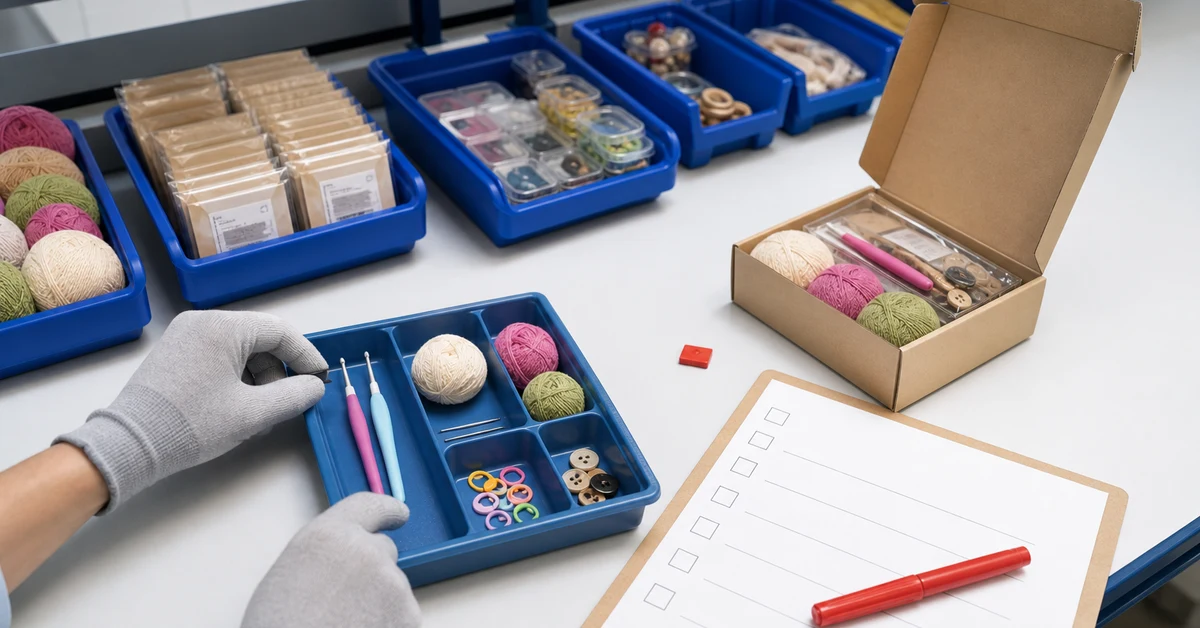
Arrange components in a fixed sequence that matches the pack standard. Give similar parts separate, clearly identified locations. Use physical limits, trays or fixtures so an operator can see whether the expected count has been reached.
Good station design reduces memory work:
- Present only the active product and revision at the station.
- Use one location for each component identifier.
- Separate visually similar colors, sizes and variants.
- Move completed sub-packs to a defined confirmed area.
- Keep rejected, damaged or excess material physically isolated.
If the operator must remember which of several open bins belongs to the current version, the process is depending on attention rather than control.
Control 4: choose a verification method for each part
No single count method fits every component. Match the method to size, variation and criticality:
Positive placement
A shaped tray, card or compartment has one visible position for each required part. This works well when components are distinct and presentation is part of the product.
Pre-counted sub-packs
Small accessories are counted and sealed as a subassembly before final kitting. The final line verifies the correct sub-pack identity and presence rather than recounting loose pieces.
Weight confirmation
A controlled weight range can detect some missing or extra components when unit weights are stable and sufficiently different from normal variation. Validate the range with actual good and intentionally incomplete kits. Weight should not be treated as proof when several component combinations can produce the same total.
Scan or identifier confirmation
Barcodes or internal identifiers can confirm the correct component or sub-pack was issued. Scanning identity does not confirm quantity unless the process also records or constrains the count.
Visual comparison
A pack-out image helps verify arrangement, color and presence. Keep the image tied to the current revision and show enough detail to distinguish similar parts.
Control 5: clear the line between products and variants
Variant changeovers create a high-risk moment. Leftover materials from the previous kit can be packed into the next product, while the correct material remains in the wrong station location.
A line-clearance record should confirm that prior components, labels, instructions, packaging and work orders have been removed or accounted for before the next version begins. The next product's master, materials and first completed kit should then be verified together.
Use this rule for rework as well. An opened kit should return through a controlled re-verification path, not directly to the finished-goods area after one part is added.
Control 6: verify the first kit, the process and the sealed result
Use layered checks with different purposes:
- First-piece approval: confirms the active master, station setup and pack sequence.
- In-process confirmation: checks that the method remains stable while the lot is running.
- Final inspection: samples finished presentation, identity and completeness after sealing.
- Shipment review: confirms lot, quantity, carton marking and release records.
Final sampling is valuable, but it does not replace positive controls for completion-critical parts. The right combination depends on component risk, process capability, order history and the cost of a defect reaching the customer.
Control 7: connect each kit to a traceable lot
Traceability should let the team answer four questions quickly: which product revision was packed, when and where it was packed, which material lots were used where relevant, and which shipment received the finished lot.
The identifier can appear on a package label, carton, internal record or combination of these. The design should support investigation without confusing the consumer or retailer. Keep retained samples or pack-out evidence according to the risk and agreement for the product.
When a missing component is reported
Respond to the customer, but also protect the remaining inventory. A practical sequence is:
- Confirm the product, revision, lot identifier and claimed missing part.
- Check whether the complaint indicates a single damaged pack or a repeated pattern.
- Contain related stock when the risk justifies it.
- Review the component master, material issue, line-clearance and verification records.
- Test the suspected escape path with retained or intentionally incomplete kits.
- Correct the process and verify effectiveness on later production.
A customer-service replacement closes the individual case. Corrective action closes the production risk.
Use defect patterns to choose the next control
Track complaints by component, product revision, production lot, line, shift and sales channel where the data is available. A repeated missing needle may point to a weak sub-pack seal. Mixed hook sizes may point to line clearance or material identification. Random omissions across many parts may indicate station overload or an ineffective confirmation step.
Do not add inspection everywhere after one complaint. Reproduce the likely failure, identify the earliest stage that can prevent it and then verify the new control under normal production conditions. This keeps the answer to how to prevent missing parts in craft kits focused on the cause rather than on paperwork volume.
Review the control after the next lots and after any meaningful product change. A new package, component source, variant or line layout can create a different escape path even when the previous corrective action remains effective.
Where Onehourcrafts fits
Onehourcrafts offers custom crochet kit manufacturing with component configuration, storage organization, instructions, packaging and labeling options. Buyers should provide a locked bill of materials, critical component list and expected pack presentation during sampling.
Related planning resources include the amigurumi quality scorecard, sewing kit quality checklist, manufacturer evidence gates and custom sampling process.
Final takeaway
Teams asking how to prevent missing parts in craft kits should look beyond the final inspector. Define one component truth, classify risk, design the station for visible completeness, control changeovers, verify critical parts and connect complaints to production evidence. The strongest system makes an incomplete kit difficult to create and easy to detect.
Frequently asked questions
Is final inspection enough to prevent missing craft kit parts?
No. Final inspection is a detection layer. High-risk components also need preventive controls during material issue, counting, sub-packing, line clearance and sealing.
Can weighing a kit confirm all components are present?
Sometimes it can detect meaningful differences, but only after validation with actual process variation. Similar-weight substitutions or combinations can pass a weight check, so use other controls where needed.
What is a component master?
It is the approved record of every part, specification, quantity, image, pack location and revision used by purchasing, production, quality, instructions and customer service.
How should similar colors or sizes be controlled?
Separate them physically, use unique identifiers and approved references, restrict the station to the active variant, and verify identity at issue and pack-out.
What should happen after a missing-part complaint?
Resolve the customer case, identify the product lot, assess related inventory, investigate the escape path and verify that the corrective action prevents recurrence.