
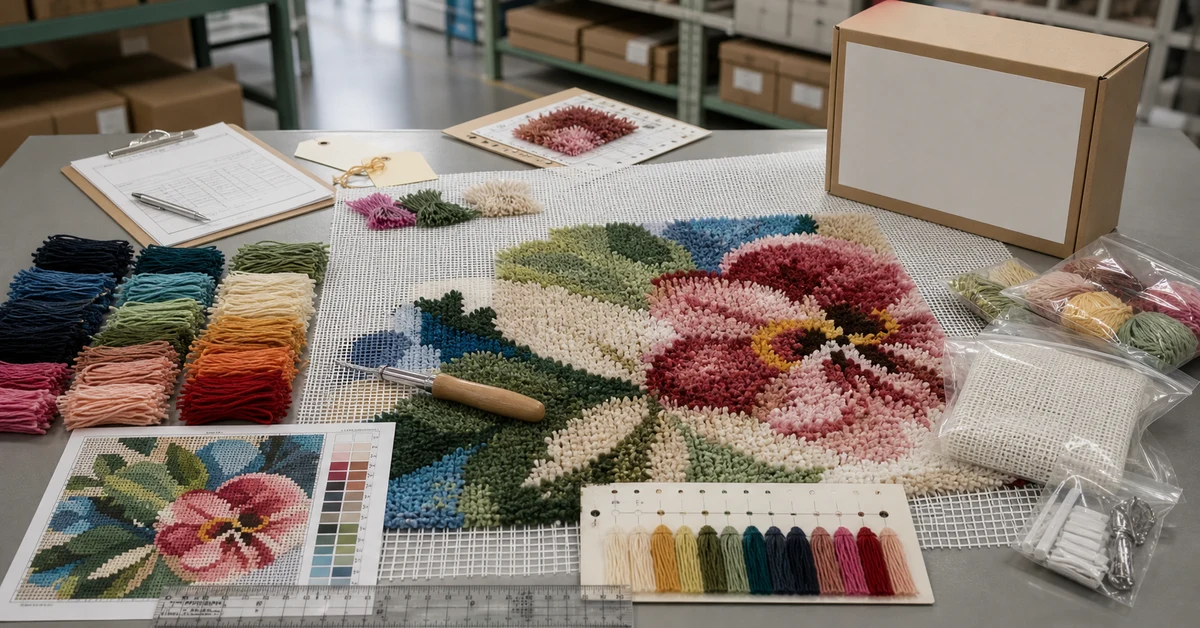
A latch hook rug kit manufacturer should control the relationship between canvas, yarn bundles, chart, tool, edging and finished dimensions. Buyers are not purchasing loose craft materials; they are purchasing a repeatable path from a printed or coded grid to a stable textile object. Supplier approval therefore needs a stitched sample, material-use evidence, count reconciliation and packaging tests, not only an attractive box mockup.
Start with the finished use, not the artwork
Define whether the project becomes a decorative rug, wall hanging, cushion front or small accessory. The intended use changes backing, edge construction, pile expectations, cleaning communication and packaging. A floor item also creates different durability and slip-risk questions from a wall piece.
| End use | Construction priority | Buyer question | Approval evidence |
|---|---|---|---|
| Decorative rug | Edge stability and pile consistency | How is the back finished and used? | Completed sample and use statement |
| Wall hanging | Shape, hanging method and weight | Is hanging hardware included? | Display trial and packed-component check |
| Cushion front | Dimensions and sewing allowance | Is backing or closure supplied? | Assembled cushion prototype |
| Starter project | Short completion path | Can a beginner read the grid? | Independent user test |
State what the kit does not include. Customers often infer backing fabric, cushion inserts, rug underlay or hanging frames from lifestyle images unless the pack is explicit.
Translate artwork into a manufacturable grid
Artwork must be simplified to the selected canvas gauge and finished size. Small curves, thin outlines and closely related shades can disappear when converted into square cells and yarn knots. Approve both the chart and a complete stitched sample under normal viewing distance.
- Set finished dimensions and usable canvas area.
- Choose grid density and calculate cell count.
- Reduce artwork to colors that remain distinguishable in yarn.
- Check isolated cells and narrow details for practical stitching.
- Generate the chart from the controlled grid file.
- Stitch the entire design and compare silhouette and color balance.
The printed image cannot serve as the only technical reference. Keep a versioned grid file, color map and approved sample photograph together.
Specify canvas by measurable performance
Canvas decisions include material, mesh count, stiffness, coating, cut size, printed alignment and edge treatment. A canvas that is too soft can distort during hooking; one that is too stiff can be uncomfortable and difficult to pack. Openings need to work with the selected yarn thickness and hook geometry.
- Mesh count and tolerance across the usable area.
- Overall cut dimensions and squareness.
- Printed or marked grid registration.
- Edge margin for finishing and handling.
- Resistance to fraying, cracking or coating transfer.
Test rolled and folded packing options. Creases may remain visible or change the stitching experience even when the canvas is technically undamaged.
Control yarn color, cut length and allowance
Pre-cut yarn is a counting system. Define fiber, yarn construction, color standard, cut length, bundle identification and quantity by color. Short variation changes pile height; color variation changes the image. Both must be controlled across repeat orders.
| Yarn variable | How to specify | How to verify | Failure seen by customer |
|---|---|---|---|
| Color | Approved physical standard and code | Lightbox or agreed lighting comparison | Visible patch or wrong motif |
| Cut length | Nominal length and tolerance | Sample measurement by lot | Uneven pile |
| Quantity | Required knots plus defined allowance | Weight/count reconciliation | Project cannot be completed |
| Organization | Bundle, label and chart relationship | Pack-out verification | Colors are confused |
| Fiber statement | Market-specific description | Supplier record and label review | Incorrect consumer information |
Where textile labeling rules may apply, confirm scope with a qualified specialist. The EU publishes Regulation (EU) No 1007/2011 on textile fibre names and related labelling; destination-market requirements and product classification still need SKU-level review.
Match the hook to the complete system
The latch hook must pass through the canvas opening, capture the supplied yarn and close without snagging. Specify hook dimensions, latch movement, handle material, surface finish and any protective packaging. Test tools from multiple production lots, not only the development sample.
During user trials, record dropped strands, incomplete knots, hand discomfort and places where the tool catches the canvas. A tool can look acceptable in isolation yet fail repeatedly with the selected mesh and yarn.
Make the chart readable at working distance
Charts need clear symbols, boundaries, orientation marks, row references and a direct mapping to yarn bundles. Large projects may need tiled pages or foldouts. Ensure overlap areas are explicit and that page breaks do not hide the relationship between adjacent sections.
Use the principles in the chart symbol design guide: avoid symbols that differ only by rotation or minor detail, retain contrast after printing and test the final page size. For beginners, show the knot sequence and explain how to recover from an incorrectly placed color.
Validate dimensions with a complete stitch-through
Finished size depends on canvas, knot placement, handling and edge finishing. Stitch the full production-intent design, then measure before and after the stated finishing process. Record yarn use by color and identify any design area where the allowance is unusually tight.
- Beginning canvas dimensions and mesh count.
- Finished stitched area and overall project dimensions.
- Yarn remaining by color.
- Time by project section.
- Observed chart questions and correction points.
- Edge treatment and final appearance.
Release the result as the golden sample and retain the exact chart, yarn standards and component list used to make it.
Build a defect catalogue before inspection
Incoming inspection should verify canvas, yarn, hooks and printed materials. Pack-out inspection should confirm every bundle and accessory. Final inspection should review package condition, assortment, labels and carton configuration.
| Severity | Example | Recommended action |
|---|---|---|
| Critical | Unsafe tool condition or prohibited material | Stop and investigate the affected lot |
| Major | Missing yarn color, wrong chart or unusable canvas | Reject or fully rework defined units |
| Major | Yarn shortage against approved allowance | Reconcile and correct the pack plan |
| Minor | Small cosmetic packaging mark | Apply agreed acceptance limit |
Use photographs and measurable thresholds. Descriptions such as “poor yarn” or “bad print” do not create consistent decisions across factories, inspectors and buyers.
Test packaging against the distribution route
Large canvas formats and many yarn bundles can create bulky packs. Compare folded, rolled and flat configurations for shelf efficiency, crease recovery and component movement. A good unboxing sequence exposes the chart and yarn system without allowing small bags to spill.
For parcel-based ecommerce programs, the International Safe Transit Association describes Procedure 3A as a general simulation for packaged products moving through parcel delivery systems in its ISTA 3A overview. Select any test plan according to the actual pack, product, route and customer requirements; passing one distribution test does not prove every shipping condition.
Plan MOQ, capacity and lead time by bottleneck
Production capacity may be limited by yarn cutting and sorting, canvas printing, manual kit assembly or packaging rather than by one headline daily quantity. Ask the supplier to map each stage and identify how assortment changes affect throughput.
MOQ may come from printed canvas, custom yarn colors, packaging or the economics of bundle preparation. For a new range, use fewer shared yarn colors and common packaging dimensions where that does not compromise design clarity. Freeze forecasts by SKU and color family so material purchasing reflects the actual assortment.
Latch hook kits wholesale programs should also separate launch quantities from repeat-order forecasts so yarn commitments and manual sorting capacity reflect the real SKU mix.
Compare suppliers with a weighted decision matrix
Price should follow technical equivalence. Score suppliers on grid accuracy, color control, complete-project validation, yarn allowance, tool performance, packaging, documentation and corrective action. Require the same samples and evidence from each candidate.
- 30% product and component performance.
- 20% chart clarity and user-test evidence.
- 15% quality system and traceability.
- 15% packaging and distribution readiness.
- 10% lead time and capacity transparency.
- 10% total landed cost and commercial terms.
Adjust weights to the program, but keep the scoring evidence-based. A polished sales sample should not outweigh repeat-order control.
Define OEM and private-label ownership
Clarify who owns the artwork, gridded pattern, chart symbols, photographs, packaging dielines and instruction files. State whether the supplier may display, reuse or adapt the design. Approve translations, trademarks, barcodes and destination-market text separately from the craft sample.
For private label latch hook kits, document ownership of every derivative grid and chart, not only the original illustration.
Revision control matters because one artwork change affects the grid, chart, yarn counts, pack image and potentially the carton assortment. Release one signed technical pack to all production teams.
Where Onehourcrafts fits
Onehourcrafts can support a buyer evaluating a latch hook rug kit manufacturer through custom design, material coordination, sample development, private-label packaging and production follow-up. A useful RFQ includes finished use, dimensions, grid artwork, target colors, skill level, packaging format, sales markets, forecast and required approval documents. Request a complete stitched sample and yarn-use record before bulk approval.
Custom latch hook rug kits should retain a signed relationship between artwork revision, grid file, yarn map, finished sample and packaging image.
Buyers can also review the company's latch hook category, manufacturing background and related batch traceability checklist. Factory credentials support qualification, but the commercial decision should remain tied to the exact SKU and controlled sample.
Frequently asked questions
What information is needed for a latch hook rug quotation?
Provide finished use, dimensions, artwork, canvas preference, color count, target skill level, packaging, order quantity, destination and launch date.
Should the canvas be printed or use a separate chart?
Either can work. Printed canvas may be easier for some users, while a separate chart can preserve a cleaner textile surface. Test the target user's preference.
How much extra yarn should be included?
Set allowance from a complete stitch-through, color-by-color consumption and expected user loss. Avoid applying one arbitrary percentage to every design.
Can yarn colors be customized?
Yes, subject to color standards, dye or sourcing minimums, lead time and repeat-order control. Approve physical samples under agreed lighting.
How is finished size verified?
Measure a full production-intent sample after stitching and the stated finishing method. Retain the starting canvas and final dimensions in the approval record.
What packaging formats are common?
Boxes, handled cases, hanging packs and rolled formats are possible. Select by canvas size, crease tolerance, shelf space, shipping route and reuse needs.
What drives the MOQ?
Printed canvas, custom yarn, packaging and manual bundle preparation can each set a different minimum. Ask for the bottleneck by component.
How long should sampling take?
Allow time for grid conversion, yarn matching, complete stitching, chart revision and packaging approval. Complex designs need more than a visual prototype.
How should defects be classified?
Define critical, major and minor examples with photographs, including missing colors, yarn shortage, canvas errors, tool defects and packaging damage.
Can a supplier protect exclusive artwork?
Use written ownership, confidentiality and permitted-use terms, control file access and document which parties may reproduce the design.
Approve the system, not only the sample image
A dependable latch hook rug kit manufacturer demonstrates that the controlled grid, canvas, yarn, hook, chart and pack work together from first knot to finished edge. Complete-project verification and lot-level traceability are the strongest protections against shortages, color drift and instructions that cannot reproduce the marketed result.