
A hotel sewing kit supplier should deliver a compact guest amenity that is safe to handle, easy to replenish and consistent with the property's service level. Procurement teams need to define the actual repair use, component count, needle retention, branded format, room placement, environmental claims and delivery cadence before comparing unit prices. The right pack solves a small guest problem without creating a larger housekeeping or quality problem.
Define the service moment and property tier
Clarify where the kit is offered: in every room, on request, inside a wardrobe amenity set, at reception or in a travel essentials shop. A one-night business hotel may need a simple emergency repair pack; a luxury resort may expect a coordinated case with higher presentation standards.
| Placement model | Guest expectation | Operational effect | Recommended pack trait |
|---|---|---|---|
| Every room | Immediate self-service | High replenishment volume | Compact, easy to count and low waste |
| On request | Useful emergency response | Central inventory control | Broader repair capability |
| Premium amenity set | Brand-consistent presentation | More SKU and artwork control | Coordinated materials and finish |
| Retail travel item | Reusable beyond the stay | Barcode and consumer-pack needs | Durable case and clear contents |
Define whether the kit is complimentary, chargeable or part of a brand standard. That choice affects packaging, labeling, cost target and how the item is tracked.
Build the contents around real emergency repairs
Hotel sewing amenities should address loose buttons, open hems and small garment failures. Extra components add cost and assembly risk if they do not improve those common repairs. Test the assortment against sample tasks using typical shirt, trouser and light dress fabrics.
- One or more securely retained needles suitable for common threads.
- Short thread lengths in practical light, dark and neutral colors.
- Buttons selected for broad emergency usefulness.
- A safety pin where the product and market review allow it.
- Brief visual instructions if threading or opening is not obvious.
Avoid presenting the kit as suitable for heavy upholstery, technical clothing or complex repairs unless the components have been designed and tested for those uses.
Specify every component and pack position
A controlled bill of materials should identify needle dimensions and finish, thread fiber and length, color references, button size, safety-pin specification, carrier card, envelope or case material, adhesive, print artwork and seal method. The packing layout should define where every item sits.
| Item | Specification question | Operational risk | Evidence |
|---|---|---|---|
| Needle | How is the point retained before and after opening? | Loose sharp object | Retention and migration test |
| Thread | Are colors, lengths and ends identifiable? | Unusable or tangled thread | Repair trial and length check |
| Buttons | What sizes and attachment holes are included? | Low repair usefulness | Component drawing and count |
| Carrier | Can housekeeping count and place it quickly? | Replenishment error | Room-turn simulation |
| Are logo, instructions and legal text approved? | Brand or market error | Signed artwork proof |
Make needle control the first quality gate
Needles must remain in their defined holder during assembly, packing, carton handling and guest-room placement. Establish lot identification, controlled issue quantities, count verification, damaged-needle handling and final reconciliation.
- Inspect incoming needle finish, straightness and dimensions.
- Issue a recorded quantity to the assembly line.
- Place each needle in a fixed protective position.
- Verify presence and retention before sealing.
- Reconcile packed, returned, damaged and rejected quantities.
- Challenge the closed pack with representative vibration and drops.
If the needle can migrate through paperboard or escape when the envelope opens, redesign the holder. A warning cannot compensate for a weak retention system.
Review product safety and labeling by destination
Applicable requirements depend on where the amenity is supplied, whether it is sold, the intended user and the materials included. For EU consumer products, the European Commission summarizes the General Product Safety Regulation. In the United States, the CPSC Art and Craft Safety Guide provides useful background on hazards and labeling for art and craft materials.
Ask a qualified specialist to confirm the product category, traceability, responsible-party information, warnings and documentation for each market. Do not automatically apply children's product statements to an adult hotel amenity, and do not omit safety review because the pack is complimentary.
Choose a format that housekeeping can manage
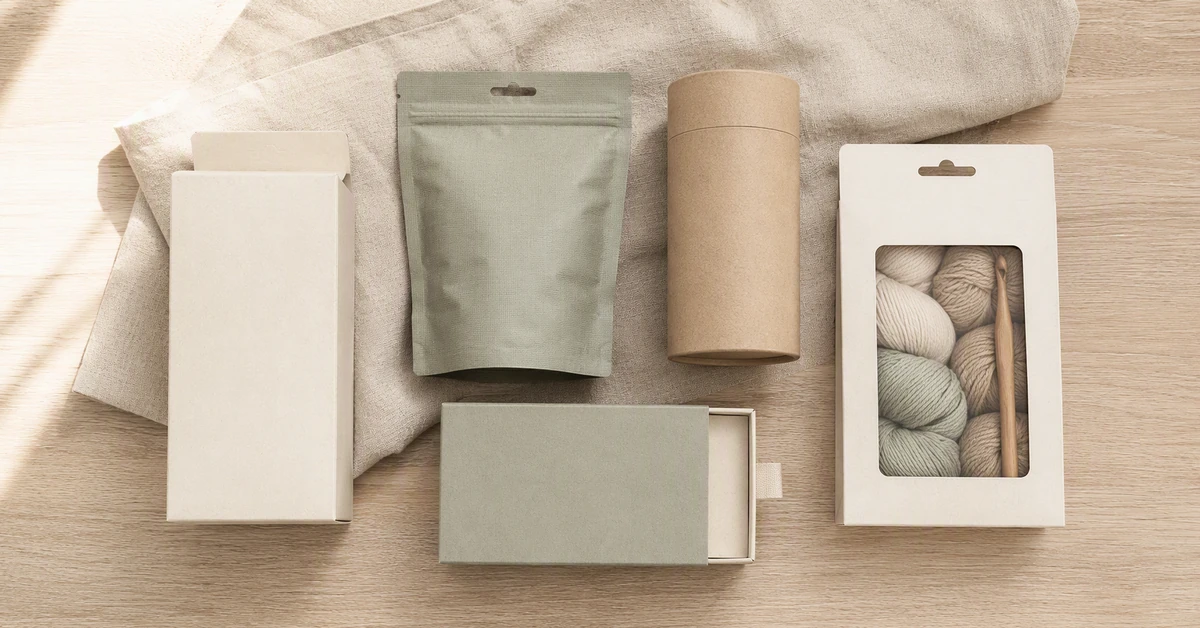
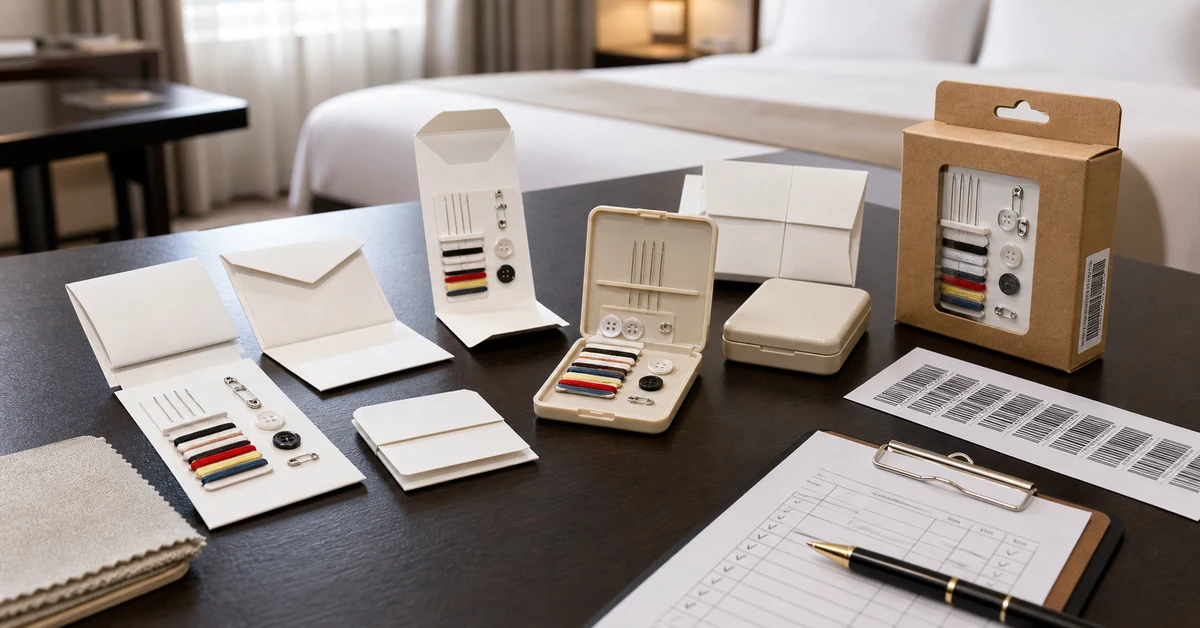
The pack should be easy to count at a glance, stable in storage and quick to place consistently. Slim envelopes use little space but may not protect the needle or organize thread well. Small cases can be reusable but cost more and may complicate recycling claims.
A hotel amenity sewing kit should therefore be approved in the exact format housekeeping receives, stores and places in the room.
| Format | Advantage | Risk | Best use |
|---|---|---|---|
| Paper envelope | Low volume and broad print area | Needle puncture and moisture sensitivity | High-volume room placement |
| Folded card | Visible component positions | Open edges or weak retention | Minimal repair assortment |
| Small rigid case | Reusable and protective | Higher cost and storage volume | Premium or retail program |
| Sealed pouch | Clean presentation and tamper evidence | Mixed-material disposal and difficult reopening | Controlled hygiene presentation |
Test the guest and housekeeping workflows
Run two practical trials. First, ask housekeeping staff to receive, store, count and place the packs during a simulated room turn. Second, ask unfamiliar users to open the amenity, identify the components, complete a simple button or hem repair and store or dispose of the remainder.
Record opening time, damaged packs, loose components, threading difficulty, unclear instructions and disposal questions. The travel sewing kit product design guide provides a broader framework for testing every item against real repairs rather than a decorative checklist.
Set quality checks around hotel failure modes
Hotel programs often fail through inconsistency: mixed branding, missing needles, wrong thread colors, unsealed packs, crushed envelopes or cartons that do not match property-level replenishment quantities. Build these issues into the defect catalogue.
- Critical: exposed needle, dangerous defect or incorrect mandatory safety information.
- Major: missing repair component, wrong property artwork, failed seal or incorrect carton quantity.
- Minor: acceptable cosmetic variation that does not affect placement or guest use.
Inspect barcode and artwork separately from physical content. A correct kit in the wrong branded sleeve is still unusable for a multi-property hotel group.
Design replenishment at room, property and group level
Forecast by occupied room nights, placement policy, replacement rate, season and opening schedule. Separate launch stock from regular replenishment. Multi-property groups should define whether every hotel uses one master SKU or whether packaging and contents vary by brand tier.
Carton quantities should match housekeeping and central-store handling. A master carton that is economical for export may be awkward for individual property distribution, so consider inner packs identified by hotel, language or region. Keep batch and artwork traceability through repacking.
Plan packaging and transit validation
Test retail or amenity packs inside the actual inner and master cartons. Compression can deform small cases; vibration can release needles; moisture can affect paper envelopes. Ecommerce or central distribution may expose the product to parcel handling before it reaches the hotel.
The International Safe Transit Association's Procedure 3A overview describes a general simulation for individual packaged products moving through parcel systems. Choose a suitable validation plan based on the real distribution route rather than naming a test that does not match the shipment.
Compare custom branding options carefully
Branding may include logo, property name, color palette, welcome message, QR code, sustainability statement and supplier information. Freeze artwork ownership, language versions, barcode rules and proof responsibility. Metallic finishes, specialty papers and custom cases can change MOQ and lead time.
Custom hotel sewing kits need separate approval for every property or brand version even when the internal components are shared.
Environmental claims need evidence. “Plastic-free,” “recyclable” or “eco-friendly” should be checked against the complete pack, local collection systems and applicable marketing rules. A paper outer pack with a plastic needle holder may not support a broad claim.
Model MOQ and total delivered cost
MOQ can be driven by custom print, case tooling, thread cards, needle holders or assembly. Request separate prices for shared generic components and property-specific packaging. This lets hotel groups consolidate the technical kit while customizing outer presentation.
- Development, proof and sample charges.
- Components, assembly and protective retention.
- Property-specific print and changeover cost.
- Inspection, inner packing and carton labels.
- Freight, storage and property distribution.
- Damage, shortage and urgent replenishment exposure.
Where Onehourcrafts fits
Onehourcrafts can support buyers selecting a hotel sewing kit supplier through component planning, protective pack development, logo and artwork customization, samples and bulk assembly controls. A useful inquiry includes property tier, placement policy, component list, format, annual volume, number of artwork versions, destination markets, carton preference and required delivery windows.
For bulk hospitality sewing kits, specify inner-pack quantities and distribution labels that match the hotel group's central warehouse and property replenishment process.
Buyers can review the company's sewing kits category, supplier quality checklist and traceability checklist. Company experience and BSCI certification are qualification inputs; the final hotel amenity still needs SKU-level approval.
Frequently asked questions
What is normally included in a hotel sewing amenity?
Common contents include securely retained needles, short neutral thread colors, buttons and sometimes a safety pin, but the exact assortment should match property policy and market review.
Should every hotel room contain a sewing kit?
That is an operational decision. In-room placement offers immediate access; on-request service reduces consumption and centralizes control.
How should needles be packaged?
Use a defined protective holder that retains the point during transit and opening. Verify count and migration in the sealed production pack.
Can each hotel brand use different packaging?
Yes. Consolidate shared components where possible, then control each artwork, language, barcode and carton version separately.
What drives MOQ?
Custom print, cases, needle holders, thread cards and assembly can set different minimums. Request a component-level MOQ breakdown.
How long does sampling take?
Allow for component approval, needle-retention testing, repair trials, artwork proofing, property review and pre-production confirmation.
Can sustainable materials be used?
Yes, but verify performance, needle protection, sourcing, end-of-life conditions and the evidence behind any environmental claim.
How should hotel groups forecast demand?
Use room count, occupancy, placement model, replacement rate, property openings, seasonal changes and safety stock.
What should a final inspection cover?
Check needle retention, component count, seal, artwork, barcode, pack appearance, property assortment, inner quantity and carton marks.
What should be included in an RFQ?
Provide contents, pack dimensions, property tier, artwork versions, volume, destination, delivery schedule, carton plan and required documents.
Procure the amenity as an operating system
A reliable hotel sewing kit supplier connects guest usefulness with sharp-tool control, brand accuracy and repeatable property replenishment. Approve the actual repair workflow and distribution pack, then purchase against a controlled specification that remains clear across hotel tiers, languages and repeat orders.