
At cruise altitude, a loose button is a small problem with an unusually constrained solution. Sewing kits for airlines must be compact, lightweight, easy to identify, securely packed and compatible with the carrier's own security, service and waste procedures. The right specification begins with the onboard use model, not with a generic hotel amenity copied into an aircraft-themed envelope.
The scene: a passenger notices a repair during service
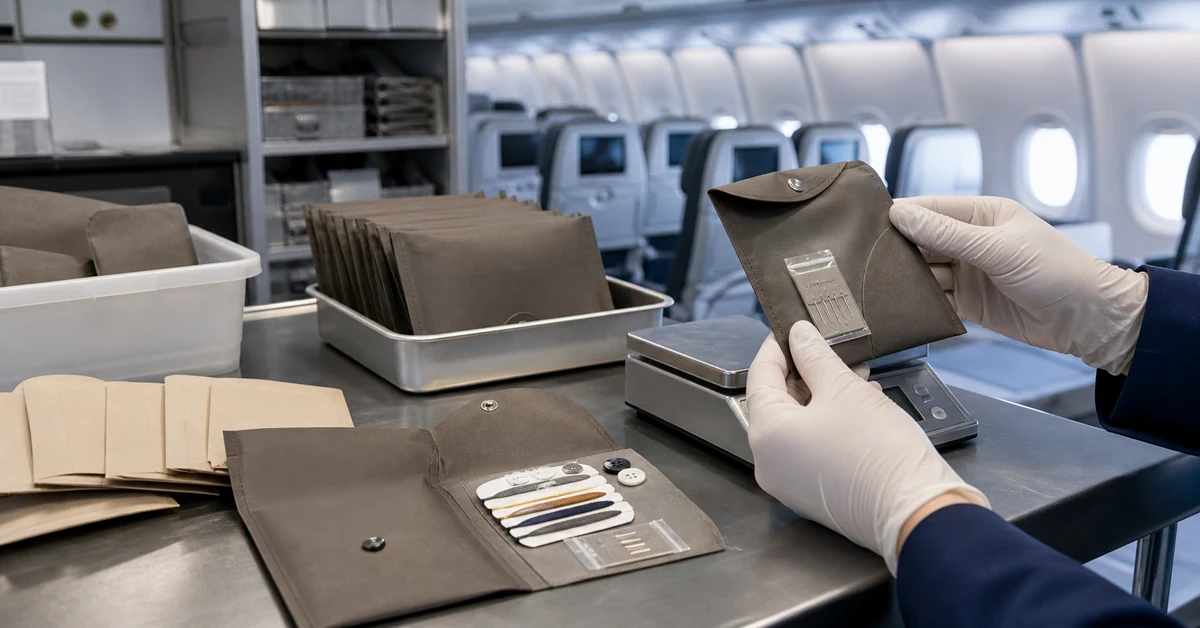
Imagine the actual moment. A traveler finds a loose button after boarding, asks a crew member for help, opens the pack at a seat and needs to understand the contents without creating loose parts. The cabin has limited light, limited workspace and strict operating routines. Every component should justify its presence in that scene.
Now compare a second model: the kit is placed inside a premium amenity pouch before flight. The customer encounters it without crew explanation, and many units may never be opened. The pack has different communication, weight, assembly and replenishment requirements. These are different products even when the component list looks similar.
Choose the operating model before the component list
| Operating model | Distribution point | Main buyer concern | Pack implication |
|---|---|---|---|
| On-request service item | Crew storage | Controlled access and fast identification | Compact, countable unit with clear handling |
| Premium amenity inclusion | Seat or amenity pouch | Brand fit, weight and unopened waste | Flat format integrated with the amenity set |
| Long-stay travel kit | Selected long-haul service | Useful repair range | Slightly broader thread and button choice |
| Disruption support | Lounge or service desk | Practical emergency use | Durable pack for staff-controlled issue |
Write the owner of distribution and disposal into the brief. If cabin crew issue the item, training and inventory processes matter. If it is preloaded into every amenity pouch, unit weight, pack thickness and unopened recovery become more important.
Specify the minimum repair, not the maximum assortment
Start with the repair cases the airline intends to support: replacing a shirt button, closing a small seam or securing a loose hem. Then select thread, buttons, needle and any threader around those tasks. Extra colors and accessories may improve perceived value while increasing weight, assembly error and loose-part exposure.
- Choose a limited thread palette that covers common travel garments.
- Use thread lengths that complete the defined repairs with handling allowance.
- Select buttons by likely garment use rather than decorative variety.
- Include a threader only when it improves access for the intended user.
- Avoid scissors unless the carrier's approved use model explicitly requires and permits them.
- Keep the needle in a secure, countable holder.
A mini sewing kit wholesale format should be assessed by usable repair coverage per gram and per cubic centimeter, not by the number of listed pieces.
The travel sewing kit product design guide offers a useful task-first method for comparing every component with the repair it is meant to complete.
Treat needle control as an operational system
Needle control begins at incoming receipt and continues through assembly, final inspection, catering or amenity integration, onboard issue and disposal. Specify needle length, point, eye, finish, quantity and holder. The holder should make an empty position visible and resist migration during vibration and handling.
Use reconciliation at the assembly line: quantity issued, packed, damaged, rejected and returned. Define line clearance when the SKU changes and a method for containing damaged needles. A sealed pack does not replace count control; it provides another layer of evidence.
Separate passenger baggage guidance from airline approval
The U.S. Transportation Security Administration currently lists sewing needles as permitted in carry-on and checked bags. That public page addresses passenger baggage screening. It does not approve a particular carrier's amenity design, onboard distribution method or operating procedure.
The airline, relevant security stakeholders and qualified advisers must approve the actual program for its routes and jurisdictions. Requirements can differ by operator, airport, contract and service model. Do not present a consumer travel page as universal authorization for procurement.
Engineer the pack for one-handed clarity
A passenger may open the item on a tray table or at a seat with limited space. The pack should reveal components in a controlled order and make the needle position obvious. Avoid opening forces that suddenly release small parts.
| Format | Strength | Risk to test | Typical use |
|---|---|---|---|
| Flat paper envelope | Low weight and easy printing | Tear path and needle migration | Amenity pouch inclusion |
| Sealed transparent pouch | Visible contents and count | Material choice and opening behavior | Staff-issued repair item |
| Folded card pack | Organized thread and button positions | Card stiffness and adhesive release | Premium compact program |
| Mini reusable sleeve | Supports storage after opening | Weight, thickness and closure cost | Long-haul or branded gift set |
Make every gram and millimeter visible in costing
Airline programs can multiply small differences across high unit volumes. Quote net product weight, pack weight, packed dimensions, units per inner, units per master carton and pallet or delivery configuration. Keep component and packaging weights separately visible so design changes can be evaluated quickly.
Do not chase weight reduction that weakens needle retention, seal integrity or legibility. The useful comparison is total program effect: unit cost, logistics, handling time, damage, unused stock and replenishment accuracy.
Design branding for the service context
Custom branded sewing kits may use airline colors, service-tier identifiers, campaign artwork or partner branding. Confirm trademark files, permitted applications, print references, color tolerances and approval ownership. Small packs require disciplined hierarchy; decorative copy should not obscure contents or handling information.
Branding also affects stock flexibility. A heavily route-specific pack can become obsolete when service changes. Consider whether the outer amenity set carries the campaign while the repair kit remains more universal.
Plan assembly across the amenity supply chain
The sewing pack may be produced by one supplier and inserted into an amenity pouch by another. Define the handoff: delivery location, inner quantity, lot code, carton marks, inspection status, orientation and acceptable handling. The amenity assembler should not need to open retail units to confirm a hidden variant.
Use batch traceability that connects needle lot, thread and button lots, packaging revision, assembly date and shipment. The batch traceability checklist offers a practical structure for linking components to finished units.
Test the journey, not only the seal
Simulate compression, vibration, temperature exposure, repeated carton handling and the final opening action. Review whether thread transfers color, buttons crack, paperboard deforms or the needle escapes its holder. The International Safe Transit Association describes Test Procedure 3A as a general simulation for parcel-delivery shipments; the actual distribution test should be tailored to the airline supply route and package system.
Use SKU-specific defect examples from the sewing kit supplier quality checklist so final inspection reflects repair use, component security and pack integrity rather than appearance alone.
Run cabin-use trials with the defined repair, low workspace and normal lighting. A laboratory seal result cannot show whether a passenger can thread the needle, distinguish colors or return unused components safely.
Use a route pilot before network rollout
A pilot should be large enough to expose assembly and service behavior but narrow enough to correct. Choose a route group or amenity tier, define the number of flights, and collect structured feedback from catering, cabin service, procurement and customer teams.
| Pilot measure | Why it matters | Decision after pilot |
|---|---|---|
| Issue or open rate | Shows real demand by service model | Adjust distribution quantity |
| Pack damage rate | Tests supply and cabin handling | Revise material or carton |
| Component incident | Reveals control weakness | Stop, investigate or redesign |
| Crew handling time | Affects operational fit | Change storage or identification |
| Passenger usefulness | Tests repair coverage | Change contents or instructions |
Forecast replenishment by service model
Preloaded amenities consume one unit per prepared set; request-based items depend on issue rate, route mix and crew stock policy. Forecast these streams separately. Build in lead time for printed packaging and secured component procurement, while defining buffer stock and obsolescence rules.
An emergency sewing kit manufacturer serving several channels should not assume airline demand follows retail seasonality. Align production releases with airline schedule changes, catering cycles, service refreshes and approved artwork windows.
Onehourcrafts support from route brief to repeat order
Onehourcrafts can support sewing kits for airlines through compact component design, secure needle packing, private-label formats, samples, assembly controls and batch records. A useful inquiry should state the operating model, route or service scope, forecast, weight and dimension targets, branding, delivery handoff and required approval process.
Onehourcrafts states manufacturing experience since 1988, BSCI certification and OEM/ODM support. Those supplier-level signals do not replace airline, market or SKU-specific review. Buyers should approve the final component and operating file with the appropriate internal and external stakeholders.
Frequently asked questions
Should every passenger receive a sewing kit?
Not necessarily. Compare preloaded amenity inclusion with on-request issue using service goals, weight, demand, waste and crew handling.
Can scissors be included?
Do not assume they are acceptable. The carrier and relevant security stakeholders must approve the exact component and use model for applicable routes.
How should the needle be retained?
Use a defined sealed card, holder or protected position that controls count, prevents migration and remains clear to the user after opening.
How many thread colors are practical?
Choose a small palette based on intended repairs and service value. More colors add weight, packing complexity and selection difficulty.
What should a route pilot measure?
Track issue rate, damage, handling time, component incidents, passenger usefulness, unused recovery and replenishment accuracy.
Can one format serve airlines and hotels?
Some components may overlap, but distribution, security review, pack weight, service context and replenishment are different. Approve separate specifications.
What traceability is useful?
Connect needle and material lots, packaging revision, assembly date, finished batch, shipment and amenity integration record.
How should branding be approved?
Use controlled artwork files, color references, trademark permissions, revision status and named airline or agency approvers.
What belongs in an RFQ?
Include service model, components, weight, dimensions, pack format, forecast, branding, route scope, delivery point, testing, approvals and target date.
How can buyers reduce waste?
Match distribution to real demand, reduce unnecessary components, use flexible branding where appropriate and measure unopened or unused units during pilots.
Approve the onboard moment before approving the unit price
Effective sewing kits for airlines are built around a specific service moment, secure component control and a measurable replenishment model. Define who issues the kit, which repair it supports, how the needle remains controlled and how stock moves through the amenity chain. Then compare cost within that approved operating system.