
Effective craft kit inventory planning for retailers separates three types of demand before placing an order: core demand that can replenish repeatedly, launch demand with little history and seasonal demand with a fixed selling window. Each type needs a different buy quantity, reorder rule and exit decision.
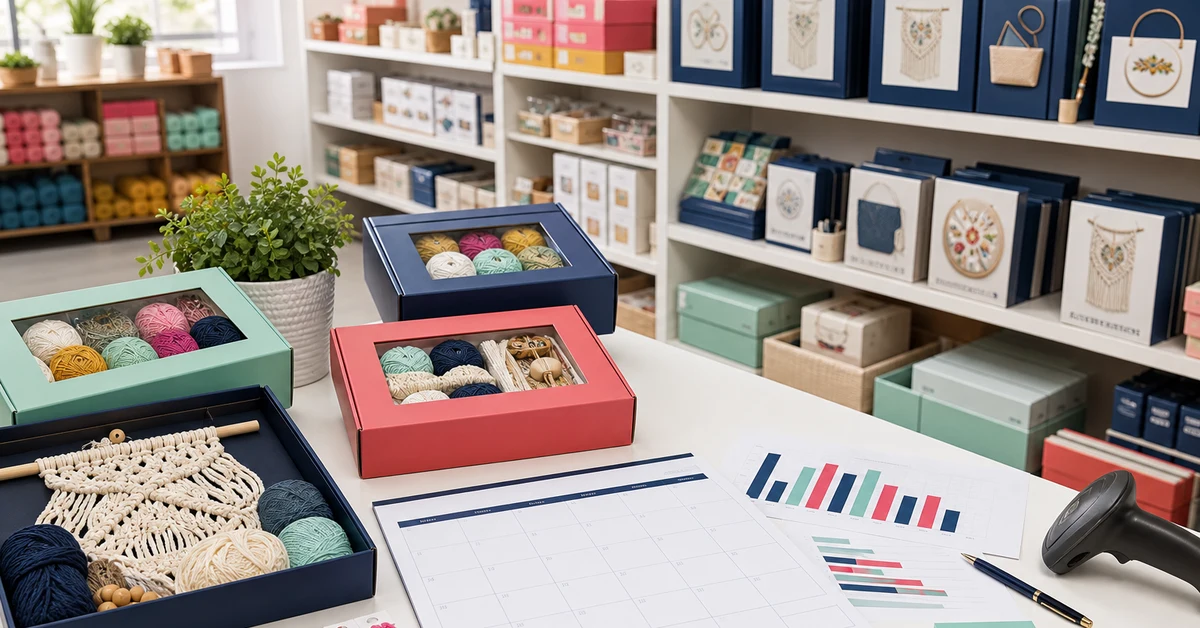
Craft kits are not a single inventory category. A compact beginner kit may sell steadily all year. A holiday gift box may have a short peak. A workshop kit may move in batches tied to event dates. Combining them into one average can produce both stockouts and excess inventory.
Assign every SKU an inventory role
Use an explicit role before forecasting:
- Core replenishment: stable product intended to remain available and reorder repeatedly.
- Launch test: new concept purchased to learn demand, conversion and customer feedback.
- Seasonal or event: product tied to a calendar window, promotion, workshop or gift period.
- Range builder: item that adds color, price or skill-level coverage even if it is not a top-volume seller.
- Exit or clearance: item that should generate cash and shelf space rather than receive another full reorder.
The role changes the success measure. A launch test can be valuable even at modest volume if it produces clear customer evidence. A core SKU is unsuccessful if it sells but stays unavailable because the reorder rule is too late.
Collect six planning inputs
| Input | Decision it supports | Common mistake |
|---|---|---|
| Expected weekly demand | Base stock and reorder quantity | Using opening-week sales as a permanent average |
| Replenishment lead time | When an order must be released | Counting factory time but excluding approval and freight |
| Order and case constraints | Feasible quantity steps | Forecasting units that cannot be ordered or displayed efficiently |
| Demand variability | Appropriate buffer | Using one buffer percentage for every SKU |
| Selling-window end | Last safe reorder date | Reordering seasonal stock after the useful window |
| Exit value | Markdown, bundle or carryover choice | Waiting until the season ends to decide |
Record assumptions separately from observed data. A new item can borrow signals from a similar project type, price point or channel, but it should not inherit another SKU's demand history without adjustment.
Build the calendar backward from shelf date
Use relative weeks so the same framework works across different lead times.
Before launch
- Shelf date minus full replenishment lead time: last point to release a normal reorder and receive it before launch.
- Artwork and sample gate: packaging, instructions, labels and pack-out must be stable before production approval.
- Content gate: photography, product copy, workshop material and staff information are prepared from the approved sample.
- Allocation gate: decide how opening stock is split across stores, eCommerce, events and reserve inventory.
Opening period
Measure availability, sell-through, channel mix, returns, missing-part reports and customer questions. Do not interpret the first few days without context. Launch promotion, initial display and limited distribution can distort the signal.
First reorder review
Ask whether demand is broad or concentrated. A high total driven by one workshop, influencer event or single store may not justify a chain-wide reorder. Compare stores or channels that had sufficient stock and similar presentation.
Exit review
For seasonal products, define the last date at which a normal replenishment can still arrive with enough selling time. After that date, use transfer, bundle, markdown or carryover rules instead of repeating the original buy.
Use a reorder point with visible assumptions
A basic planning relationship is:
Reorder point = expected demand during the replenishment lead time + a buffer for uncertainty.
The calculation is only as useful as the inputs. Include supplier production, approval time, booking, freight, receiving and store allocation where they affect availability. Review the buffer according to demand variation, service goal, product margin, order constraints and the cost of leftover stock.
For seasonal products, add a separate rule: never place a reorder merely because inventory reaches the trigger if the goods will arrive too late to sell at normal value.
Separate launch inventory from replenishment inventory
Launch stock must answer a learning question. Decide in advance:
- Which stores, channels or customer groups will receive the product.
- What display or content support will be consistent.
- How many selling weeks are needed before the decision.
- Which result triggers expansion, revision, hold or exit.
A large launch buy can hide weak product-market fit behind discounting. A launch buy that is too small can create immediate stockouts and produce no reliable repeat-demand evidence. Size the test to create a usable signal within the actual order and case constraints.
Plan variants as a family, not isolated forecasts
Color, theme, project and difficulty variants compete for the same attention and shelf space. Review the family total and each SKU's role. A balanced range may include:
- A high-conversion entry kit.
- A giftable project with strong visual impact.
- A skill-builder that encourages repeat purchase.
- A seasonal or trend-led test.
- A higher-value kit that anchors the price range.
If several variants sell slowly, adding more themes may spread demand rather than grow it. Use customer questions and substitution behavior to determine whether the range needs more choice or clearer differentiation.
Connect packaging decisions to inventory economics
Packaging affects units per case, storage cube, shelf capacity, pick efficiency and damage exposure. A pack that looks premium but halves units per carton changes receiving and replenishment economics. Confirm:
- Finished unit dimensions and weight.
- Units per inner and master carton.
- Case dimensions, gross weight and labeling.
- Shelf, peg or tabletop presentation.
- Whether the product remains organized after customer handling.
The OEM crochet kit packaging guide can help buyers compare containment, protection, instructions, branding and logistics before the final case pack is approved.
Create a weekly exception review
Do not manually debate every SKU. Review the exceptions:
- Core items forecast to stock out before replenishment.
- Launch items with strong demand but low distribution coverage.
- Seasonal items approaching the last safe reorder date.
- Variants with repeated customer confusion or returns.
- Items whose order constraints create more stock than the likely selling window supports.
Assign an action and owner: reorder, transfer, accelerate, revise, bundle, markdown, hold or exit. Record the reason so the next range review learns from the decision.
Measure forecast quality without hiding availability
A low sales result can mean low demand, or it can mean the item was unavailable, poorly displayed or launched in too few locations. Keep availability and distribution beside the forecast comparison. Otherwise the team may discontinue a product that customers could not buy or reorder a product whose apparent demand came from one temporary event.
For repeat items, compare the forecast with actual demand over the same stores, channels and selling weeks. For launch items, focus first on the decision the test was designed to support. Good craft kit inventory planning for retailers improves assumptions over time without pretending that every difference is a forecasting failure.
Record major interventions such as promotions, workshop bookings, content launches, stock transfers and price changes. These notes make the next season's planning evidence more useful than a raw sales total.
Ask the supplier for a planning data pack
Before launch, request the information needed to model replenishment:
- Minimum order and practical quantity breaks.
- Case pack and carton data.
- Sample, approval and production timing.
- Component or packaging items with long procurement times.
- Options for repeat orders using approved materials and artwork.
- Rules for mixed variants, spare components or replacement support.
The crochet kit MOQ guide, sampling timeline and cost breakdown connect order constraints to the commercial plan.
Where Onehourcrafts fits
Onehourcrafts supports wholesale and OEM/ODM crochet DIY kits with customizable component sets, yarn colors, instructions, packaging and logistics labels. Retailers can align samples and case data with launch roles before approving a range.
For assortment direction, review craft kit trends for retailers and private-label collection ideas. Use trend signals as test hypotheses rather than automatic volume forecasts.
Final takeaway
Strong craft kit inventory planning for retailers gives every SKU a role, builds a calendar backward from availability, exposes the assumptions inside the reorder point and sets a last safe decision date for seasonal stock. The objective is not perfect prediction. It is faster, evidence-based action before a stockout or surplus becomes unavoidable.
Frequently asked questions
How should a retailer forecast a new craft kit?
Start with a comparable product, adjust for price, project type, channel and promotion, then treat the first order as a measured launch with defined expansion or exit criteria.
What is a simple craft kit reorder point?
Use expected demand during the full replenishment lead time plus a buffer for uncertainty. Adjust for order constraints and stop reordering when seasonal arrival would be too late.
Should all craft kit variants use the same safety stock?
No. Demand variation, margin, substitution, order constraints, selling window and replenishment reliability differ by SKU.
When should seasonal craft kits stop being reordered?
Set the last safe reorder date by subtracting the full replenishment lead time and required selling period from the end of the normal-price selling window.
What supplier data is most useful for inventory planning?
Minimum order, quantity breaks, case pack, carton dimensions, lead-time stages, long-lead components, repeat-order options and mixed-variant rules are the most useful starting points.